

- Introduction
- Is a Facelift Worth It?
- What Does “Worth It” Mean When Considering Facelift Surgery?
- What Factors Affect Whether Facelift Surgery Feels Worthwhile?
- Why is the Word “Worth” Difficult in Cosmetic Surgery?
- What Can a Facelift Realistically Address?
- What Areas Are Commonly Assessed Before Facelift Surgery?
- Can a Facelift Address The Neck?
- What Concerns Will a Facelift Not Address?
- Why Does Skin Quality Still Matter?
- Why is Facial Structure Important?
- Who May Be Suitable for Facelift Surgery?
- Does Age Decide Suitability?
- Who May Not be Suitable for Facelift Surgery?
- When Might Surgery be Delayed?
- When Might Another Option be More Appropriate?
- What are the Potential Benefits of Facelift Surgery?
- Why Should Benefits be Discussed Alongside Limitations?
- What Recovery Commitment Should Patients Expect?
- What Happens in the First Few Weeks?
- What Happens After the Early Recovery Period?
- What Risks and Complications Should be Considered?
- What is Haematoma and Why Does It Matter?
- What Nerve-Related Risks Should Patients Understand?
- What Can Affect Healing Risk?
- How Long Can Facelift Results Last?
- Why Do Facelift Results Change Over Time?
- What Helps Support Longer-Term Results?
- What Alternatives Should Patients Consider Before Facelift Surgery?
- When is No Surgery Reasonable?
- Facelift Before and After Photos
- When Might Another Procedure Be More Appropriate?
- How Does Dr Michael Kernohan Assess Facelift Suitability?
- What Should Patients Bring to Consultation?
- Take the Quiz
- How is the Decision Made?
- FAQs About Whether a Facelift Is “Worth It”
- Next Step: Discuss Facelift Options With Dr Michael Kernohan
- Download Dr Kernohan’s Facelift Surgery Guide
- Further Reading
Introduction
Dr Michael Kernohan, Specialist Plastic & Reconstructive Surgeon in Sydney, helps patients assess whether facelift surgery is worth considering for their anatomy and circumstances. A facelift may be worth considering when lower-face or jawline changes match what surgery can address, and when the patient understands the recovery, risks and limitations.
Many patients search this question after noticing jowls, a less defined jawline, deeper lower-face folds or changes between the face and neck. Others are unsure whether surgery is appropriate because they have read mixed information online, seen heavily edited images or heard claims that may not reflect clinical reality.
A facelift, known medically as rhytidectomy, is a face surgery procedure that may address selected visible changes in the face and neck, including jowls, jawline changes and loose skin in suitable patients. Medical sources describe facelift surgery as involving the repositioning of tissues beneath the skin, redraping of skin and removal of excess skin where appropriate.
The decision is personal, but it should not be made from advertising language or before-and-after images alone. In Australia, cosmetic surgery guidance places strong emphasis on informed consent, patient suitability, realistic expectations and discussion of risks and alternatives.
This article explains what “worth it” can mean in facelift surgery. It covers what a facelift may address, what it will not correct, who may be suitable, who may need another approach, and what questions to ask before deciding.
Is a Facelift Worth It?
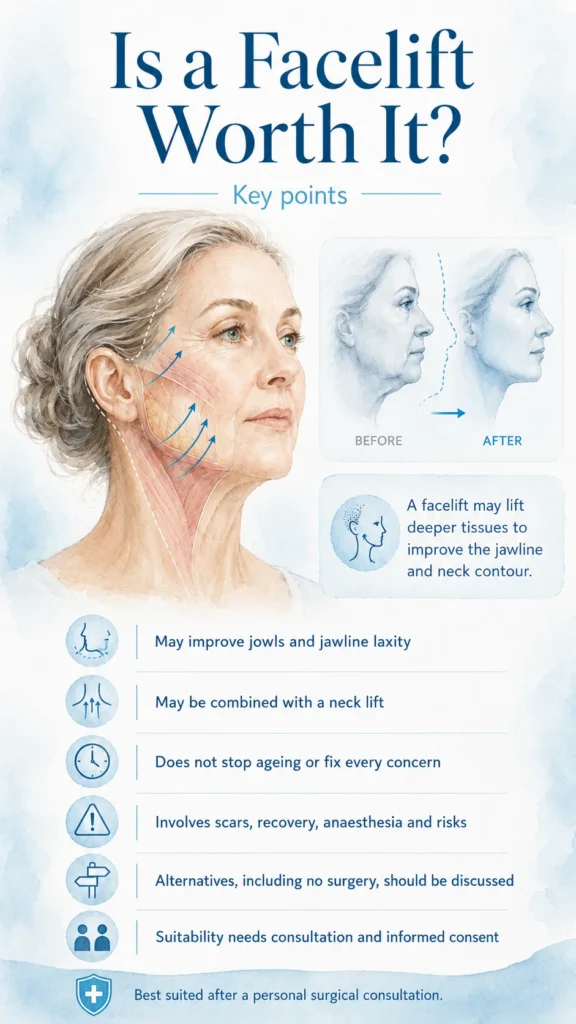
A facelift surgery may be considered worth it for selected patients who have lower-face, jawline or neck changes that cannot be addressed by skin care or less invasive treatments alone. The decision depends on anatomy, health, recovery time, risks, cost factors, expectations and whether no surgery or another option may be more appropriate.
Key points:
- A facelift may address jowls, lower-face tissue descent and selected jawline concerns.
- It may be combined with neck lift surgery when the neck is also contributing.
- It does not stop ageing or treat every facial concern.
- It involves scars, recovery time, anaesthesia and surgical risks.
- The decision should include a clear discussion of alternatives, including no surgery.
- Suitability requires an individual consultation and informed consent.
The phrase “worth it” means different things to different patients. For some, it relates to whether surgery addresses the concern well enough to justify scars, recovery and risk, while for others it relates to timing, health, work, family responsibilities and long-term expectations.
What Does “Worth It” Mean When Considering Facelift Surgery?
When patients ask whether a facelift is “worth it”, they are usually asking whether the likely outcome justifies the recovery, cost factors in Sydney, scars and risks. The answer cannot be the same for everyone because each patient has different anatomy, health, priorities and tolerance for surgery.
- For one patient, “worth it” may mean addressing jowls or lower-face tissue descent that has become more noticeable over time.
- For another patient, it may mean deciding whether recovery time fits around work, family or caring responsibilities.
- For some patients, the key issue is whether neck changes also need to be treated.
- For others, the main concern may be whether the expected improvement is enough to justify the scars and risks.
- Some patients may decide that no surgery is the most appropriate choice.
This is why the question should be reframed from “Is a facelift worth it?” to “Is a facelift worth considering for my anatomy, health and priorities?” Dr Michael Kernohan uses consultation to help patients work through this decision in a structured way.
What Factors Affect Whether Facelift Surgery Feels Worthwhile?
Several factors influence whether a patient may feel that facelift surgery is a reasonable choice. These include the anatomical concern, the expected change, the recovery period, risk profile and whether the patient is making the decision for personal reasons rather than external pressure.
- The concern should match what facelift surgery can actually address.
- The patient should understand that surgery cannot stop future ageing.
- Recovery time should be practical for work, home and social commitments.
- The patient should accept that facelift scars are permanent, even when they fade.
- The patient should understand that complications can occur.
- The decision should not be rushed or based on a single online image.
A facelift may be worth considering when these factors align. If they do not align, delaying surgery, considering another option or choosing no surgery may be more appropriate.
Why is the Word “Worth” Difficult in Cosmetic Surgery?
The word “worth” can be difficult because it can imply a universal answer. In cosmetic surgery, a procedure may be appropriate for one patient and unsuitable for another.
- Different patients value different outcomes.
- Risk tolerance varies between individuals.
- Health factors can change the balance of risk and benefit.
- Recovery demands may be manageable for one person but not another.
- Expectations can influence satisfaction and decision-making.
For this reason, Dr Michael Kernohan avoids treating “worth it” as a simple yes-or-no question. A more useful discussion focuses on suitability, safety planning, realistic expectations and informed consent.
What Can a Facelift Realistically Address?
A facelift can realistically address selected changes in the lower face, jawline and sometimes the upper neck, depending on the surgical plan. It is most often considered when jowls, lower-face tissue descent or skin laxity are contributing to the patient’s concern.
- Jowls along the jawline may be addressed in suitable patients.
- Lower-face tissue descent may be improved through deeper tissue support.
- Loose skin in the lower face may be redraped after deeper tissues are adjusted.
- The jawline-neck transition may be improved when the neck is included in the plan.
- A neck lift may be discussed when neck bands, under-chin fullness or neck skin laxity are present.
A facelift should not be understood as a skin-tightening procedure alone. Many modern facelift approaches involve deeper tissue layers because skin-only tension may not address the underlying cause of lower-face change.
What Areas Are Commonly Assessed Before Facelift Surgery?
Facelift assessment usually includes the lower face, jawline, cheeks, neck and skin quality. The aim is to identify which structures are contributing to the concern.
- Jowls and lower-face descent.
- Jawline support and the transition into the neck.
- Skin thickness, elasticity and sun exposure.
- Neck skin laxity, platysma bands and under-chin fullness.
- Facial asymmetry that was present before surgery.
- Previous surgery, scars, injectable treatments or skin procedures.
This assessment helps determine whether facelift surgery is suitable, whether neck lift surgery should also be considered, or whether another pathway may be more appropriate. It also helps the patient understand which concerns are likely to remain.
Can a Facelift Address The Neck?
A facelift may improve selected upper-neck or jawline-neck changes, but it does not automatically treat every neck concern. When the neck is a major concern, a neck lift may need to be discussed separately or as part of a combined face and neck plan.
- Mild upper-neck laxity may be affected by lower-face repositioning.
- More visible neck bands may need direct platysma treatment.
- Fullness under the chin may have several causes and needs separate assessment.
- Loose neck skin may require neck-specific surgical planning.
- A facelift alone may leave some neck concerns untreated.
This is one reason patients should avoid choosing a procedure based only on its name. Dr Michael Kernohan examines both areas before explaining whether the concern is mainly facial, mainly neck-related or a combination.
What Concerns Will a Facelift Not Address?
A facelift has important limits. It does not address every sign of facial ageing, change the underlying bone structure or remove the need for skin care and long-term health planning.
- It does not treat eyelid skin excess or eyelid bags.
- It does not lift the brow.
- It does not correct skin pigmentation or sun damage.
- It does not remove all facial lines or surface wrinkles.
- It does not change the shape of the nose, chin or cheekbones.
- It does not stop future ageing.
A facelift mainly works on lower-face and selected neck support. Other concerns may need separate assessment, different procedures or no treatment.
Why Does Skin Quality Still Matter?
Skin quality matters because facelift surgery repositions and redrapes tissue, but it does not reverse sun damage or change the biology of the skin. Patients with fine lines, pigmentation, redness or texture concerns may need a separate skin-focused plan.
- Sun exposure can affect elasticity and healing.
- Fine surface lines may remain after surgery.
- Pigmentation and redness are not corrected by facelift surgery.
- Skin texture changes may need non-surgical or dermatology-based care.
- Scars may behave differently depending on skin type and healing history.
Dr Michael Kernohan discusses this distinction during consultation so patients do not expect a facelift to treat concerns outside its scope. This helps reduce misunderstanding and supports more realistic planning.
Why is Facial Structure Important?
Facial structure can affect what a facelift can achieve. Bone structure, chin position, jaw shape and facial asymmetry all influence the way soft tissues sit.
- A weak chin can affect the appearance of the neck and jawline.
- Jaw shape can influence the lower-face contour.
- Facial asymmetry may remain after surgery.
- Weight changes can alter facial fullness.
- Deep folds may not disappear completely.
A facelift works with the patient’s existing anatomy. It should not be presented as a way to create a different face or guarantee a specific appearance.
Who May Be Suitable for Facelift Surgery?
A patient may be suitable for facelift surgery if their concerns match what the procedure can address and they are medically fit for surgery. Suitability also depends on expectations, recovery capacity and willingness to accept scars and risks.
- The main concern involves jowls, lower-face descent or jawline changes.
- Neck changes may be present and can be assessed as part of the plan.
- The patient is in suitable general health for anaesthesia and surgery.
- Medical conditions such as blood pressure or diabetes are reviewed and managed.
- The patient understands recovery time, scars, risks and limitations.
- The patient is making the decision for personal, stable reasons.
Suitability is not based on age alone. Patients in their 40s, 50s, 60s and beyond may have very different anatomy, skin quality, health profiles and priorities.
What Factors May Support Facelift Suitability?
A stronger candidate is usually someone whose concern is clearly anatomical and matches what facelift surgery can address. They also need to understand the recovery and have realistic expectations about what will and will not change.
- The concern is mainly in the lower face, jawline or selected neck area.
- Weight is reasonably stable.
- Smoking or nicotine use is addressed before surgery.
- Blood pressure and other medical issues are controlled.
- The patient can attend follow-up and follow post-operative instructions.
- The patient has time for recovery and support at home.
These factors do not guarantee a specific outcome. They simply help determine whether surgery can be considered with a more organised plan.
Does Age Decide Suitability?
Age alone does not decide suitability for facelift surgery. A patient’s health, skin quality, tissue laxity, medications and goals are usually more important than age by itself.
- Some younger patients may have early jowls or inherited lower-face laxity.
- Some older patients may be medically suitable and have clear concerns.
- Other patients may not be suitable despite being younger.
- Medical history and anaesthetic risk matter at every age.
- Skin quality and tissue support can vary widely.
This is why an individual assessment is needed. Dr Michael Kernohan does not recommend facelift surgery based on age alone.
Who May Not be Suitable for Facelift Surgery?
Facelift surgery may not be suitable for patients whose medical risks are high, whose expectations do not match what surgery can achieve, or whose concerns are better addressed another way. It may also be delayed if preparation is needed first.
- Patients with unstable or unmanaged medical conditions may need further review.
- Smoking or nicotine use can increase wound-healing and skin-related risks.
- Blood-thinning medicines and some supplements may need careful planning.
- Patients unable to allow recovery time may need to delay surgery.
- Patients seeking a guaranteed or exact appearance may not be suitable.
- Patients whose concerns are mainly skin texture, eyelids or brow position may need another approach.
Not being suitable now does not always mean never being suitable. It may mean that medical issues, smoking, medications, timing or expectations need to be addressed first.
When Might Surgery be Delayed?

Surgery may be delayed when risk factors need more attention or when the decision-making process would benefit from more time. Delaying surgery can be a responsible recommendation.
- Blood pressure may need better control.
- Diabetes may need further optimisation.
- Smoking or nicotine use may need to stop before surgery.
- Medications or supplements may need review with the GP or specialist.
- Weight changes may need to stabilise.
- The patient may need more time to consider risks and alternatives.
Dr Michael Kernohan may recommend additional medical review before proceeding. This is part of planning surgery carefully rather than rushing a decision.
When Might Another Option be More Appropriate?
Another option may be more appropriate when the patient’s main concern is not caused by lower-face or neck tissue descent. This is common when patients are concerned about skin texture, eyelids, brow position or facial volume.
- Eyelid concerns may need eyelid surgery assessment.
- Brow position may need separate review.
- Skin pigmentation may need skin-focused care.
- Fine lines may not be corrected by facelift surgery.
- Neck bands or under-chin fullness may need neck lift assessment.
- Mild concerns may not justify surgery.
Choosing a different pathway can be the better decision when it matches the concern more accurately. Dr Michael Kernohan discusses these distinctions during consultation so patients understand why a facelift may or may not be the right procedure.
What are the Potential Benefits of Facelift Surgery?
The potential benefits of facelift surgery should be described in practical and anatomical terms. A facelift may address selected lower-face, jawline and neck-related changes when the concern matches the procedure and the patient is suitable for surgery.
- It may address jowls along the jawline.
- It may improve the transition between the lower face and upper neck in selected patients.
- It may redrape loose lower-face skin after deeper tissues are supported.
- It may be combined with neck lift surgery when neck laxity or platysma bands are also present.
- It may provide a longer-term structural change than treatments that work only on the skin surface.
These potential benefits vary between patients. Dr Michael Kernohan discusses likely changes in relation to the patient’s own anatomy rather than promising a fixed result.
Why Should Benefits be Discussed Alongside Limitations?
Benefits should always be discussed with limitations because facelift surgery cannot address every concern. A balanced discussion helps patients decide whether the expected change is enough to justify the recovery, scars and risks.
- A facelift may not correct eyelids, brow position or skin pigmentation.
- Neck concerns may need direct neck lift planning.
- Scars are permanent, even when they become less noticeable over time.
- Results vary because anatomy and healing vary.
- Ageing continues after surgery.
This discussion helps patients make a decision based on clinical reality. Dr Michael Kernohan explains both the likely benefits and the trade-offs before surgery is considered.
What Recovery Commitment Should Patients Expect?
Facelift recovery requires planning, time away from usual activities and careful aftercare. Patients should expect swelling, bruising, tightness, altered sensation and activity restrictions during the early healing period.
- The first week often involves visible swelling and bruising.
- The second week may bring gradual improvement, but signs of surgery may still be noticeable.
- Many patients need support at home during the early recovery period.
- Exercise, heavy lifting and bending are usually restricted for a period.
- Follow-up appointments are needed to check wounds, swelling and healing.
Recovery is not only about how soon a patient feels ready to resume activities. Internal tissue healing, scar maturation and sensation changes continue for weeks to months.
What Happens in the First Few Weeks?
The first few weeks after facelift surgery are usually the most visible part of recovery. Swelling and bruising may change from day to day, and patients may feel tightness or numbness around the cheeks, ears, jawline or neck.
- Rest and head elevation may be recommended.
- Dressings or support garments may be used depending on the surgical plan.
- Pain relief should be taken only as prescribed.
- Gentle walking is often encouraged, but exertion should be avoided.
- Sudden swelling, bleeding or worsening pain should be reported promptly.
This stage can feel uneven because healing does not happen at the same speed on both sides of the face. Dr Michael Kernohan’s team provides instructions so patients know what is expected and when to seek review.
What Happens After the Early Recovery Period?
After the early recovery period, swelling and bruising usually continue to reduce. Some patients feel more comfortable returning to non-strenuous work or social activities, depending on their healing and the nature of their work.
- Mild swelling may remain around the jawline, cheeks or neck.
- Numbness or tingling may continue as nerves recover.
- Scars may appear pink, firm or raised before they mature.
- Exercise is usually reintroduced gradually after clearance.
- Sun protection remains important while scars are maturing.
Patients should avoid judging the result too early. Dr Michael Kernohan reviews recovery over time so any concerns can be assessed in context.
What Risks and Complications Should be Considered?
Facelift surgery involves risks because it is an operation involving anaesthesia, incisions and deeper tissue work. Patients should understand both common recovery effects and less common complications before deciding.
- Haematoma, or bleeding beneath the skin, is one of the most recognised early facelift complications.
- Infection can occur whenever skin is cut.
- Scars may become raised, widened, thickened or more visible than expected.
- Numbness or altered sensation may occur around the ears, cheeks, jawline or neck.
- Temporary or longer-lasting nerve-related movement changes can occur.
- Anaesthetic risks and general surgical risks must also be considered.
These risks should be discussed as part of informed consent before surgery.
What is Haematoma and Why Does It Matter?

A haematoma is a collection of blood beneath the skin after surgery. It can create pressure on healing tissues and may need urgent treatment.
- It can cause sudden swelling, tightness or pain.
- It may be more likely when blood pressure is high.
- Blood-thinning medicines and some supplements may increase bleeding risk.
- It often occurs early after surgery.
- Treatment may involve returning to theatre to remove the blood and control bleeding.
Patients should not ignore sudden one-sided swelling or increasing pain after surgery. Dr Michael Kernohan provides post-operative instructions so patients know when to contact the clinic or seek urgent care.
What Nerve-Related Risks Should Patients Understand?
Facelift surgery is performed near sensory and motor nerves. Nerve-related changes may be temporary, but longer-lasting changes can occur.
- Numbness or altered sensation can occur around the ears and face.
- Tingling or hypersensitivity may occur as nerves recover.
- Temporary weakness may affect facial movement.
- Lower lip movement can be affected if the marginal mandibular nerve is involved.
- Any sudden or worsening facial weakness should be reviewed promptly.
Nerve risks are an important part of the consent discussion, even when they are uncommon. Dr Michael Kernohan explains these risks in relation to the planned technique and the patient’s anatomy.
What Can Affect Healing Risk?
Healing risk varies between patients. Smoking, nicotine use, medical conditions, medications and tissue quality can all influence recovery.
- Smoking and nicotine can reduce circulation to healing tissues.
- Diabetes can affect wound healing and infection risk.
- High blood pressure can increase bleeding risk.
- Blood-thinning medicines and supplements may need a careful plan.
- Previous surgery, scars or sun-damaged skin can affect tissue behaviour.
Some risk factors can be reduced before surgery, while others need to be managed carefully. Dr Michael Kernohan may recommend medical review or delaying surgery if risk factors need more attention.
How Long Can Facelift Results Last?
Facelift results can last for many years, but they are not permanent because ageing continues. Longevity depends on anatomy, skin quality, surgical technique, weight stability, sun exposure, smoking status and long-term health factors.
- Skin elasticity influences how tissues settle over time.
- Deeper tissue support can affect long-term stability.
- Weight changes can alter the lower face and neck.
- Sun exposure can affect skin quality and scar maturation.
- Smoking and nicotine use may affect healing and skin quality.
Patients should be cautious with any claim that facelift results last a fixed number of years for everyone. Dr Michael Kernohan discusses longevity as a range influenced by individual factors.
Why Do Facelift Results Change Over Time?
Facelift results change because the face continues to age after surgery. Skin, ligaments, fat, muscle and deeper support structures all keep changing with time.
- Collagen and skin elasticity change with age.
- Facial fat distribution may alter.
- Weight gain or weight loss can affect facial shape.
- Neck laxity may progress if not addressed or if ageing continues.
- Lifestyle and genetics influence long-term tissue behaviour.
A facelift can create structural change, but it cannot stop future ageing. Understanding this helps patients avoid expecting a permanent endpoint.
What Helps Support Longer-Term Results?
Patients may support longer-term results by maintaining a stable weight, avoiding smoking and following aftercare advice. Skin protection and general health also matter over time.
- Maintain weight stability where possible.
- Avoid smoking and nicotine.
- Use sun protection on the face and neck.
- Attend follow-up appointments as advised.
- Follow activity restrictions during recovery.
- Manage medical conditions with the appropriate doctors.
These steps do not guarantee a specific result, but they may reduce avoidable factors that affect healing and long-term tissue quality. Dr Michael Kernohan discusses practical aftercare as part of the overall surgical plan.
What Alternatives Should Patients Consider Before Facelift Surgery?
Alternatives should be considered before deciding on facelift surgery. These may include no surgery, skin-focused treatments, neck lift surgery, eyelid surgery, brow assessment or staged planning, depending on the patient’s concern.
- No surgery may be appropriate if the concern is mild or the risks are not acceptable.
- Skin-focused treatments may help texture, pigmentation or surface concerns.
- Neck lift surgery may be considered if the neck is the main concern.
- Eyelid or brow procedures may be relevant if the concern sits in the upper face.
- Staged surgery may be discussed when multiple areas are involved.
Alternatives are part of informed consent, not an afterthought. Dr Michael Kernohan discusses options so patients understand more than one pathway may be available.
When is No Surgery Reasonable?
No surgery is a reasonable option when the concern is mild, risks are too high or the patient is not ready for recovery. It may also be appropriate when the expected change does not justify the trade-offs.
- The concern does not match what facelift surgery treats.
- Recovery time is not practical.
- Medical risk needs further review.
- The patient is unsure about scars or risks.
- Expectations need more discussion.
Choosing no surgery can be a considered and appropriate decision. A consultation can still be useful because it helps clarify whether surgery is needed at all.
Facelift Before and After Photos
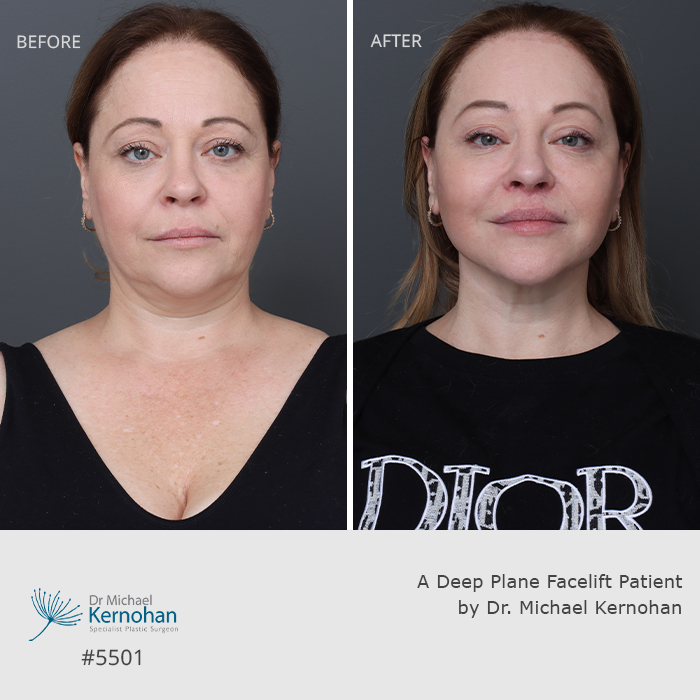
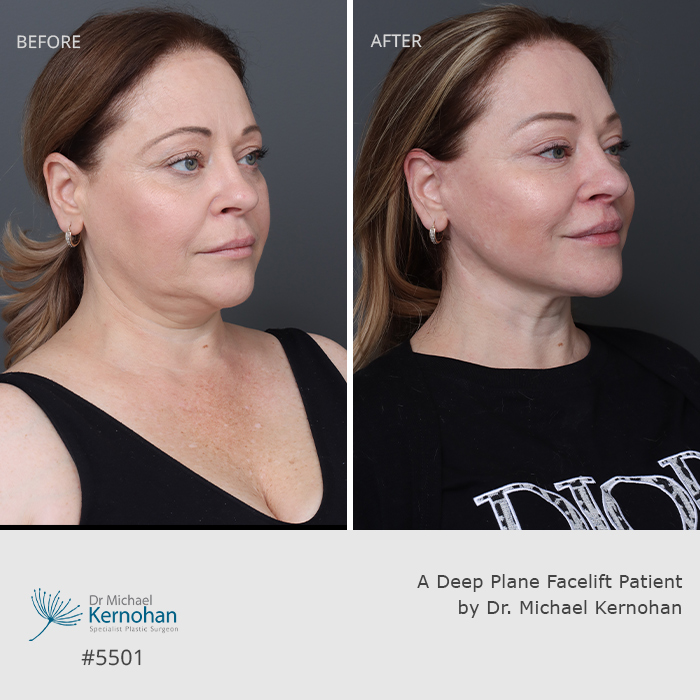
Disclaimer: All surgical or invasive procedures come with inherent risks, and results can vary widely between individuals due to factors like lifestyle, anatomy, overall health, weight, and nutrition. We encourage you to conduct thorough research and consider seeking a second opinion from a qualified healthcare provider.
When Might Another Procedure Be More Appropriate?
Another procedure may be more appropriate when the main concern is outside the typical facelift treatment area. A facelift mainly addresses lower-face and selected neck concerns, not every facial feature.
- Eyelid surgery may be assessed for upper or lower eyelid concerns.
- Brow surgery may be assessed when brow position is the main issue.
- Neck lift surgery may be assessed for neck bands or under-chin fullness.
- Skin treatments may be assessed for pigmentation or surface texture.
- Chin or jawline structure may need separate consideration in selected patients.
This distinction helps prevent a patient from choosing a facelift for a concern it will not address. Dr Michael Kernohan explains the relevant options during consultation.

How Does Dr Michael Kernohan Assess Facelift Suitability?
Dr Michael Kernohan assesses facelift suitability by reviewing the patient’s anatomy, medical history, expectations and recovery capacity. The assessment helps determine whether facelift surgery, another procedure, staged planning or no surgery may be more appropriate.
- Lower-face and jawline changes are assessed.
- Neck laxity, platysma bands and under-chin fullness are reviewed.
- Skin quality, sun exposure and scarring history are considered.
- Medical conditions, medications and supplements are reviewed.
- Smoking, vaping and nicotine use are discussed.
- Recovery needs, work demands and home support are considered.
This assessment is designed to support informed decision-making. It also helps identify risk factors that may need to be addressed before any surgery is planned.
What Should Patients Bring to Consultation?
Patients can prepare for consultation by bringing clear information about their health, medicines and priorities. This helps make the appointment more practical and specific.
- A list of prescription medicines and supplements.
- Details of allergies or previous reactions to anaesthesia.
- Information about smoking, vaping or nicotine use.
- Details of previous facial procedures or injectable treatments.
- Photos from earlier years if they help show facial change over time.
- Questions about risks, recovery, scars and alternatives.
A good consultation should allow time for questions and reflection. Dr Michael Kernohan encourages patients to understand the decision fully before proceeding.
Take the Quiz
How is the Decision Made?
The decision is made by matching the patient’s concern to the safest and most appropriate pathway. This may involve surgery, another procedure, preparation before surgery, or no surgery.
- The concern must match what facelift surgery can address.
- The patient must be medically suitable.
- Recovery time must be realistic.
- Risks and limitations must be understood.
- Alternatives must be discussed.
- The patient should not feel pressured to decide immediately.
A facelift may be worth considering when these factors align. If they do not, another pathway may be more appropriate.

FAQs About Whether a Facelift Is “Worth It”
Next Step: Discuss Facelift Options With Dr Michael Kernohan
If you are asking yourself, “Is a facelift worth it for me?”, the most helpful next step is a detailed, unhurried consultation.
Meeting Dr Michael Kernohan, Specialist Plastic & Reconstructive Surgeon in Sydney, gives you the opportunity to:
- Explain what bothers you most about your face and neck.
- Have your skin, underlying tissues and general health assessed in person.
- Hear how current evidence on satisfaction, risks and longevity relates to your situation.
- Talk through realistic timelines, scars and recovery, rather than best-case scenarios only.
You can bring old and recent photos, a list of medications, and written questions. His clinic’s online contact page and complimentary photo assessment page allow you to conveniently convey enquiries, send photos or schedule appointments. The aim is shared decision-making – so that, whatever you decide, you feel it was based on clear information, not pressure.
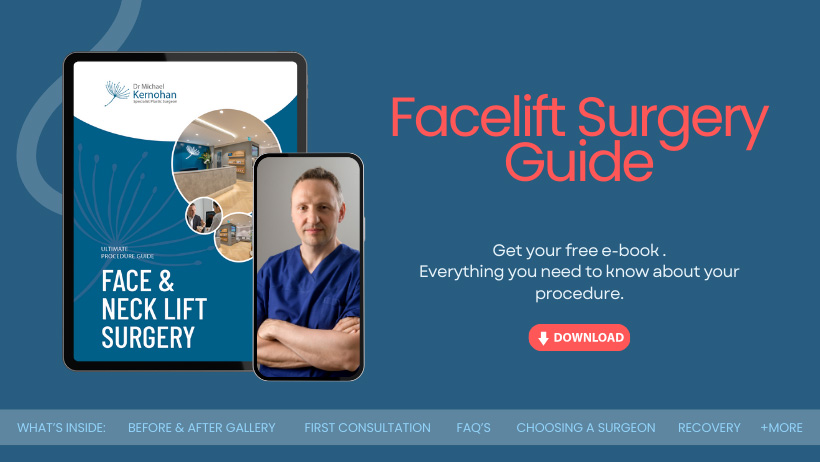
Download Dr Kernohan’s Facelift Surgery Guide
Further Reading
- Read Dr Michael Kernohan’s Procedure Page on Facelift Surgery
- Read Dr Michael Kernohan’s Procedure Page Mini Facelift vs Full Facelift
- Read Dr Michael Kernohan’s Resource Page on Facelift Risks & Complications
- Read Dr Michael Kernohan’s Resource Page on Facelift Recovery Timeline
- Read Dr Michael Kernohan’s Blog on Facelift Longevity
- Read Dr Michael Kernohan’s Blog on Page Facelift Scars & Incisions
- Read Dr Michael Kernohan’s Blog on Facelift Cost
- Read Dr Michael Kernohan’s Blog on How to Prepare for a Facelift Safely