

- At a Glance
- Why Do Facelift Incisions Matter?
- Why Are Shorter Incisions Not Always Better?
- Where Are Facelift Scars Usually Placed?
- What Does a Typical Facelift Incision Involve?
- Why Are Incisions Often Placed Around the Ear?
- Can Facelift Surgery Change the Earlobe or Ear Shape?
- When Is a Hairline Incision Used?
- Can Facelift Incisions Affect the Hairline?
- Why Might an Incision Be Placed Under the Chin?
- How Does Neck Lift Planning Affect Facelift Scars?
- How Does Ear Shape Affect Incision Placement?
- How Does Hairline Position Affect Facelift Incision Planning?
- What Factors Can Affect Scar Healing After Facelift Surgery?
- How Does Dr Michael Kernohan Plan Facelift Incisions?
- What Risks and Limitations Should Patients Understand?
- What Is Recovery Like for Facelift Scars and Incisions?
- When Should Patients Contact the Clinic About Incisions?
- What Alternatives Should Patients Consider Before Facelift Surgery?
- Facelift Before and After Photos
- Who May Be Suitable for Facelift Surgery?
- Who May Not Be Suitable for Facelift Surgery?
- Are Costs Relevant When Discussing Facelift Scars and Incision Placement?
- Take the Quiz
- Summary
- FAQs About Facelift Scars and Incision Placement
- Download Dr Kernohan’s Facelift Surgery Guide
- The Next Step: Book a Consultation With Dr Michael Kernohan
- Further Reading
Dr Michael Kernohan, Specialist Plastic & Reconstructive Surgeon in Sydney, discusses incision placement and scar planning with patients before facelift surgery. Scars are a normal part of facelift surgery, and understanding where they may sit can help patients make a more informed decision.
Many patients are concerned about whether facelift scars will be visible, how long they may take to settle and whether incision placement can be adjusted for their hairline or ear shape. These are important questions because scar position depends on anatomy, skin quality, the type of facelift planned and whether neck lift surgery is also included.
Facelift incisions are not planned only to make scars as short as possible. They must also allow access to the deeper facial and neck tissues, support careful skin redraping and avoid excess tension on the skin.
This article explains common facelift incision locations, how scar planning works and what factors can affect scar healing. It is general information only and does not replace a consultation with Dr Michael Kernohan.
At a Glance
✓ Where Are Facelift Scars Usually Placed?
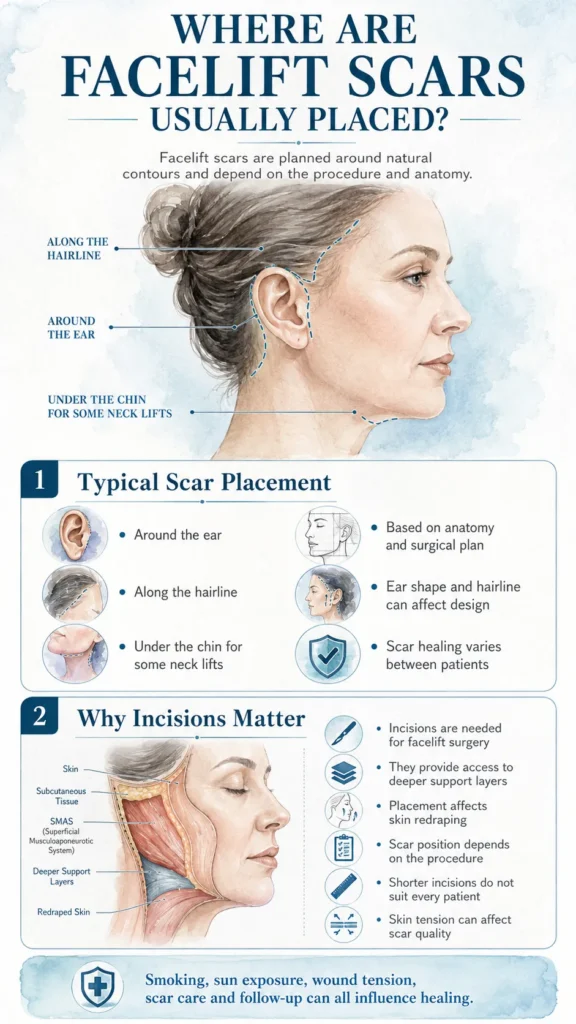
Facelift incisions are commonly placed around the ear, within natural creases where possible, and sometimes into the hairline or under the chin if neck lift planning is included. Scar visibility varies between patients and depends on incision design, skin quality, healing, skin tension, aftercare and individual scar behaviour.
- Facelift surgery involves scars.
- Incisions are often placed around the ear and hairline.
- A neck lift may involve an incision under the chin.
- Scar placement depends on anatomy and the surgical plan.
- Hairline and ear shape can influence incision design.
- Scar healing varies between patients.
- Smoking, sun exposure and wound tension can affect scar healing.
- Scar care and follow-up are important after surgery.
Facelift scars cannot be made invisible. Dr Michael Kernohan plans incision placement by assessing the lower face, neck, jawline, ears, hairline, skin quality and the amount of access needed for the procedure.
Why Do Facelift Incisions Matter?
Facelift incisions matter because they give the surgeon access to the deeper facial and neck tissues. They also influence where scars sit, how skin is redraped and how much tension is placed on the skin during closure.
- Incisions are needed to perform facelift surgery.
- Their placement helps the surgeon access deeper support layers.
- Incision design affects skin redraping.
- Scar position depends on the procedure and anatomy.
- Shorter incisions do not suit every patient.
- Skin tension can affect scar quality.
A well-planned incision is not only about where the scar sits. It is also about allowing the operation to be performed safely and appropriately for the patient’s anatomy.
Why Are Shorter Incisions Not Always Better?
A shorter incision may sound appealing, but it is not always the most suitable option. If access is too limited, the surgeon may not be able to address the tissues that are contributing to the concern.
- Shorter incisions may limit access to deeper tissues.
- Limited access may not suit neck laxity or jowls.
- Skin may not redrape well if the incision is too restricted.
- Extra tension can affect scar healing.
- Some patients need longer incisions for suitable access.
The incision should match the operation required. Dr Michael Kernohan explains why a particular incision pattern may be recommended and what trade-offs are involved.
Where Are Facelift Scars Usually Placed?
Facelift scars are usually placed around the ear and may extend into nearby hairline areas depending on the surgical plan. If neck lift planning is included, there may also be an incision beneath the chin.
- Around the sideburn or temple area in selected patients.
- In front of the ear.
- Around the earlobe.
- Behind the ear.
- Into the lower hairline or scalp where needed.
- Under the chin if central neck access is required.
The exact pattern varies between patients. Dr Michael Kernohan plans incision placement based on the lower face, neck, ear anatomy, hairline, skin laxity and whether a neck lift is part of the operation.
What Does a Typical Facelift Incision Involve?
A typical facelift incision may begin near the temple or sideburn area, pass around the front of the ear, curve around the earlobe and continue behind the ear. It may extend into the hairline if skin redraping or neck planning requires it.
- The temple or sideburn area may be involved.
- The incision may follow natural curves around the ear.
- The earlobe area needs careful planning.
- The incision may continue behind the ear.
- The lower hairline may be involved in some cases.
- The pattern changes when neck lift surgery is added.
Patients should ask where their own incisions are likely to sit. A diagram or explanation during consultation can help make the plan clearer.
Why Are Incisions Often Placed Around the Ear?
Incisions are often placed around the ear because the ear has natural curves, folds and creases that can help place scars in less exposed areas. The area also provides access to the lower face, jawline and neck.
- Natural ear creases can guide incision placement.
- The incision may pass in front of the ear.
- The incision may curve around the earlobe.
- The incision may continue behind the ear.
- Ear shape affects the incision design.
- Skin tension needs to be managed carefully.
Ear-area planning is important because poor tension control can affect scar behaviour or ear position. Dr Michael Kernohan considers ear shape, earlobe attachment and tissue movement when planning facelift incisions.
Can Facelift Surgery Change the Earlobe or Ear Shape?
Facelift surgery can affect the earlobe or nearby ear shape if skin tension is not managed appropriately. This is why deeper tissue support and careful closure are important parts of incision planning.
- Excess tension may pull on the earlobe.
- Scar placement may affect the front or back of the ear.
- Earlobe attachment varies between patients.
- Previous surgery can affect ear-area planning.
- Healing patterns can influence the final scar.
The aim is to reduce avoidable tension on the skin and ear area. However, ear-area changes are a recognised risk and should be discussed before surgery.
When Is a Hairline Incision Used?
A hairline or scalp incision may be used when the surgical plan requires access near the temple, sideburn or behind-ear area. It may also be needed when skin redraping extends beyond the ear area.
- A temple or sideburn incision may be used in selected cases.
- The incision may extend into the hair-bearing scalp.
- A behind-ear hairline incision may be needed for neck planning.
- Hair density and hairstyle can affect scar visibility.
- Previous hair loss or hair transplant history may influence planning.
- Hairline shift is a possible concern.
Hairline incision planning must be individualised. Dr Michael Kernohan considers hairline position, hair density, hairstyle preferences and the amount of tissue movement required.
Can Facelift Incisions Affect the Hairline?
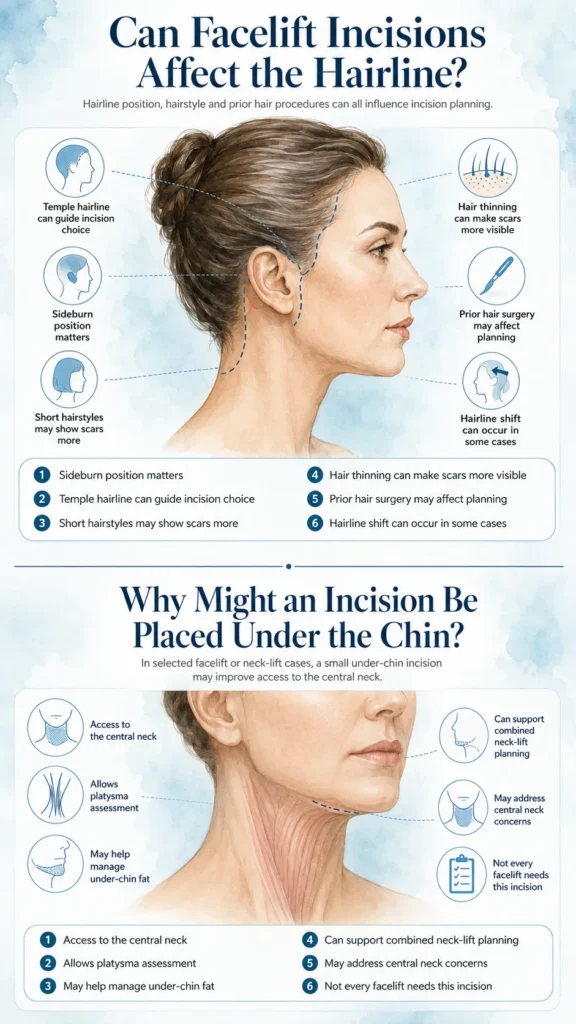
Facelift incisions can affect the hairline in some patients, especially when incisions are placed near the temple, sideburn or behind the ear. The risk depends on incision placement, tissue movement, hair density, healing and previous procedures.
- The sideburn position may need to be considered.
- The temple hairline may affect incision choice.
- Scars may be more visible with short hairstyles.
- Hair thinning can make scars easier to see.
- Prior hair surgery can affect planning.
- Hairline shift can occur in some cases.
Patients who wear their hair up, have short hair or have thinning hair should discuss this during consultation. These details can influence how incision placement is planned.
Why Might an Incision Be Placed Under the Chin?
An incision may be placed under the chin when central neck access is needed. This can allow assessment and treatment of platysma bands, under-chin fullness or selected deeper neck structures.
- It may provide access to the central neck.
- It may allow platysma muscle assessment.
- It may be used for under-chin fat management in selected patients.
- It may be used when neck lift planning is included.
- It may help address central neck concerns.
- Not every facelift requires this incision.
The under-chin incision is usually discussed when the neck is part of the surgical plan. Dr Michael Kernohan explains whether this incision is needed and where it is likely to sit.
How Does Neck Lift Planning Affect Facelift Scars?
Neck lift planning can affect facelift scars because the neck may require additional access or extension of the incision pattern. This is common when neck skin laxity, platysma bands or under-chin fullness are part of the concern.
- Incisions may extend behind the ear.
- The lower hairline may be involved.
- An under-chin incision may be needed in selected cases.
- Neck laxity may require more skin redraping.
- Platysma bands may need central neck access.
- Jowls and neck laxity may need coordinated planning.
A facelift and neck lift are often assessed together because the lower face and neck are connected. Dr Michael Kernohan discusses whether neck lift planning is needed and how it may change scar placement.
How Does Ear Shape Affect Incision Placement?
Ear shape can affect incision placement because facelift scars often pass around the front and back of the ear. The surgeon needs to consider natural ear creases, earlobe position, tragus shape and how the skin will move during closure.
- The earlobe may be attached or more separated.
- The crease in front of the ear may vary between patients.
- The tragus area can influence incision design.
- The groove behind the ear may guide scar placement.
- Previous surgery can change ear-area anatomy.
- Skin tension near the ear needs careful management.
Incision planning should support both access and closure. Dr Michael Kernohan assesses ear shape before surgery so he can explain where scars may sit and what risks apply to the ear area.
How Does Hairline Position Affect Facelift Incision Planning?
Hairline position affects facelift incision planning because some incisions may sit near the temple, sideburn or behind-ear hairline. Hair density, hairstyle, previous hair loss and previous hair procedures can all influence the surgical plan.

- A high temple hairline may need careful planning.
- A low sideburn may affect incision placement.
- Thin hair can make scars more visible.
- Short hairstyles may expose behind-ear scars.
- Tied-back hair can make hairline scars easier to see.
- Previous hair transplant or hair loss may change the options.
Dr Michael Kernohan considers hairline and hairstyle during consultation. Patients should mention hair thinning, hair restoration procedures or concerns about wearing their hair up after surgery.
What Factors Can Affect Scar Healing After Facelift Surgery?
Scar healing varies between patients and cannot be guaranteed. Some factors are related to the patient’s biology, while others are related to wound care, skin tension and general health.
- Genetics and personal scar tendency.
- Previous thick, raised or widened scars.
- Skin quality and sun exposure.
- Smoking, vaping or nicotine use.
- Diabetes or other medical conditions.
- Blood supply and wound tension.
- Infection or delayed wound healing.
- Wound care and follow-up attendance.
- Sun protection after surgery.
A scar that looks noticeable early may continue to change over time. Dr Michael Kernohan provides scar care advice once the incisions are ready for that stage of recovery.
How Does Dr Michael Kernohan Plan Facelift Incisions?
Dr Michael Kernohan plans facelift incisions by assessing the patient’s lower face, jawline, neck, ear anatomy, hairline and skin quality. The incision plan is matched to the procedure needed rather than using the same pattern for every patient.
- The patient’s main concerns are discussed.
- Lower-face laxity and jowls are assessed.
- Neck laxity and platysma bands are reviewed.
- Ear shape and earlobe position are considered.
- Hairline position and hair density are checked.
- Previous scars or surgery are reviewed.
- The likely incision locations are explained.
- Scar risks and aftercare are discussed.
The consultation should help patients understand where scars may be placed and why. It should also make clear that scar healing varies and scars cannot be made invisible.
What Risks and Limitations Should Patients Understand?
Facelift surgery involves scar-related risks as well as general surgical risks. Scar visibility cannot be guaranteed, even when incisions are carefully planned and aftercare instructions are followed.
- Scars may be visible, widened, raised or thickened.
- Delayed wound healing can occur.
- Infection can affect wound and scar quality.
- Bleeding or haematoma can occur after surgery.
- Skin edge healing problems may occur.
- Hairline change or local hair thinning may occur near incisions.
- Earlobe or ear contour changes are possible.
- Numbness, tingling or altered sensation can occur.
- Asymmetry may remain.
- Facial nerve-related movement changes are uncommon but important to discuss.
- Revision surgery may not always be suitable.
Scars cannot be removed completely because they are part of the healing process. Dr Michael Kernohan explains scar-related risks in relation to the patient’s anatomy, skin quality, health history and surgical plan.
What Is Recovery Like for Facelift Scars and Incisions?
Recovery for facelift scars and incisions happens in stages. Early recovery focuses on wound healing, while longer-term recovery involves scar maturation and softening over time.
- Dressings may be used during early healing.
- Wound checks are usually scheduled after surgery.
- Bruising and swelling may occur near incision sites.
- Tightness may be felt around the ears, jawline or neck.
- Sutures or staples may be used depending on the plan.
- Hair washing should follow clinic instructions.
- Scar care should only begin when cleared by the clinic.
- Sun protection is important after surgery.
- Smoking and nicotine should be avoided as advised.
Early scars may appear pink, firm or more visible before they settle. Scar maturation takes time, and each patient heals differently.
When Should Patients Contact the Clinic About Incisions?
Patients should contact the clinic if their incision symptoms change suddenly or appear outside their post-operative instructions. Early review can help identify wound-healing concerns, infection or bleeding.
- Increasing redness around an incision.
- Worsening pain or swelling.
- Heavy bleeding or fluid leakage.
- Wound separation.
- Fever or feeling unwell.
- Increasing warmth around the incision.
- New facial movement changes.
- Sudden swelling on one side.
If symptoms are urgent or severe, patients should seek emergency care. Dr Michael Kernohan’s clinic provides specific post-operative instructions so patients know what to monitor after surgery.
What Alternatives Should Patients Consider Before Facelift Surgery?
Alternatives should be discussed before facelift surgery as part of informed consent. The right option may be no surgery, delayed surgery, skin-focused care, neck lift planning, combined surgery or staged treatment.
- No surgery may be appropriate if the concern is mild or risks are not acceptable.
- Delaying surgery may allow more time for decision-making or health optimisation.
- Skin care and sun protection may support skin health.
- Dermatology-led treatments may help texture or pigmentation concerns.
- Neck lift alone may be considered when the concern is mainly in the neck.
- Facelift with neck lift may be discussed when the lower face and neck both contribute.
- Scar management advice may be relevant for patients with previous scars.
- A second opinion may help if the patient is unsure.
Non-surgical treatments may help selected surface concerns, but they do not replace facelift surgery when deeper tissue laxity is the main issue. Dr Michael Kernohan discusses alternatives so patients can compare options before deciding.
Facelift Before and After Photos
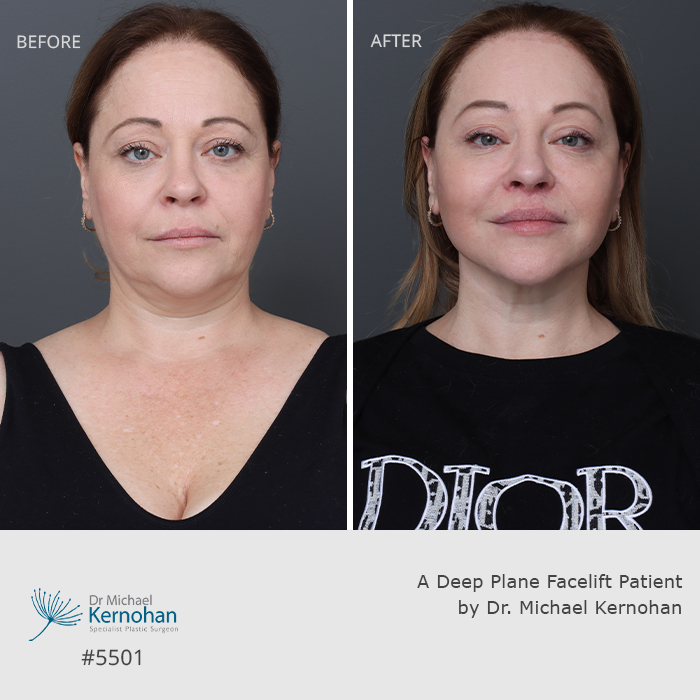
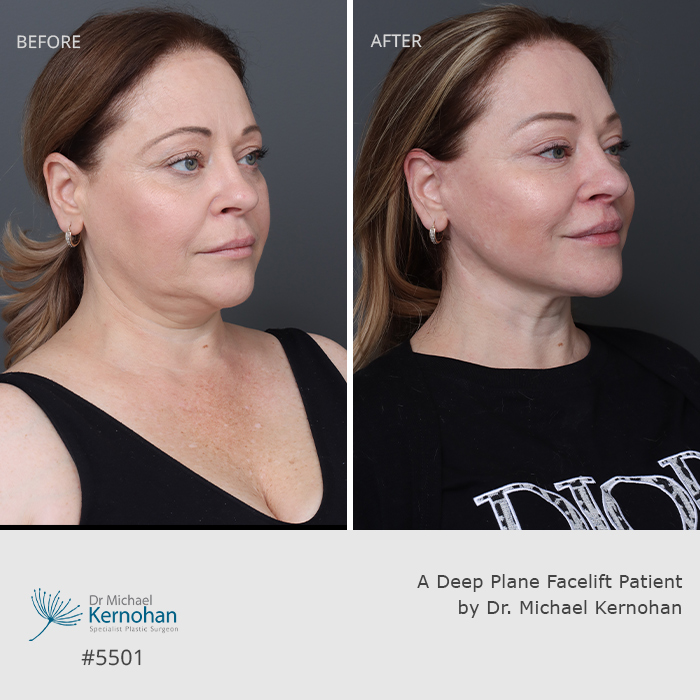
Disclaimer: All surgical or invasive procedures come with inherent risks, and results can vary widely between individuals due to factors like lifestyle, anatomy, overall health, weight, and nutrition. We encourage you to conduct thorough research and consider seeking a second opinion from a qualified healthcare provider.
Who May Be Suitable for Facelift Surgery?
A patient may be suitable for facelift surgery if their concerns match what the operation can address and they are medically suitable for surgery and anaesthesia. Suitability also requires understanding that scars, recovery and risks are part of surgery.
- Lower-face laxity or jowls are suitable for facelift assessment.
- Neck concerns may require combined planning.
- The patient is in suitable general health for surgery.
- Weight is reasonably stable.
- Smoking, vaping or nicotine use has been discussed and managed.
- The patient understands that scars are part of facelift surgery.
- Expectations about scar healing are realistic.
- The patient can follow wound care and follow-up instructions.
Suitability cannot be confirmed from photos alone. Dr Michael Kernohan assesses the face, neck, jawline, skin quality, hairline, ears and medical history before discussing whether facelift surgery is appropriate.
Who May Not Be Suitable for Facelift Surgery?
Some patients may not be suitable for facelift surgery or may need to delay surgery until risk factors are addressed. This may include patients with high wound-healing risk, concerns better treated another way, or expectations that surgery cannot meet.
- Uncontrolled medical conditions may need review first.
- High anaesthetic risk may make surgery unsuitable.
- Smoking or nicotine use can increase wound-healing risks.
- A history of thick scarring may need careful review.
- Expectations of scar-free surgery are not realistic.
- Concerns mainly about skin texture may need another pathway.
- Patients not ready for recovery or wound care may need more time.
- Patients who feel pressured or uncertain should pause before deciding.
Not being suitable at one point does not always mean surgery is never possible. Dr Michael Kernohan may recommend medical review, waiting, another pathway, scar-focused advice or no surgery depending on the situation.
Are Costs Relevant When Discussing Facelift Scars and Incision Placement?
Costs may be relevant when comparing facelift surgery, facelift with neck lift or staged planning, but incision placement should not be chosen mainly because of cost. The incision plan should be based on anatomy, access, skin redraping, scar position and safety.
- Facelift and facelift with neck lift may involve different planning.
- Theatre and anaesthetic time may vary.
- Dressings, follow-up and scar care needs may vary.
- Revision or staged surgery may involve separate cost considerations.
- A shorter incision may not suit every patient.
- Individual cost information can only be provided after consultation.
For more information about the factors that can affect fees, including surgeon, anaesthetist and hospital costs, read Dr Michael Kernohan’s guide to facelift costs in Sydney.
Choosing a smaller incision for cost or convenience may not address the patient’s anatomy properly. Dr Michael Kernohan discusses cost information after consultation, once the surgical plan and suitability have been assessed.
Take the Quiz
Summary
Facelift surgery involves scars, and incision placement is an important part of surgical planning. Common incision areas include around the ear, near the hairline and sometimes under the chin when neck lift planning is included.
Scar visibility varies between patients and depends on incision design, skin quality, wound tension, genetics, nicotine use, sun exposure, healing and aftercare. Scars cannot be made invisible, and patients should understand this before surgery.
Dr Michael Kernohan, Specialist Plastic & Reconstructive Surgeon in Sydney, assesses the face, jawline, neck, ears, hairline, skin quality and medical history before discussing facelift incision placement. A consultation can help patients understand where scars may sit, what risks apply and whether facelift surgery, neck lift planning, another pathway or no surgery may be appropriate.

FAQs About Facelift Scars and Incision Placement
Download Dr Kernohan’s Facelift Surgery Guide
The Next Step: Book a Consultation With Dr Michael Kernohan
If you are considering facelift surgery and would like to understand more about scars and incision placement, a personalised consultation with Dr Michael Kernohan can provide clarity tailored to your facial anatomy and goals.
Dr Kernohan’s clinic website has resources and contact information that prospective patients can explore. To arrange an appointment or submit photographs for a complimentary assessment, contact the clinic team in Sydney. Informed planning and realistic expectations are essential steps toward a considered surgical decision.
Further Reading
- Read Dr Michael Kernohan’s Procedure Page on Partial Facelift Surgery NSW
- Read Dr Michael Kernohan’s Procedure Page on Revision Facelift Sydney – Also Known as Secondary Facelift
- Read Dr Michael Kernohan’s Blog about Incisions in a Neck Lift – Where They Are Placed and Why
- Read Dr Michael Kernohan’s Blog about Managing and Treating Necklift Scars

Surgical Options for Loose Neck Skin After 40, 50 and 60
Dr Michael Kernohan, Specialist Plastic & Reconstructive Surgeon in South West Sydney, assesses loose neck…

Incisions in a Neck Lift – Where They Are Placed and Why
When people start looking into neck lift surgery, one of the most common questions is,…

High-SMAS vs Deep-Plane Approaches in Neck Lift Surgery
Why Technique Matters In Neck Lift Surgery When planning a neck lift – especially in…