
- Why Technique Matters In Neck Lift Surgery
- Take The Quiz
- Understanding Neck, Jawline and SMAS Anatomy
- How High-SMAS May Support Neck and Jawline Repositioning
- Download Dr Kernohan’s Facelift Surgery Guide
- How Deep-Plane Dissection May Relate to Neck Lift Planning
- Neck-Lift Considerations: High-SMAS vs Deep-Plane
- Why Facelift and Neck Lift Planning Are Often Considered Together
- Recovery After Combined Facelift and Neck Lift Approaches
- Setting Expectations for Neck and Jawline Changes
- How Surgeons Select an Approach for the Neck and Jawline
- High‑SMAS Vs Deep‑Plane Neck Lift FAQs
- Do’s And Don’ts When Considering A High‑SMAS Or Deep‑Plane Neck Lift
- Facelift Before and After Photos
- High-SMAS and Deep-Plane Approaches in Neck Lift Planning
- Next Step: Discuss How Advanced Facelift Techniques Can Be Tailored To You
- Further Reading
Why Technique Matters In Neck Lift Surgery
When planning a neck lift – especially in combination with a facelift – one of the core decisions a surgeon makes is which tissue plane to reposition and tighten. Two commonly discussed approaches are the High‑SMAS (Superficial Musculoaponeurotic System) technique and the Deep‑Plane technique. Both are designed to adjust neck and jawline contours by addressing deeper support structures under the skin, but they differ in how tissues are mobilised and repositioned. This article focuses specifically on how these approaches may be incorporated into neck lift planning, rather than providing a general comparison of facelift techniques.
The comparison of these approaches – High‑SMAS vs Deep‑Plane Neck Lift – is clinically relevant because it helps patients understand why surgeons choose one technique over another based on anatomy, ageing patterns, and individual facial characteristics. Dr Michael Kernohan, Specialist Plastic & Reconstructive Surgeon based in Sydney, emphasises that the choice of technique is not about which is inherently “better,” but which is more appropriate for a given anatomical presentation and surgical goal.
Take The Quiz
Understanding Neck, Jawline and SMAS Anatomy
To contextualise these techniques, it helps to understand the role of the SMAS layer. The SMAS is a fibromuscular layer that lies between the skin and the deeper facial muscles. It connects to the cheek, jawline, and neck and serves as an anchor for facial soft tissues. Because it is a strong and consistent layer, it is a target for repositioning in facelift and neck lift surgery to achieve structural support rather than relying solely on skin tightening.
In the neck, surgical planning may also consider the platysma muscle, submental tissues and how the lower face transitions into the jawline and neck.
By incorporating the SMAS into surgical planning, surgeons can redistribute soft tissue in a way that resists gravitational descent more effectively than skin‑only lifts. In combined neck lift procedures, manipulating this layer – whether by High‑SMAS or Deep‑Plane technique – allows adjustments that integrate skin and deeper tissue support.
How High-SMAS May Support Neck and Jawline Repositioning
The High‑SMAS approach involves elevating and repositioning the SMAS layer higher on the cheek and along the jawline and neck. Instead of treating the skin alone, this technique lifts deeper soft tissues as a composite layer, allowing a coordinated adjustment of both the superficial and deeper planar supports.
In practice, High‑SMAS dissection separates the SMAS layer from deeper facial muscles at a higher point on the face, giving access to neck and jawline tissues with greater control. The advantage is that it allows repositioning of the midface and neck with changes in two planes – superficial and deeper – without extensive undermining of deeper muscular structures.
Surgeons often consider High‑SMAS when midface support and jawline contour require enhancement but the deeper neurovascular structures can be respected without full deep‑plane dissection. This approach can be particularly suited to patients whose ageing changes involve soft tissue descent without profound deep structural adherence or tethering.
Download Dr Kernohan’s Facelift Surgery Guide

How Deep-Plane Dissection May Relate to Neck Lift Planning
The Deep‑Plane approach advances the underlying facial musculature and connective tissues by elevating not just the SMAS but also a deeper fascial (sub‑SMAS) layer as a unified segment with the overlying skin. It allows mobilisation of a thicker block of tissue and facilitates repositioning of the midface and neck as a unit.
In Deep‑Plane neck lift surgery, dissection continues beneath the SMAS and involves releasing deeper attachments around the cheek, jawline and neck to reposition tissues with less reliance on skin traction. This sometimes leads to a more natural redraping of tissues, as skin is not the primary layer under tension; the deeper support structures contribute to the repositioning.
Given the proximity to facial nerve branches and deeper anatomical structures, Deep‑Plane techniques require careful anatomical understanding and meticulous dissection. They are often considered when deeper tethering or more extensive descent of midfacial tissues is present, or when maximal soft tissue mobilisation is required.
Neck-Lift Considerations: High-SMAS vs Deep-Plane

✓ Soft Tissue Distribution And Descent Patterns
Patients with moderate soft tissue descent and good skin quality may be well served with a High‑SMAS approach. The coordinated movement of SMAS and overlying tissues can achieve pleasing contour in the neck and jawline with controlled tissue mobilisation. In contrast, patients with more profound descent, especially in the cheek and midface region, or with deeper fibrous attachments, may benefit from Deep‑Plane techniques, which address deeper tissue adherence and laxity.
Both approaches distribute tension away from the skin alone and into deeper support structures, which is a foundation of modern neck lift planning. The choice between them often depends on how tissues behave during clinical examination and how much deep release is expected to be beneficial.
✓ Anatomical Safety And Facial Nerves
Because Deep‑Plane dissection is closer to the facial nerve branches, it requires detailed anatomical navigation to avoid nerve injury. While High‑SMAS also traverses important layers, it usually does not involve as extensive sub‑SMAS dissection. Both approaches are safe when performed by experienced surgeons trained in complex facial anatomy, but they carry different technical demands.
Patients are assessed for nerve safety through clinical examination and surgical planning, and the surgeon’s experience with each technique informs decision‑making. A careful, layered approach to dissection and planned pathways for tissue repositioning help minimise risk.
Why Facelift and Neck Lift Planning Are Often Considered Together
In the neck, surgical planning may also consider the platysma muscle, submental tissues and how the lower face transitions into the jawline and neck.
Many patients seeking facial rejuvenation find that ageing changes in the neck and jawline are most effectively addressed when a neck lift is combined with either High‑SMAS or Deep‑Plane facial dissection. This combined approach allows a holistic improvement in contour from the midface down to the neck without isolated treatment of one region alone.
In combined neck lift surgery, High‑SMAS or Deep‑Plane techniques help create continuity between the lifted cheek tissues and the neck. The neck portion focuses on tightening lax platysma bands, refining the jawline, and supporting deeper soft tissue repositioning. This often leads to a more harmonised result over the face and neck as a unit, compared with neck lift alone.
Recovery After Combined Facelift and Neck Lift Approaches

Recovery after either High‑SMAS or Deep‑Plane combined neck lift involves phases of swelling, bruising and gradual reduction of discomfort. Because both techniques involve mobilisation of deeper tissue planes, postoperative swelling may be more noticeable in the early days compared with surgeries that affect only superficial tissues. Most patients find that swelling and bruising decrease significantly within two to three weeks, with deeper tissue remodelling continuing for several months.
Patients are encouraged to follow surgeon‑led protocols for rest, gentle mobility and monitoring. Avoiding heavy lifting or strenuous activity during the early recovery months helps minimise strain on healing tissues. Communication with the surgical team is important if any unusual symptoms arise.
Setting Expectations for Neck and Jawline Changes
Whether a High‑SMAS or Deep‑Plane technique is chosen, it is important to maintain realistic expectations. These approaches aim to provide structural support and refined contouring, but they do not halt ageing. Over time, tissues continue to respond to intrinsic and extrinsic ageing factors, and future changes may occur.
During consultation, Dr Michael Kernohan discusses expected changes based on your anatomy, age, skin quality, and lifestyle, supporting an informed understanding of what surgical neck lift approaches can achieve. This grounded discussion helps align goals with the chosen technique without promising outcomes beyond anatomical possibility.
How Surgeons Select an Approach for the Neck and Jawline
Choosing between High‑SMAS and Deep‑Plane neck lift technique involves clinical examination, assessment of skin quality and tissue behaviour, and consideration of how deep attachments affect movement with simulated lifts. Surgeons also consider patient goals, expectations, and overall health to ensure safety and suitability.
In Sydney and similar metropolitan practice settings, patients often benefit from a structured consultation that integrates photographic assessment, physical examination, and discussion of recovery and outcomes. This clinical dialogue guides patients toward a choice that respects both anatomical presentation and personal priorities.

High‑SMAS Vs Deep‑Plane Neck Lift FAQs
Do’s And Don’ts When Considering A High‑SMAS Or Deep‑Plane Neck Lift
When planning a combined facelift and neck lift, patient preparation plays a crucial role in optimising recovery and supporting natural outcomes. Whether your procedure involves a High‑SMAS or Deep‑Plane approach, here are practical recommendations to follow and habits to avoid.
Do’s
- Do attend a thorough consultation with a qualified specialist – Ensure your surgeon is experienced in both High‑SMAS and Deep‑Plane techniques, and ask about their rationale for selecting a particular approach.
- Do follow preoperative instructions closely – These may include avoiding certain medications, preparing your home for rest, and arranging support for the first few days post-surgery.
- Do allow adequate time for recovery – Both techniques involve deeper tissue work, which means your body needs time to heal. Follow your surgeon’s activity and mobility guidelines to avoid setbacks.
- Do ask about scar care and follow-up assessments – Ongoing monitoring helps your surgeon track your healing and support tissue integration over time.
- Do maintain a balanced lifestyle postoperatively – Nutritional support, hydration, and gentle mobility can contribute positively to recovery.
Don’ts
- Don’t choose a procedure based solely on online comparisons – Technique selection should be based on clinical assessment, not popularity or generalisations.
- Don’t underestimate the depth of dissection – These procedures are technically advanced, so respect your body’s healing needs and don’t rush into strenuous activities.
- Don’t smoke or use nicotine products – These significantly impair blood flow and can interfere with wound healing and tissue viability.
- Don’t skip follow-up appointments – Even if you’re healing well, your surgeon needs to monitor progress and make any necessary adjustments.
- Don’t compare your recovery to others’ experiences – Every face is different, and so is every healing journey. Focus on your own plan and stay in close communication with your clinic.
These do’s and don’ts are designed to complement your surgeon’s personalised advice. Following a structured approach ensures the best possible environment for healing and long-term results.
Facelift Before and After Photos
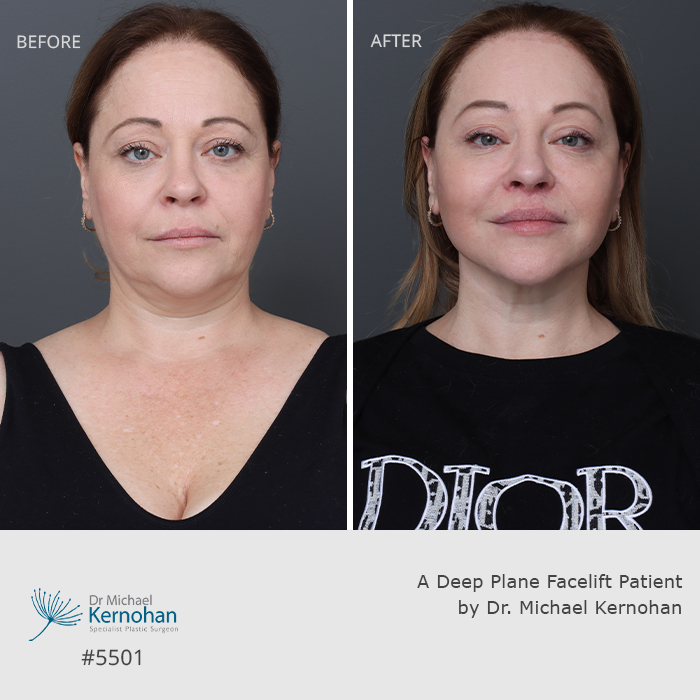
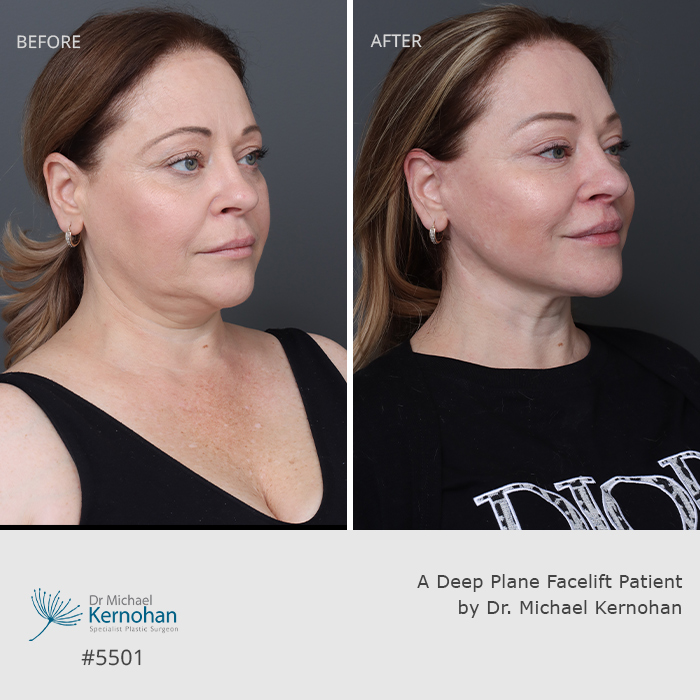
Disclaimer: All surgical or invasive procedures come with inherent risks, and results can vary widely between individuals due to factors like lifestyle, anatomy, overall health, weight, and nutrition. We encourage you to conduct thorough research and consider seeking a second opinion from a qualified healthcare provider.
High-SMAS and Deep-Plane Approaches in Neck Lift Planning
Both High‑SMAS and Deep‑Plane approaches provide pathways to reposition deeper facial and neck tissues with support beyond the skin layer. The decision between these techniques, especially when combined with a neck lift, depends on tissue descent patterns, anatomical detail, and surgeon experience with advanced facial dissection.
Dr Michael Kernohan uses a personalised approach to surgical planning for patients in South West Sydney, aligning technique selection with individual anatomy, goals, and safety considerations. A thoughtful comparison of High‑SMAS vs Deep‑Plane Neck Lift supports shared decision‑making that is grounded in clinical reality and long‑term perspective.
Next Step: Discuss How Advanced Facelift Techniques Can Be Tailored To You
Choosing the most appropriate approach for your neck lift, whether High‑SMAS or Deep‑Plane, begins with a detailed clinical assessment. Dr Michael Kernohan, Specialist Plastic & Reconstructive Surgeon in South West Sydney, provides personalised consultations that focus on your features, anatomy and recovery planning. His website’s contact page and photo assessment option can help you start a discreet enquiry about your neck lift options. Contact the clinic to explore which technique may be suitable for your neck lift goals and start your journey with informed understanding.
Your surgical plan deserves specialist insight – contact us to book a consultation.
Further Reading
- Read more about Partial Facelift Surgery NSW
- Read more about Buccal Fat Removal Sydney
- Read more about Trifecta Lift
- Read Dr Kernohan’s Blog on Lower Facelift Vs. Full Facelift – Appropriate Candidates For Each
- Read Dr Kernohan’s Blog on The History of Facelift Surgery: From Early Techniques to Modern Advances
- Read Dr Kernohan’s Blog on How to Prepare for Necklift Surgery
- Read Dr Kernohan’s Blog on Neck Lift Options – Types of Neck Lift Surgery