

Body Contouring Sydney – Plastic Surgery after Weight Loss
Dr Michael Kernohan is an AHPRA-registered Specialist Plastic & Reconstructive Surgeon, FRACS (Plast), who consults with patients considering body surgery after significant weight loss in Gledswood Hills and Surry Hills. Body contouring after weight loss refers to one or more operations used to address selected areas of excess skin and soft tissue after weight has stabilised.
Post-weight-loss body contouring is not one operation. A patient may have changes involving the abdomen, lower torso, arms, thighs, breast or chest, or upper body, and these areas do not necessarily need to be treated at the same time.
Dr Kernohan considers the areas affected, current health, weight history, previous surgery, nutrition, scars, recovery requirements and surgical risk before discussing which procedure may be considered first and whether other procedures should be staged.
These operations leave permanent scars and carry risks including wound-healing problems, fluid collections, infection, bleeding and blood clots. Surgery cannot remove every area of excess skin or guarantee a particular body shape or degree of symmetry.
Body Contouring After Weight Loss at a Glance
| Topic | General Information |
|---|---|
| Procedure | One or more post-weight-loss body operations |
| Surgeon | Dr Michael Kernohan, Specialist Plastic & Reconstructive Surgeon |
| AHPRA Registration | MED0001208990 |
| Consultations | Gledswood Hills and Surry Hills |
| Areas Assessed | Abdomen, lower torso, arms, thighs, breast/chest and upper body where relevant |
| Weight Stability | Considered before surgical planning |
| Bariatric History | Relevant to medical and nutritional assessment |
| Medication-Assisted Weight Loss | Relevant where applicable |
| Staged Surgery | May be considered when several areas are involved |
| Scars | Permanent and vary according to procedure |
| Recovery | Depends on the areas treated and extent of surgery |
| Suitability | Requires individual clinical assessment |
What Is Body Contouring After Weight Loss?
Significant weight loss can leave skin and soft tissues that no longer correspond with the person’s current body size.
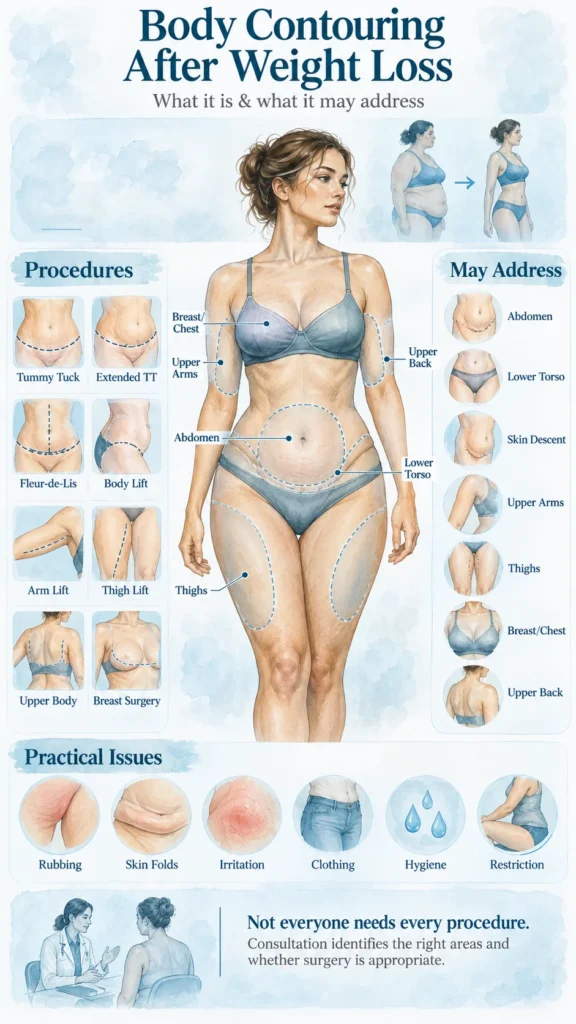
These changes vary considerably.
Some patients mainly notice excess abdominal skin. Others have changes involving several regions, such as the lower torso, upper arms, thighs, breast or chest, or upper back.
Body contouring after weight loss is an umbrella term for surgical procedures used to address selected areas.
It may include procedures such as:
- Abdominoplasty.
- Extended abdominoplasty.
- Fleur-de-lis abdominoplasty.
- Lower body lift.
- Arm lift or brachioplasty.
- Thigh lift.
- Upper body surgery where relevant.
- Breast surgery where clinically appropriate.
Not every patient requires all of these procedures.
The role of consultation is to identify which areas are contributing to the patient’s concerns and whether surgery is appropriate.
What Can Body Contouring After Weight Loss Address?
Post-weight-loss surgery may be considered for selected areas of excess skin and soft tissue.
Depending on the individual anatomy, surgery may address:
- Abdominal skin excess
- Skin folds around the lower torso
- Selected soft-tissue descent
- Upper-arm skin excess
- Thigh skin excess
- Breast or chest tissue changes
- Upper-body skin excess where relevant
In some patients, these changes can also contribute to practical issues such as:
- Skin rubbing
- Difficulty managing skin folds
- Skin irritation
- Difficulty with some forms of clothing
- Problems with hygiene in skin folds
- Physical restriction caused by substantial excess tissue
The operation selected depends on the location and extent of the tissue involved.
What Can Body Contouring Surgery Not Address?
Body contouring has important limitations.
It does not directly:
- Cause further weight loss
- Maintain a patient’s weight
- Treat all stretch marks
- Remove every area of skin laxity
- Correct skin texture across untreated areas
- Guarantee symmetry
- Guarantee a particular clothing size
- Prevent future skin or tissue change
- Prevent the effects of future weight change
Stretch marks located within skin that is surgically removed may also be removed, but marks outside that tissue will remain.
The amount of tissue that can be treated must also be balanced against scar length, blood supply, surgical duration and recovery requirements.
Which Areas Can Be Assessed After Significant Weight Loss?
Patients often have changes in more than one region.
✓ Abdomen
The abdomen may have horizontal skin excess, vertical skin excess, or both.
The appropriate operation depends on factors including:
- Amount of skin
- Direction of excess
- Existing scars
- Abdominal wall anatomy
- Previous abdominal surgery
- Whether tissue extends around the flanks
✓ Lower Torso
Some patients have skin and soft-tissue changes extending around the waist, flanks and lower back.
A circumferential procedure such as a lower body lift may be considered in selected patients.
✓ Upper Arms
An arm lift may be considered where skin excess extends along the upper arm.
The trade-off is a permanent scar whose position and length depend on the operation.
✓ Thighs
Thigh surgery may address selected skin excess involving the inner or other areas of the thigh.
Scar position and recovery differ from abdominal or arm surgery.
✓ Breast or Chest
Significant weight loss can alter breast or chest skin and tissue position.
Where clinically appropriate and within the patient’s priorities, separate breast or chest surgery may be discussed.
✓ Upper Body
Selected patients may have excess tissue involving the upper back or lateral chest.
Whether surgery is appropriate depends on anatomy, existing scars and how that procedure fits within the wider surgical plan.

What Dr Kernohan Assesses Before Planning Surgery
Post-weight-loss surgery requires more than deciding which area has the most excess skin.
Dr Kernohan considers several factors before a surgical plan is developed.
✓ Current Weight and Weight History
He considers:
- Current weight
- Recent weight change
- Whether further substantial weight loss is expected
- Previous highest weight where relevant
- How weight was lost
✓ Areas of Excess Skin and Soft Tissue
Each body region is assessed separately.
This helps determine whether one procedure can address the main concern or whether several operations may eventually be considered.
✓ Previous Surgery and Scars
Previous surgery may affect:
- Blood supply
- Scar position
- Tissue mobility
- Incision planning
- Future procedure options
✓ General Health
Medical conditions may affect whether elective surgery is appropriate and how it should be planned.
✓ Nutrition
Nutritional status can be particularly relevant after bariatric surgery or substantial dietary change.
✓ Nicotine Exposure
Nicotine can affect wound healing and tissue blood supply.
Patients should tell Dr Kernohan about current nicotine exposure, including smoking and other nicotine-containing products.
✓ Blood Clot Risk
Personal and medical factors that may affect venous thromboembolism risk are reviewed.
✓ Mobility and Recovery Support
Recovery planning may be more demanding when surgery involves large areas or several surgical sites.
✓ Patient Priorities
The area that concerns a patient most is important, but it is only one part of surgical sequencing.
The first operation may not always be the procedure the patient initially expected.
Why Weight Stability Matters Before Body Contouring Surgery
Body contouring is generally planned when the patient’s weight trajectory is sufficiently stable for the proposed operation.
Further substantial weight loss can change:
- Skin excess
- Soft-tissue position
- Procedure choice
- Incision planning
- Long-term appearance
Weight regain can also alter tissues after surgery.
There is no single number of months that answers this question for every patient.
Dr Kernohan considers the overall weight history, expected future change, method of weight loss, health and proposed operation before discussing timing.
Does It Matter How I Lost Weight?
Significant weight loss may occur through:
- Lifestyle and dietary change
- Bariatric surgery
- Prescription weight-management medication
- A combination of approaches
The method of weight loss can be relevant to surgical planning.
For example, previous bariatric surgery may prompt additional consideration of nutritional status, previous abdominal surgery and relevant medical history.
Patients who have used prescription weight-management medications should provide an accurate medication history during consultation.
Medication management around surgery should be discussed with the relevant treating practitioners rather than changed without medical advice.
Nutrition and Medical Preparation After Significant Weight Loss
Adequate nutritional status is important for surgical healing.
Some patients, particularly those with a history of bariatric surgery, may require further assessment of nutritional or medical factors before elective surgery.
Depending on the individual circumstances, this may include investigation of:
- Anaemia
- Iron status
- Relevant vitamin or micronutrient deficiencies
- Protein or nutritional status where clinically indicated
- Diabetes
- Other medical conditions affecting healing
This page does not replace individual nutritional advice.
Where concerns are identified, Dr Kernohan may recommend further assessment or management before surgery proceeds.
How Dr Kernohan Decides Which Area to Treat First
When several body regions are affected, procedure order is an important part of planning.
Factors may include:
- Functional Concerns: An area causing repeated irritation, hygiene difficulty or physical restriction may deserve particular consideration.
- Anatomy: One operation may affect how a later procedure is planned.
- Scar Placement: Existing scars and future incision patterns need to be considered together.
- Surgical Duration: Treating several large regions can substantially increase the extent and duration of an operation.
- Recovery Mobility: Some combinations of procedures may make standing, walking, sleeping or self-care more difficult during early recovery.
- Support at Home: The patient’s household responsibilities and available assistance form part of practical planning.
- Medical Risk: Health factors may favour a shorter operation or staged approach.
- Patient Priorities: The patient’s main concerns remain central to the discussion.
There is no universal order that applies to everyone.
CLICK to Download Dr Michael Kernohan’s Excess Skin Reduction Guide

Why Procedures May Need to Be Staged
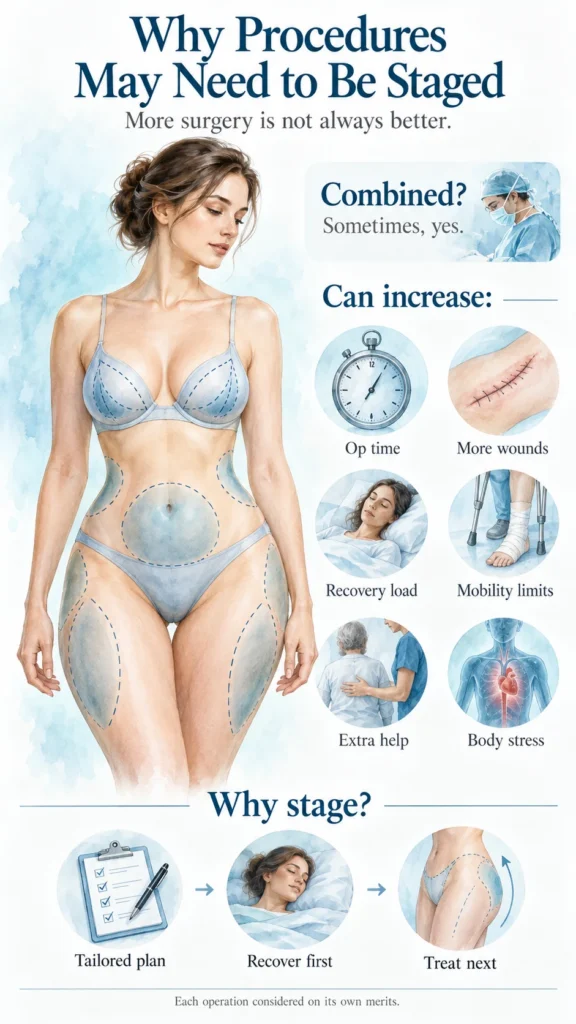
Patients sometimes ask whether several areas can be treated during one operation.
In selected circumstances, procedures may be combined.
However, more surgery is not automatically preferable.
Combining procedures can increase:
- Operating time
- Number of surgical wounds
- Recovery demands
- Mobility restrictions
- Need for assistance
- Overall physiological burden
For these reasons, Dr Kernohan may recommend that procedures be separated into stages.
A staged plan allows each operation to be considered on its own merits.
It can also allow recovery from one procedure before another region is treated.
Abdominal Surgery After Weight Loss
The abdomen is one of the most common areas patients ask about after significant weight loss.
However, not all abdominal skin excess is the same.
Depending on the pattern of tissue, Dr Kernohan may discuss procedures such as:
A fleur-de-lis approach may be considered where there is significant skin excess in more than one direction.
A lower body lift may be more relevant where tissue changes extend around the torso.
Patients considering abdominal surgery after major weight loss can also read our guide to abdominoplasty after weight loss, including procedure options, weight stability, recovery and risks.
Lower Body Lift After Weight Loss
A lower body lift is a larger circumferential operation used in selected patients with tissue excess extending around the lower torso.
It is different from an abdominoplasty because it addresses a broader anatomical area.
The operation involves long permanent scars and a substantial recovery period.
Suitability depends on health, anatomy, weight history and the patient’s ability to manage postoperative recovery.
Arm Lift After Weight Loss
An arm lift, or brachioplasty, may be considered when excess skin extends along the upper arm.
The extent of surgery depends on the amount and distribution of tissue.
Patients should understand that the procedure involves a permanent arm scar.
The position and length of this scar depend on the required operation.
Thigh Lift After Weight Loss
A thigh lift may be considered where excess skin is present around the thigh.
The operation, incision position and recovery depend on where the tissue is located.
Thigh surgery has different mobility and wound-care considerations from abdominal or arm surgery.
For this reason, it should be planned as a separate procedure rather than assumed to form part of a standard post-weight-loss package.
Breast and Chest Surgery After Weight Loss
Significant weight loss can also alter breast or chest skin and tissue position.
Where appropriate, separate breast or chest surgery may be discussed after assessment.
Possible procedures depend on the patient’s anatomy and clinical findings.
These operations should be considered separately from abdominal or lower-body surgery rather than treated as an automatic component of post-weight-loss body contouring.
Take The Quiz
What Should I Know About Scars?
Post-weight-loss body surgery can involve long permanent scars.
This is an important trade-off.
Scar location depends on the procedure.
Possible areas include:
- Lower abdomen
- Around the lower torso
- Upper arms
- Inner thighs
- Breast or chest
- Upper back where relevant
A larger amount of tissue removal may require a longer incision.
Scars change as they mature, but they do not disappear.
Scar appearance is influenced by:
- Genetics
- Skin
- Wound tension
- Infection
- Healing
- Previous scars
- Nicotine exposure
- Individual scar biology
Raised, widened, pigmented or otherwise noticeable scars can occur.
Risks and Possible Complications
All surgery carries risks. Post-weight-loss body contouring can involve large wounds and, in some patients, several body regions.
Possible complications include:
- Bleeding
- Haematoma
- Seroma
- Infection
- Delayed wound healing
- Wound separation
- Skin healing problems
- Skin loss
- Permanent scars
- Raised or widened scars
- Altered sensation
- Numbness
- Asymmetry
- Contour irregularities
- Lymphatic swelling where relevant
- Pain
- Anaesthetic complications
- Deep vein thrombosis
- Pulmonary embolism
- Need for additional treatment
- Further surgery
The risks relevant to an individual patient depend on the operation, health, procedure duration and other clinical factors.
Measures are taken to reduce avoidable risk, but complications cannot be completely prevented.
Blood Clot Risk and Prevention Planning
Blood clots are an important consideration in body surgery.
Risk varies between patients.
Factors can include:
- Personal or family history
- Previous thrombosis
- Mobility
- Medical conditions
- Extent of surgery
- Operating time
- Number of procedures performed
- Other individual factors
Dr Kernohan assesses these factors as part of surgical planning.
Prevention measures are individualised according to clinical circumstances.
Recovery After Body Contouring Surgery
There is no single recovery timetable for all post-weight-loss procedures.
Recovery after arm surgery is different from recovery after an abdominoplasty or circumferential lower body lift.
The recovery burden may also increase when more than one area is treated.
Early recovery can include:
- Swelling
- Bruising
- Tightness
- Wound discomfort
- Altered sensation
- Reduced mobility
Patients receive procedure-specific instructions covering:
- Wound care
- Dressings
- Drains where used
- Garments where indicated
- Sleeping and positioning
- Walking
- Driving
- Work
- Lifting
- Exercise
- Follow-up appointments
Patients should follow their individual written instructions rather than relying on a generic online timetable.
Recovering From More Than One Procedure
Recovery planning becomes particularly important when more than one surgical area is involved.
Before surgery, patients should consider:
- Who will help at home
- Access to food and daily necessities
- Getting in and out of bed
- Stairs
- Transport
- Childcare
- Caring responsibilities
- Time away from work
- Follow-up travel
- Wound care
- Garments
- Drains where used
Some combinations may make everyday movement difficult during early recovery.
This is one reason procedure sequencing is considered before surgery rather than after it.
What Happens During a Body Contouring Consultation?
Consultation begins with understanding the patient’s weight history and which areas are causing concern.
Dr Kernohan may ask about:
- Current weight
- Previous weight
- Recent changes
- Method of weight loss
- Bariatric surgery
- Weight-management medications
- Previous surgery
- Medical conditions
- Medicines
- Supplements
- Nicotine use
- Diabetes
- Anaemia or nutritional problems
- Previous blood clots
- Recovery support
Examination may include the:
- Abdomen
- Flanks
- Lower torso
- Arms
- Thighs
- Breast or chest
- Upper body where relevant
- Existing scars
The consultation then considers:
- Which areas may be suitable for surgery
- Which procedure corresponds to each area
- Which procedure may be considered first
- Whether operations should be staged
- Scar locations
- Surgical risks
- Recovery requirements
- Whether further medical assessment is needed
- Whether surgery should be delayed
- Whether surgery should not proceed
A consultation does not commit a patient to surgery.
What to Bring to Your Consultation
Where relevant, patients may find it useful to bring:
- A current medicines list
- Details of previous medical conditions
- Information about previous bariatric surgery
- Previous operation reports if available
- Details of previous body surgery
- Relevant blood test results where available
- Information about current weight-management treatment
- Details of previous complications
- Questions about scars
- Questions about staging
- Questions about recovery
It is also useful to consider which area is creating the greatest practical difficulty or concern.
Your Post-Weight-Loss Surgery Planning Pathway
- Consultation: Identify the areas involved and the patient’s priorities.
- Medical Review: Review weight history, health, previous surgery, nutrition and other relevant risk factors.
- Procedure Mapping: Identify which operations may correspond to the affected areas.
- Staging Plan: Determine which operation may be considered first and whether other procedures should be separated.
- Surgical Planning: Discuss scars, risks, anaesthesia, facility and recovery requirements.
- Recovery Planning: Prepare home support, transport, mobility arrangements and follow-up.
This process may change if new medical information becomes available.
Body Contouring Before and After Photos
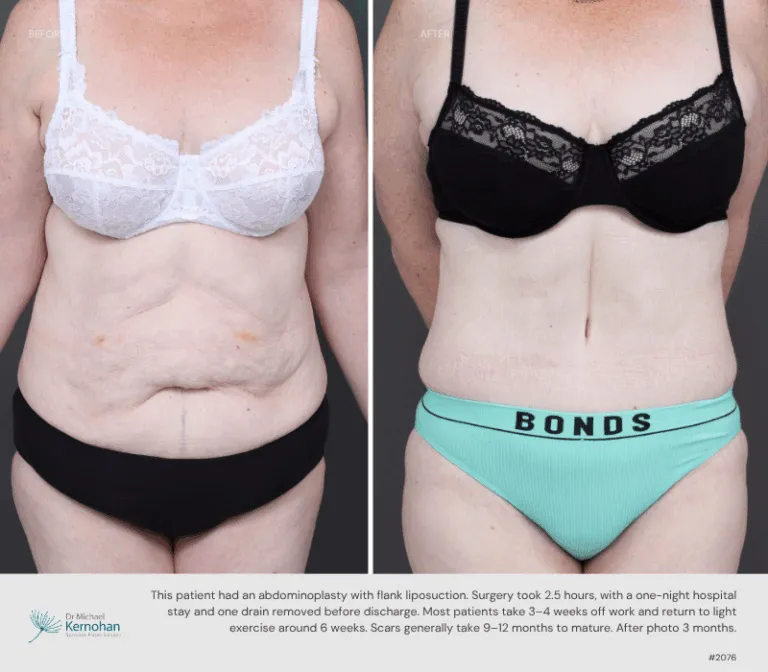


Disclaimer: All surgical or invasive procedures come with inherent risks, and results can vary widely between individuals due to factors like lifestyle, anatomy, overall health, weight, and nutrition. We encourage you to conduct thorough research and consider seeking a second opinion from a qualified healthcare provider.
Before-and-after photographs can help patients understand the range of starting anatomies and procedures used after significant weight loss.
They cannot predict another patient’s result.
Case information should clearly state:
- Which procedure was performed
- Whether surgery was staged
- Which anatomical areas were treated
- Broad timing of postoperative photographs
Differences between patients may relate to:
- Starting anatomy
- Weight history
- Scars
- Procedures performed
- Healing
- Health
- Tissue quality
Images should be interpreted as individual clinical cases rather than expected outcomes.

How Much Does Body Contouring After Weight Loss Cost in Sydney?
The cost depends on the procedures being considered.
Relevant factors can include:
- Body areas treated
- Number of operations
- Whether procedures are staged
- Operating time
- Anaesthetist fees
- Hospital or surgical facility fees
- Follow-up requirements
A personalised written estimate can be provided after consultation once the surgical plan has been established.
Body Contouring Consultations in Sydney and South-West Sydney
Dr Michael Kernohan consults at:
- Gledswood Hills, South-West Sydney
- Surry Hills, Sydney
He operates at:
- The George Centre, Gledswood Hills
- Camden Surgical Hospital, Elderslie
- St Vincent’s Hospital by request only
Patients travelling from Camden, Campbelltown, surrounding areas of South-West Sydney, the Southern Highlands or regional New South Wales should consider practical recovery planning.
This may include:
- Transport following surgery
- Accommodation where relevant
- Home support
- Follow-up travel
- Wound reviews
- Time away from work
- Caring responsibilities
These considerations can be particularly important when surgery is staged across more than one operation.
About Dr Michael Kernohan
Dr Michael Kernohan is an AHPRA-registered Specialist Plastic & Reconstructive Surgeon and Fellow of the Royal Australasian College of Surgeons, FRACS (Plast).
His qualifications include:
- MBBS – Bachelor of Medicine, Bachelor of Surgery
University of Newcastle-upon-Tyne, 2000. CLIK - MSc – Master of Science
University of Newcastle-upon-Tyne, 2007, with research in speech and swallowing. Plastic Surgery Hub - BDS – Bachelor of Dental Surgery
University of Glasgow, 1994. CLIK - MRCS – Member of the Royal College of Surgeons
Royal College of Surgeons of Edinburgh, 2003. MRCS is a postgraduate surgical qualification demonstrating achievement of the core knowledge and competencies required to progress through specialist surgical training. Royal College of Surgeons - FDSRCS – Fellow in Dental Surgery of the Royal College of Surgeons
Royal College of Surgeons of Edinburgh, 1997. This postgraduate dental surgical fellowship reflects further training and assessment beyond the primary dental degree. Royal College of Surgeons - FRCS (Plast) – Fellow of the Royal College of Surgeons in Plastic Surgery
Intercollegiate UK qualification, awarded in 2008. This denotes specialist-level surgical training and examination in Plastic Surgery within the UK system. Plastic Surgery Hub - FRACS (Plast) – Fellow of the Royal Australasian College of Surgeons in Plastic and Reconstructive Surgery
Awarded in Australia in 2016. This is the specialist surgical fellowship associated with recognised training in Plastic and Reconstructive Surgery in Australia and New Zealand.
His AHPRA registration number is MED0001208990.
Dr Kernohan consults at Gledswood Hills and Surry Hills.
His surgical practice includes plastic and reconstructive surgery of the face, breast and body, along with reconstructive procedures.
✓ Medical Review
Medically reviewed by Dr Michael Kernohan
AHPRA-registered Specialist Plastic & Reconstructive Surgeon
FRACS (Plast)
AHPRA Registration: MED0001208990
Last medically reviewed: September 2026

FAQs About Body Contouring After Weight Loss
Summary
Body contouring after significant weight loss is a surgical planning process rather than one standard operation.
Patients may have changes involving:
- Abdomen
- Lower torso
- Arms
- Thighs
- Breast or chest
- Upper body
Important considerations include:
- Weight stability
- Method of weight loss
- Previous bariatric surgery
- Nutrition
- Medical health
- Existing scars
- Blood clot risk
- Procedure sequencing
- Recovery support
- Permanent scarring
Several areas do not necessarily need to be treated during one operation.
Dr Michael Kernohan assesses which regions are affected, which procedure corresponds to each area and whether surgery should be staged before developing an individual surgical plan.
Discuss Body Contouring After Weight Loss With Dr Michael Kernohan
A consultation can help determine which areas may be suitable for surgery and how a post-weight-loss surgical plan could be structured.
Dr Kernohan can discuss:
- Weight history
- Body areas affected
- Appropriate procedure options
- Procedure order
- Staged surgery
- Previous bariatric surgery
- Relevant medical and nutritional factors
- Permanent scars
- Risks and complications
- Recovery requirements
- Home support and follow-up planning
Further Reading
- Read Dr Kernohan’s Blog on Abdominoplasty After Weight Loss – What Patients Should Know
- Read Dr Kernohan’s Blog on Recovery After Bodylift Surgery for Skin Removal
- Read Dr Kernohan’s Blog on How to Manage and Treat Bodylift Scars After Surgery
- Read more about Bra Line Backlift NSW
- Read Dr Kernohan’s Info Page on How to Stop Smoking Before Surgery: Support from Dr Michael Kernohan
- Read Dr Kernohan’s Info Page on How to Get a Medical Referral