
- Take The Quiz
- Understanding your surgical journey
- Cost of Plastic Surgery Guide
- Stage 1: Thinking About Surgery and Getting a Referral
- Stage 2: Consultation and Decision-Making
- Stage 3: Preparing for Your Operation
- Stage 4: The Day of Surgery
- Stage 5: Recovery and Follow-up
- Supporting Your Journey if You Live Outside South West Sydney
- A Simple Surgical Journey Checklist
- Bringing Your Surgical Journey Together
- Planning Your Next Step with Dr Kernohan
- FAQs About Your Surgical Journey
- Further Reading
Dr Michael Kernohan is a Specialist Plastic & Reconstructive Surgeon based in South West Sydney. He sees patients from across Sydney, regional NSW and interstate who are considering plastic or reconstructive surgery. Many people want to understand what actually happens from the moment surgery is first mentioned through to long-term follow-up. Knowing the steps in advance can make the process feel more structured and less overwhelming.
Your “surgical journey” is not just the day in the theatre. It begins when surgery is first discussed, continues through referrals, consultations, preparation, the hospital stay and recovery at home, and includes longer-term review.
Australian perioperative frameworks now describe this as a whole-of-journey approach, from the time surgery is contemplated through to recovery and ongoing care. This article outlines that journey in clear stages, using the way Dr Michael Kernohan and his team in South West Sydney usually organise care.
Take The Quiz
Understanding your surgical journey
✓ Seeing the whole path, not just the operation
Perioperative care frameworks in Australia and New Zealand describe surgery as a pathway that starts when an operation is first considered and continues until you have recovered as well as you reasonably can. This pathway includes the initial referral from your GP, consultations with Dr Michael Kernohan, pre-operative assessment, the day of surgery, time in hospital or day surgery, and follow-up visits. Each stage has its own tasks and decisions.
✓ Why planning the journey matters
When the whole journey is planned carefully, communication tends to be clearer, tests and appointments are better coordinated, and patients are more involved in decisions. NSW perioperative toolkits and checklists emphasise that good preparation and shared decision-making can help reduce delays, improve the flow of information, and support safer care. Dr Michael Kernohan’s practice in Sydney follows this approach by focusing on structured pre-operative planning, clear written information, and regular follow-up.
✓ A quick snapshot of the main stages
Your journey with Dr Michael Kernohan often follows five main stages:
- Thinking about surgery and discussing a referral with your GP
- Attending consultation appointments and deciding whether to proceed
- Preparing your health, home and support network before your operation
- Coming to hospital or day surgery on the day of your procedure
- Recovering at home and attending follow-up to monitor healing and longer-term results
Cost of Plastic Surgery Guide
Find out the cost of plastic surgery in Australia for your procedure.

Stage 1: Thinking About Surgery and Getting a Referral
✓ Starting the conversation with your GP
For most people, the surgical journey begins in their GP’s room. You might attend because of symptoms, functional problems, previous trauma, or concerns about changes in appearance after weight loss or other events. Your GP can review your general health, discuss whether a surgical option might be appropriate such as facelift surgery in Sydney, and talk about non-surgical alternatives where these exist.
✓ Why a medical referral matters
To see a Specialist Plastic & Reconstructive Surgeon, such as Dr Michael Kernohan, a valid medical referral is required. This referral summarises your history, current medications and any key test results. It also allows your GP and surgeon to stay in contact about your care. In South West Sydney and other parts of Australia, this shared approach is increasingly emphasised in perioperative guidelines as part of patient-centred care.
✓ Using this time to prepare questions
Once you have your referral and a consultation booked, it can help to start a simple list of questions. These might include what the operation is called, what it is intended to achieve, how long you may need off work, and what kind of help you might need at home. Bringing written questions to your first appointment with Dr Michael Kernohan can make that consultation more productive and less rushed.
Stage 2: Consultation and Decision-Making
✓ What happens at your first consultation
At your first consultation, Dr Michael Kernohan will review your referral, take a detailed medical history and examine the areas you are concerned about. He will ask about your overall health, past operations, medicines, allergies and any previous anaesthetic issues. Together, you will talk about what is bothering you day to day and what you are hoping surgery might address.
✓ Understanding options, risks and limitations
Part of this stage is understanding potential benefits, risks, limitations and alternatives. Australian guidelines on perioperative care and patient engagement highlight the role of shared decision-making, where your goals and concerns are considered alongside clinical evidence. Dr Michael Kernohan will explain what surgery can and cannot reasonably achieve, outline different approaches if relevant, and describe the types of risks that apply in your situation.
✓ Taking time to decide
You are not expected to decide immediately. Many patients find it useful to take written information home, talk with trusted family or friends, and then attend a second consultation. At follow-up, you can ask more detailed questions about timing, recovery, time off work, and any special preparations you may need. It is reasonable to seek a second opinion from another appropriately qualified practitioner if you wish before making a final decision.
Stage 3: Preparing for Your Operation
✓ Health checks and optimisation
Once you and Dr Michael Kernohan agree that surgery is an option, preparation begins in more detail. This often involves a GP review, blood tests, and sometimes additional investigations such as an ECG or scans, depending on your age and health. Perioperative guidelines from NSW and Queensland describe this stage as assessing and, where possible, improving health before surgery to reduce complications.
✓ Everyday habits and practical planning
You may be asked to make lifestyle changes, such as stopping smoking, reducing alcohol, adjusting exercise levels, or working with a dietitian. These steps are usually tailored to your individual situation. At the same time, you can start planning your home environment for after surgery: where you will sleep, who will drive you home, who can help with meals or caring duties, and what work or study leave you will need.
✓ Hospital pre-admission and written instructions
Many patients will also attend a hospital pre-admission clinic or receive a phone call from nursing staff. At this stage, you will be given written instructions on fasting, medicines, arrival times and what to bring. NSW perioperative toolkits emphasise that clear, written information reduces confusion and supports safer care on the day of surgery. Keeping all documents together in a folder or digital file can be very helpful.
Stage 4: The Day of Surgery
✓ Arriving at the hospital or day surgery
On the day itself, you will check in at the hospital or day surgery unit. Staff will confirm your identity, the planned procedure and your fasting status, and they will review your medications and allergies. You will change into a gown and have observations recorded. For many patients of Dr Michael Kernohan in Sydney, this part of the journey is quite structured, with staff explaining each step as it occurs.
✓ Meeting the anaesthetist and final checks
Before surgery, you will meet the anaesthetist. They will confirm your medical history, current medicines, any previous anaesthetic experiences and your airway assessment. They may talk about options such as general anaesthesia, local anaesthetic techniques or pain-relief plans for after the operation. This conversation is based on standards of perioperative medicine that emphasise risk assessment, planning and communication.
✓ Going into the theatre
In the operating theatre, the surgical and anaesthetic team will perform a series of safety checks, often using a standardised checklist. These checks are part of everyday practice in Australian hospitals and help reduce errors such as wrong-site surgery or missed information. Once these steps are completed, your anaesthetic will begin and the operation will proceed.
Stage 5: Recovery and Follow-up
✓ Immediate recovery in the hospital
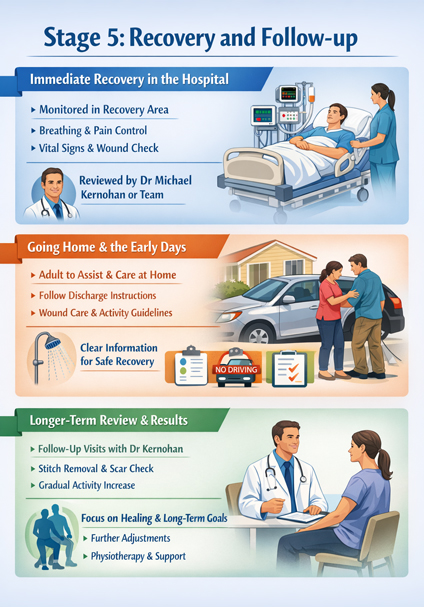
After surgery, you will move to a recovery area where nurses and anaesthetic staff monitor your breathing, circulation, pain levels and early wound status. Once you are more awake and stable, you may move to a day surgery lounge or an inpatient ward, depending on the type of operation and your individual plan. Dr Michael Kernohan or a member of his team will review you and confirm the early post-operative instructions.
✓ Going home and the early days
If you are having day surgery, you will need a responsible adult to take you home and stay with you for at least the first night. For inpatient stays, you will be discharged once certain criteria are met. At home, you will follow written instructions about wound care, activity levels, showering, driving and when to seek help. Queensland and NSW perioperative resources note that clear discharge information is central to reducing unplanned readmissions and supporting smoother recovery.
✓ Longer-term review and results
Follow-up appointments with Dr Michael Kernohan in South West Sydney allow your wounds, scars and function to be monitored. Stitches may be removed, dressings adjusted, and activity levels gradually increased. Over time, the focus shifts from early healing to longer-term outcomes, including any need for further adjustments or supportive therapies such as physiotherapy. At each stage, you are encouraged to raise questions and mention any changes or concerns.
Supporting Your Journey if You Live Outside South West Sydney
✓ Planning around distance and travel
Some patients travel from regional NSW, the ACT or cities such as Melbourne to see Dr Michael Kernohan. In these cases, your journey needs extra planning. You may need to group appointments together, arrange accommodation near the hospital, and consider how long you should stay locally after surgery before travelling home. Perioperative frameworks now recognise the role of virtual care and telehealth in supporting people who live further away.
✓ Working with your local GP and health services
Your local GP remains an important part of your care, even if surgery takes place in South West Sydney. Information can be shared between Dr Kernohan and your GP so that dressings, medications and longer-term health issues are managed close to home where possible. In some cases, local imaging or blood tests can be arranged near where you live, with results sent to Dr Kernohan for review.
A Simple Surgical Journey Checklist
Three key planning steps you can review with your team
A single high-level checklist can help you, your GP, your support person, and Dr Michael Kernohan stay aligned:
- Before surgery is booked, make sure you understand the name of your procedure, why it is being considered, what alternatives exist, and what the main risks and limitations are, and bring written questions to your consultations in South West Sydney.
- In the weeks before surgery, work with your GP on health checks, any lifestyle changes that have been suggested, and the management of regular medicines, while also arranging support at home, transport, time off work or study, and accommodation if you are travelling.
- Around the day of surgery, follow fasting and medication instructions exactly as written, keep your hospital paperwork together, ensure your support person knows when and where to collect you, and attend all planned follow-up visits so that your recovery can be monitored and any concerns addressed early.
Bringing Your Surgical Journey Together
✓ Seeing your care as a connected pathway
Your surgical journey is more than a date on a calendar. It is a connected pathway that starts when surgery is first discussed and continues through preparation, the day in theatre, early recovery and longer-term review. National and state perioperative frameworks now describe this joined-up view as a key part of modern surgical care.
✓ How Dr Michael Kernohan’s team supports this approach
In Sydney, Dr Michael Kernohan and his team focus on planning each stage with you rather than treating the operation as an isolated event. This includes clear information at consultation, coordination with your GP, structured pre-operative assessment, and a follow-up plan that reflects your home situation, work, caring responsibilities and travel. Whether you live close to Gledswood Hills and Campbelltown or travel from interstate, the aim is a journey that feels organised, honest and well-explained.
Planning Your Next Step with Dr Kernohan
✓ Talking through your own surgical journey
Every surgical journey is individual. Your health, work, family responsibilities and location all shape how the pathway looks in practice. If you would like to explore what your own journey might involve with Dr Michael Kernohan, Specialist Plastic & Reconstructive Surgeon in South West Sydney, you can contact the team through the contact page to arrange an appointment and discuss your situation in more detail.
✓ Starting with an online photo assessment
Site visitors can discreetly present their concern online. If you would rather begin with an online review, you can use the complimentary photo assessment form on Dr Kernohan’s website. By sharing images and background information, you allow the team to consider whether a face-to-face consultation may be appropriate and what kinds of options could be discussed at a later visit. This can be a practical first step, especially if you are travelling from outside South West Sydney or from another state such as Victoria.
FAQs About Your Surgical Journey

Further Reading
- Read more about Facial Surgery
- Read more about Breast Surgery
- Read more about Body Surgery
- Read more about Will Medicare cover my surgery?
- Read more about Can Super Help Pay for Surgery?
- Plastic Surgery Pricing and Fees