

- Understanding Neck Lift Incisions
- Download Dr Kernohan’s Facelift Surgery Guide
- Common Incision Locations in Neck Lift Surgery
- Aesthetic Considerations – How Incisions Are Hidden
- Functional and Safety Considerations
- Facelift Before and After Photos
- Healing, Scars and What to Expect
- Take The Quiz
- How Dr Michael Kernohan Plans Neck Lift Incisions in Sydney
- Neck Lift Incision Placement FAQs
- Considering a Neck Lift? Take the Next Steps With Dr Michael Kernohan
- Further Reading
When people start looking into neck lift surgery, one of the most common questions is, “Where are the cuts made – and will people see them?”
In Sydney, Dr Michael Kernohan, Specialist Plastic & Reconstructive Surgeon, finds that thoughtful discussion about neck lift incisions often helps patients feel more settled than any “before and after” photos. Understanding where incisions are placed, why they are needed, and how scars usually behave is an important part of preparing for surgery.
This article explains, in plain language, how neck lift incisions are planned, what they allow the surgeon to do, and what you can realistically expect from healing. It is general information only and does not replace a personal consultation with Dr Michael Kernohan in Sydney.
Understanding Neck Lift Incisions
✓ What A Neck Lift Is Actually Doing
A neck lift (sometimes called lower rhytidectomy, cervicoplasty or platysmaplasty) is an operation that changes the way the neck and jawline look by working on skin, muscle and fat underneath the chin and along the front of the neck. The American Society of Plastic Surgeons notes that neck lift surgery can address extra fat under the chin, loose neck skin and visible muscle bands.
To reach those structures safely, the surgeon needs openings in specific places. These openings are the incisions. They are planned so the surgeon can see and adjust the deeper layers, then close the skin in a way that aims to blend scars into natural folds and hair-bearing areas.
✓ How Neck Lift Incisions Differ From Facelift Incisions
A neck lift can be done on its own, or together with a facelift. When it is combined with a facelift, many of the incisions around the ear and hairline are shared. When the neck is treated on its own, the pattern can be more focused: often a small incision under the chin, sometimes combined with shorter cuts behind the ears. The Aesthetic Society’s neck lift guidance describes a common pattern of a submental (under-chin) incision plus limited incisions behind each ear.
In Sydney, Dr Michael Kernohan will explain whether your neck concerns are best treated with neck-only incisions, or as part of a broader lower face and neck approach.
Download Dr Kernohan’s Facelift Surgery Guide
Common Incision Locations in Neck Lift Surgery
✓ Under-Chin (Submental) Incision

The submental incision is a short cut made in the natural crease just under the chin, where the chin meets the upper neck. This is a standard opening described in university and specialist neck lift guides.
From this point, the surgeon can:
- Remove or reshape local fat under the chin if needed.
- Tighten or “gather” the thin neck muscle (platysma) if it has separated in the middle, creating vertical bands.
- Work on deeper tissue to change the angle between the chin and the neck.
Because the incision sits in a shadow line, it is usually less obvious in everyday conversation once it has healed, especially when people are talking to you face-to-face.
✓ Incisions Around The Ear And Hairline
When extra skin needs to be removed or the neck changes run into the jawline and lower face, neck lift incisions may also be placed around the ear and into the hairline. ASPS describes a traditional neck lift incision that starts in the hairline near the sideburn, runs around the ear and then into the hair at the back of the head.
These incisions allow Dr Michael Kernohan to:
- Free and reposition skin and deeper tissues along the jaw and upper neck.
- Remove extra skin in a controlled way so it can be closed without strong drag on the earlobe or hairline.
- Tuck scars into natural creases and hair-bearing areas, which usually makes them less noticeable over time.
For many patients in their 40s–60s in Sydney, this “around-the-ear” pattern is part of a combined lower face and neck plan, rather than a neck-only procedure.
✓ Limited-Incision Neck Lift
In some people, the main concern is fullness directly under the chin or early changes in neck contour, with fewer issues around the jawline. In these cases, a limited-incision neck lift may be considered. The Aesthetic Society notes that this can involve a submental incision alone, or a submental incision plus short cuts behind the ears, depending on what needs to be addressed.
A limited pattern may mean shorter scars, but it also gives less access to certain areas. In your consultation, Dr Michael Kernohan will explain whether a limited approach is realistic for you, or whether your neck concerns require the access provided by more extensive incisions.
Aesthetic Considerations – How Incisions Are Hidden
✓ Working With Natural Lines, Folds And Hair
Neck lift incisions are planned to sit where your eye expects to see a line anyway. Around the ear, this often means hiding cuts in the crease in front of the ear, along the fold behind the ear, and within the hairline.
Under the chin, the incision is tucked into the existing crease between the chin and neck. Written descriptions and diagrams from specialist neck lift centres show how this position uses natural shadow to disguise the line once it has settled.
When Dr Michael Kernohan plans surgery in Sydney, he looks at how you usually wear your hair, how your sideburns and beard (if present) grow, and how visible your under-chin area is in day-to-day life. This helps him choose the path that is least likely to draw attention once healed.
✓ Protecting The Ear And Hairline
Around the ear, incisions must be planned so that the shape of the earlobe and the junction between cheek and ear stay in proportion after surgery. Reviews of neck and facelift complications describe problems such as “pixie ear”, where the earlobe is pulled down and stuck to the cheek, often linked with tight closure and poorly balanced skin removal.
Similarly, incisions in the hairline need to respect the direction of hair growth. If hair-bearing skin is pulled too far, it can move sideburns or create patches of thin hair. This is why incision design is tailored; there is no single line that suits every patient.
In Sydney, Dr Michael Kernohan pays particular attention to these details in patients in their 40s–60s, when hair density, greying and hairline shape may already be changing.
Functional and Safety Considerations
✓ Access To Deeper Structures
The aim of a neck lift is not only to tighten the skin. Modern neck lift techniques, described in plastic surgery journals and major health-system guides, work on several layers: fat above and below the platysma muscle, the platysma itself, and sometimes deeper structures.
Incisions are positioned to give safe access to these layers. The under-chin cut allows the surgeon to meet the two edges of the platysma in the midline, adjust them and support the neck angle. Incisions behind the ear allow skin and deeper tissues to be freed and re-draped without placing too much strain on any one edge.
✓ Protecting Nerves And Blood Supply
Important nerves that move the lower face and provide feeling to the ear and neck lie close to the operative field. Systematic reviews of neck lift and facelift techniques emphasise that surgeons work within known “safe planes” and use incisions that allow good visibility so these structures can be protected.
Similarly, blood vessels under the skin must be handled gently. Adequate exposure through well-placed incisions helps reduce the risk of a blood collection (haematoma) or skin-healing problems, both of which are recognised facelift and neck lift risks.
In his Sydney practice, Dr Michael Kernohan will talk honestly about these risks, how incision planning supports safety, and what is done before, during and after surgery to monitor and manage them.
✓ Balancing Incision Length And Tension
A common question is, “Can you do the same job with a shorter cut?” Sometimes the answer is YES – but not always. Articles on neck lift incision placement note that very short incisions can restrict what can be done underneath, which may lead to more tension on the skin, or less thorough treatment of the neck.
When there is a lot of extra skin, or when both the neck and lower face are being treated, a somewhat longer incision, carefully hidden, may actually heal more quietly than a short one that has to carry more pull. This is one of the key functional trade-offs that Dr Michael Kernohan will explain during your consultation in Sydney.
Facelift Before and After Photos
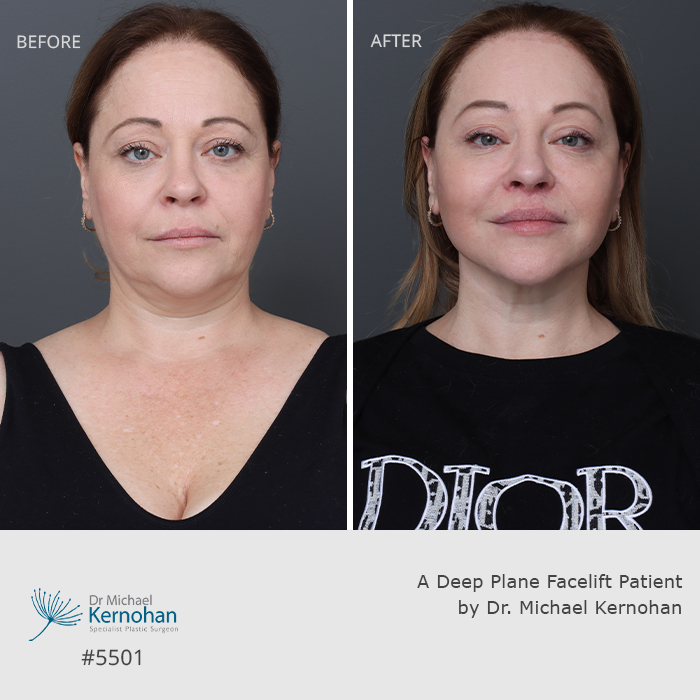
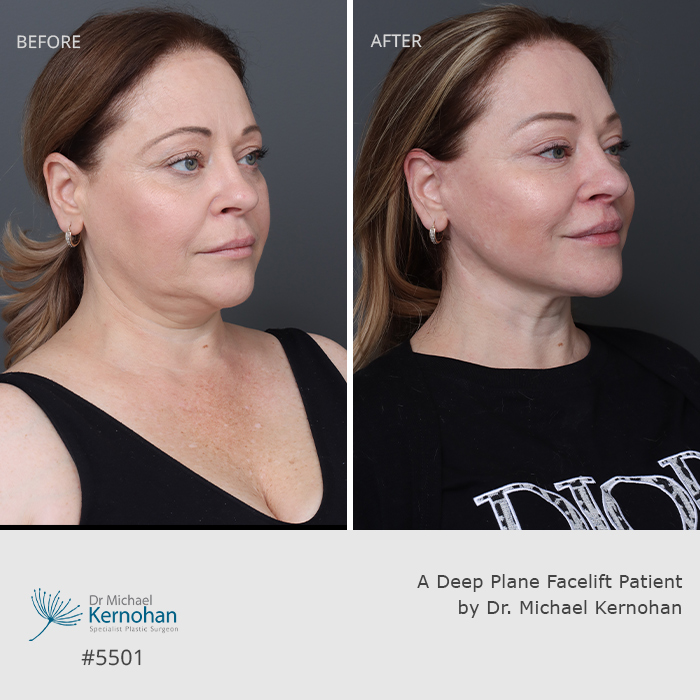
Disclaimer: All surgical or invasive procedures come with inherent risks, and results can vary widely between individuals due to factors like lifestyle, anatomy, overall health, weight, and nutrition. We encourage you to conduct thorough research and consider seeking a second opinion from a qualified healthcare provider.
Healing, Scars and What to Expect
✓ How Long Neck Lift Incisions Take To Settle
ASPS and other reputable bodies explain that neck lift incision lines usually look pink and firm at first, then soften and fade over time. It can take several weeks for swelling to settle and up to six months or more for incision lines to mature.
Scars are permanent, but most people find that, once they have flattened and lightened, they are hard to see at normal conversational distance, especially when they are tucked into creases and hair-bearing areas. An Australian government-backed resource on facelift and neck surgery makes the same point: scarring is expected, but it usually fades.
✓ Individual Scar Behaviour
Everyone heals differently. NHS and hospital scar-care leaflets describe how some people form thicker or raised scars (hypertrophic or keloid), even after small cuts or piercings.
If you, or close family members, have had this kind of scarring in the past, it is important to tell Dr Michael Kernohan before surgery. He can then:
- Factor this into the discussion about risks and benefits.
- Plan incision placement with this in mind.
- Discuss possible scar-management options if needed later on.
A high-trust approach means being upfront that no surgeon can promise a particular neck scar outcome. The goal is to reduce avoidable risk, not to pretend that scars will vanish.
Take The Quiz
How Dr Michael Kernohan Plans Neck Lift Incisions in Sydney
In a consultation with Dr Michael Kernohan, Specialist Plastic & Reconstructive Surgeon in Sydney, incision planning is part of a broader discussion, not a quick sketch at the end.
He will examine your neck, jawline, ear position, hairline and under-chin area with you seated upright. This is important because gravity and skin drape are different compared with lying down, and surgical texts emphasise that upright marking improves incision placement.
Your weight history, past surgery, scar history, job and hobbies are all part of the picture. For example, someone who often wears their hair up or has very short hair may prioritise the way scars sit around the ear and hairline. Someone who does a lot of online video calls may be more focused on the under-chin area.
Rather than offering a fixed “template”, Dr Michael Kernohan explains the options: whether your neck is likely to need a submental incision only, a submental incision plus short cuts behind the ears, or a longer pattern shared with a lower facelift. Each choice has pros and cons. The aim is to match the incision plan to your anatomy and to the amount of change you are hoping for, while staying within a realistic and medically responsible range.

Neck Lift Incision Placement FAQs
Considering a Neck Lift? Take the Next Steps With Dr Michael Kernohan
If you are thinking about neck lift surgery and want clear, transparent information about incisions and scars, the most helpful step is a detailed consultation.
Meeting Dr Michael Kernohan, Specialist Plastic & Reconstructive Surgeon in Sydney, gives you the chance to:
- Explain what bothers you about your neck and jawline.
- Have your neck, under-chin area, ears and hairline assessed in person.
- See how incision lines would be mapped for your anatomy.
- Discuss risks, healing time and realistic scar behaviour in a calm, unhurried way.
You can bring old and recent photos, a list of medicines, and written questions about neck lift incisions, scars and recovery. Check out the contact page or the complimentary photo assessment page where you can send enquiries, photos and appointment requests. The aim is informed, steady decision-making – not pressure.
Further Reading
- Read more about Partial Neck Lift Sydney
- Read more about Deep Plane Facelift NSW
- Read more about Partial Facelift Surgery NSW
- Read more about Chin Surgery Sydney NSW
- Read Dr Kernohan’s Blog on Jaw Profile – How to Increase the Contour of your Jaw
- Read Dr Kernohan’s Blog on Neck Lift Options – Types of Neck Lift Surgery
- Read Dr Kernohan’s Blog on How to Prepare for Necklift Surgery
- Read Dr Kernohan’s Blog on Managing and Treating Necklift Scars
- Read Dr Kernohan’s Blog on Neck Lift Recovery Tips for a Better Result

Male Neck Lift Considerations – Why Techniques Differ for Men
Introduction Dr Michael Kernohan is a Specialist Plastic & Reconstructive Surgeon in Sydney. Male neck…

Neck Lift vs Lower Facelift – Which Option Is Right for Different Patients?
Dr Michael Kernohan is a Specialist Plastic & Reconstructive Surgeon in Sydney. A neck lift…

Managing Subplatysmal Fat During Neck Lift Surgery
Dr Michael Kernohan, Specialist Plastic & Reconstructive Surgeon in Sydney, assesses the neck in layers…