

- Take The Quiz
- How the Neck Responds to Weight Changes
- Download Dr Kernohan’s Facelift Surgery Guide
- Weight Gain and Neck Appearance
- Weight Loss and Neck Appearance
- Where Neck Lift Surgery Fits In
- Facelift Before and After Photos
- Neck Appearance and Weight in Your 40s, 50s and 60s
- Practical Ways to Support Your Neck With Weight Changes
- Weight and Neck Appearance FAQs
- Next Step: Discuss Neck and Weight Changes With Dr Michael Kernohan
- Further Reading
Many people in their 40s, 50s and 60s notice the same thing in photos: even when they feel quite healthy, the neck can look heavier or looser than it used to. Changes in weight often make this more noticeable.
In Sydney, Dr Michael Kernohan, Specialist Plastic & Reconstructive Surgeon, regularly sees patients who say, “My weight goes up and down and my neck shows it first,” or “I’ve lost weight, but I still have a full neck.” On his neck lift information pages, he explains that the neck is very sensitive to both fat distribution and skin quality, and that age, lifestyle and weight history all play a role.
This article explains how weight gain and weight loss affect neck appearance, how this links with neck lift surgery, and what people in the 40–60 age group in Sydney and Melbourne can discuss with Dr Michael Kernohan in Sydney. It is general information only and does not replace a personal consultation.
Take The Quiz
How the Neck Responds to Weight Changes
✓ The neck, submental fat and skin
Under the chin and along the front of the neck is a pocket of fat called submental fat. Extra body weight can increase fat in this area, just as it does around the waist or hips. Patient-education and dermatology articles describe how this “double chin” or submental fullness can give the neck a heavier outline and soften the angle between the jaw and the neck.
At the same time, the neck skin is thin and mobile. Over time, the skin’s collagen and elastin reduce. This age-related change has been shown to make the skin less able to “spring back” after stretching. When weight goes up and down, the neck skin must constantly adapt to different volumes of fat and soft tissue underneath.
In Sydney, Dr Michael Kernohan sees this often in patients who have had several cycles of weight gain and loss through their 40s and 50s. Even when they reach a healthier weight, the neck may still look fuller or looser than they expect.
✓ Age, elasticity and the 40–60 age group
In the 40–60 age group, natural ageing and weight changes usually happen together. Research on submental fullness shows that age on its own can reduce skin firmness and muscle tone in the neck, regardless of body weight.
This means that by midlife:
- Extra weight can show quickly under the chin and along the jawline.
- After weight loss, skin may not tighten as much as it once did.
- The thin neck muscle (the platysma) can start to form visible bands.
For many people in Sydney and Melbourne, this is the stage where they begin to think about neck lift surgery with a Specialist Plastic & Reconstructive Surgeon such as Dr Michael Kernohan in Sydney.
Download Dr Kernohan’s Facelift Surgery Guide
Weight Gain and Neck Appearance
✓ How extra weight changes the neck profile
When you gain weight, fat cells increase in many parts of the body, including the neck. Information on submental fullness explains that weight gain can add volume beneath the chin and along the front of the neck, which may:
- Blur the line between the jaw and neck.
- Make the chin look shorter in profile.
- Emphasise a soft fold or “second” chin in photos.
Not everyone is affected in the same way. Genetics, body shape and where you naturally tend to store fat all play a role. Some people gain weight mainly around the middle, while others notice even small weight changes under the chin and jaw.
✓ Why the neck can look heavier even at a “normal” weight
Several sources on double chin causes note that submental fullness is not always a sign of being generally overweight. It can appear in people whose overall weight is within a healthy range if their neck and jaw structure, genetics and skin quality all tend to hide the natural angle under the chin.
Patients in their 40s and 50s often tell Dr Michael Kernohan that they have improved their lifestyle, but their neck still looks heavier than they feel it should for their weight. In these cases, he looks at the neck as a combination of:
- Local fat distribution under the chin.
- Skin elasticity after years of sun and movement.
- The position and tone of the platysma muscle.
Understanding which of these is most important helps guide whether lifestyle change alone is likely to help, or whether neck lift surgery could be considered.
Weight Loss and Neck Appearance
✓ What happens to the neck with gradual weight loss
Guides on submental fat and double chin management explain that when weight loss is gradual, the volume of fat in the neck usually reduces along with the rest of the body. This can make the jawline clearer and reduce a heavy fold under the chin.
However, in the 40–60 age group, the skin and soft tissues have been stretched and relaxed many times over the years. If the skin’s elasticity is reduced, it may not fully tighten to match the smaller volume underneath. That can leave:
- Loose folds in the front of the neck.
- Fine creases or “accordion” lines.
- More visible vertical muscle bands.
People in Sydney who have lost a steady amount of weight often tell Dr Michael Kernohan that they feel better overall but are more self-conscious about their neck in photos, especially in side profile.
✓ Rapid weight loss and “Ozempic neck”
Over the last few years, there has been a lot of discussion in the media about rapid weight loss from powerful weight-loss injections, sometimes called “fat jabs” or GLP-1 medicines. Reports describe a pattern where people, especially in midlife, lose facial and neck fat quickly, but the skin does not have time to adapt.
This has led to informal terms such as “Ozempic neck” to describe an older-looking or more deflated neck after fast weight loss. While this is not a formal medical diagnosis, it reflects a real issue: rapid changes in weight can leave the neck skin and soft tissues with less support, particularly when collagen levels are already reduced by age.
In patients seeing Dr Michael Kernohan in Sydney, the focus is on understanding how quickly weight has changed, how long it has been stable, and whether the neck concerns are due mainly to skin, fat, muscle, or a mix of these.
✓ Why a double chin can remain after weight loss
Several recent articles on double chin and weight loss point out that even with good lifestyle change, a full neck can persist because of:
- Remaining pockets of stubborn submental fat.
- Loose skin that has stretched and not tightened fully.
- Muscle and ligament changes in the neck that come with age.
This is why some people still see a “soft” neck or double chin after losing weight, especially in their 40s and 50s. In these cases, neck lift surgery or related procedures may be discussed as options, once weight has been stable for a period of time.
Where Neck Lift Surgery Fits In
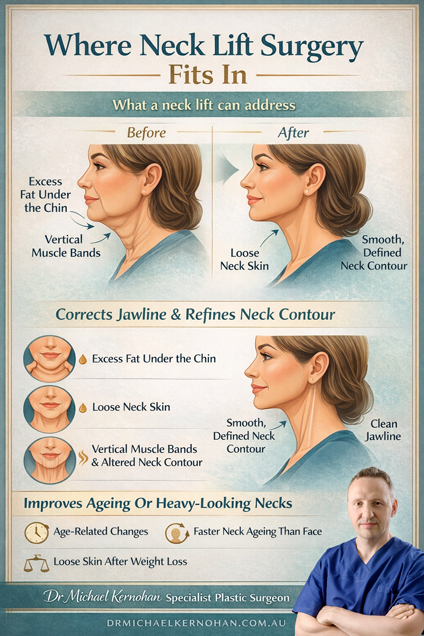
✓ What a neck lift can address
A neck lift (sometimes called a lower rhytidectomy or platysmaplasty) is an operation that alters the appearance of the neck and jawline. Patient information from the American Society of Plastic Surgeons and other reputable centres explains that neck lift surgery can address:
- Excess fat under the chin.
- Loose neck skin.
- Vertical muscle bands and altered neck contour.
On his neck lift page, Dr Michael Kernohan describes neck lift surgery as a way to change an ageing or heavy-looking neck and improve the outline of the chin and jawline. He notes that this can be helpful in people with age-related changes, in those who feel the neck has aged faster than the face, and in some who have lost weight and are concerned about loose skin.
In Sydney, he tailors the operation to the patterns he sees in your neck: sometimes focusing more on skin and muscle; in other cases, on localised fat or a combination.
✓ Neck lift and weight stability
Information from Australian and international neck lift resources highlights that people who have had major weight loss may be more likely to have loose skin on the neck and may benefit from a neck lift once their weight is steady.
From a planning point of view, stable weight before and after neck lift surgery is important because:
- Further weight loss afterwards can reveal more looseness than expected.
- Significant weight gain can add fat back under the chin and around the neck, softening the result.
When you see Dr Michael Kernohan in Sydney, he will ask about your weight history and current plans. For many people in the 40–60 age group, he advises aiming for a steady, sustainable weight before neck lift surgery is considered.
Facelift Before and After Photos
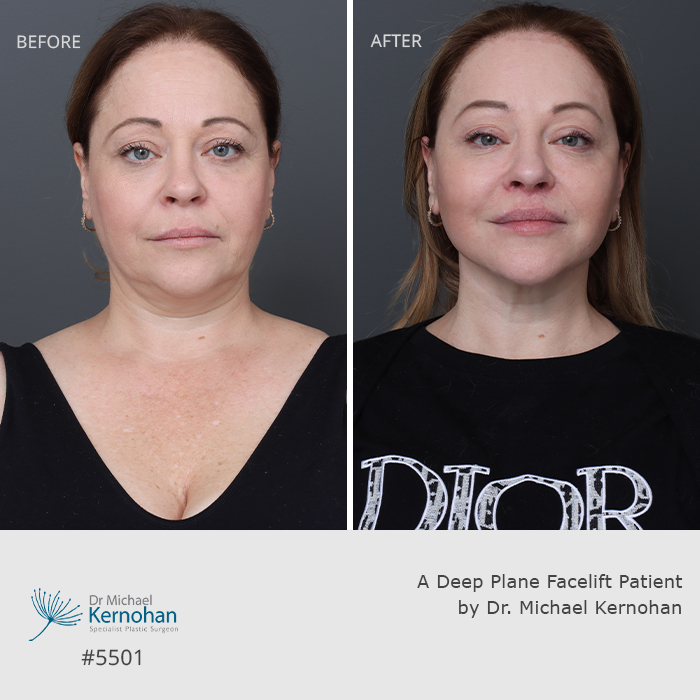
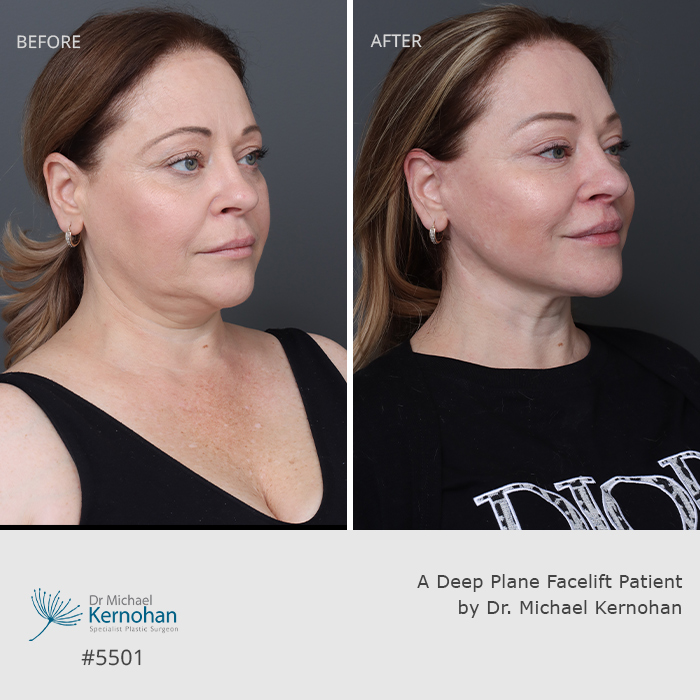
Disclaimer: All surgical or invasive procedures come with inherent risks, and results can vary widely between individuals due to factors like lifestyle, anatomy, overall health, weight, and nutrition. We encourage you to conduct thorough research and consider seeking a second opinion from a qualified healthcare provider.
Neck Appearance and Weight in Your 40s, 50s and 60s
✓ Common patterns in midlife
By the time people reach their 40s and 50s, they often notice several overlapping changes:
- Old photos show a sharper angle under the chin than now.
- The neck looks heavier after even small weight gains.
- After weight loss, the neck may look “deflated” rather than firm.
Studies on submental fullness and ageing necks describe this as the combined effect of fat distribution, reduced collagen, muscle banding and gravity over time.
In Sydney, Dr Michael Kernohan often reviews patients who have been through years of gradual weight change, pregnancies, shift work and busy family life. Their main wish is not to look radically different, but to have a neck that is more in line with how they feel for their age and activity level.
✓ Lifestyle factors in Sydney and Melbourne
Australian life can be tough on the neck. Many people:
- Spend long hours at computers or on phones, which can encourage a forward-head posture that blunts the jawline.
- Live in strong sun, which affects skin quality over the years.
- Have social and work lives that involve regular photos and video calls, where the neck is very visible.
These factors do not replace the effects of weight, but they add to the overall picture. When Dr Michael Kernohan assesses neck appearance in Sydney, he considers posture, sun exposure and daily habits along with weight.
Practical Ways to Support Your Neck With Weight Changes
Even if you are considering or have had neck lift surgery with Dr Michael Kernohan, day-to-day choices still matter. Articles on double chin and submental fullness suggest that general measures can help support the neck over time, even if they cannot fully replace surgery in someone with advanced changes.
A steady weight based on balanced nutrition and regular movement supports your neck in the same way it supports your heart and joints. Large, repeated swings in weight are harder on the skin and soft tissues than smaller, steadier shifts. In the 40–60 age group, where skin elasticity is already lower, this becomes more important.
Good posture helps by keeping the head in a neutral position rather than pushed forward. This can reduce constant folding of the skin at the front of the neck, which some studies link with earlier lines and skin changes.
Skin care and sun protection also play a role. Australian guidelines on sun safety stress covering the neck with clothing, hats and sunscreen to reduce both cancer risk and visible ageing. After neck lift surgery, Dr Michael Kernohan usually encourages long-term sun protection for the neck and around the ears, to help scars settle and to slow ongoing change in the skin.
Finally, avoiding smoking and limiting heavy alcohol intake support the small blood vessels and collagen in the skin. Plastic surgery and lifestyle research consistently link these habits with later, more noticeable changes in the neck and lower face.

Weight and Neck Appearance FAQs
Next Step: Discuss Neck and Weight Changes With Dr Michael Kernohan
If weight changes have left you with concerns about your neck – whether it feels heavier than it used to, or looser after weight loss – a personalised assessment is often the most useful next step.
A consultation with Dr Michael Kernohan, Specialist Plastic & Reconstructive Surgeon in Sydney, gives you the chance to:
- Talk through your weight history and what bothers you most about your neck and jawline.
- Have your skin, fat and muscle pattern assessed in detail.
- Hear how weight stability, lifestyle and neck lift surgery may interact in your situation.
- Plan any next steps at a pace that fits your health, work and family life.
You can bring old and recent photos, a list of medicines and written questions. The clinic contact page and complimentary photo assessment page are excellent avenues for sending enquiries and scheduling appointments. The aim is careful, honest planning so that any decision about neck lift surgery takes account of both your weight journey and your long-term health.
Further Reading
- Read more about Partial Neck Lift Sydney
- Read more about Deep Plane Facelift NSW
- Read more about Partial Facelift Surgery Sydney
- Read more about Facelift Surgery Sydney
- Read Dr Kernohan’s Blog on Neck Lift Options – Types of Neck Lift Surgery
- Read Dr Kernohan’s Blog on How to Prepare for Necklift Surgery
- Read Dr Kernohan’s Blog on Managing and Treating Necklift Scars
- Read Dr Kernohan’s Blog on Neck Lift Recovery Tips for a Better Result

High-SMAS vs Deep-Plane Approaches in Neck Lift Surgery
Why Technique Matters In Neck Lift Surgery When planning a neck lift – especially in…

Incisions in a Neck Lift – Where They Are Placed and Why
When people start looking into neck lift surgery, one of the most common questions is,…
How Weight Changes Affect Neck Appearance
Many people in their 40s, 50s and 60s notice the same thing in photos: even…