

- What Is Subplatysmal Fat, and Why Does It Matter During Neck Lift Surgery?
- What Is Subplatysmal Fat?
- How Does Subplatysmal Fat Affect the Neck?
- How Is Subplatysmal Fat Different From Superficial Neck Fat?
- Why Does the Fat Layer Matter in Surgery?
- Why Can Subplatysmal Fat Matter During Neck Lift Surgery?
- Can Subplatysmal Fat Be the Reason Liposuction Is Not Enough?
- How Does Dr Michael Kernohan Assess Deeper Neck Fullness?
- What Patient History Matters During Assessment?
- When May Subplatysmal Fat Be Managed During Surgery?
- When May Deeper Fat Management Not Be Needed?
- How Is Subplatysmal Fat Managed During Neck Lift Surgery?
- Why Is the Under-Chin Incision Sometimes Used?
- Why Is Conservative Planning Important?
- What Can Happen if Too Much Deeper Fat Is Removed?
- What Role Do the Platysma Muscle and Deeper Neck Structures Play?
- Can the Platysma Muscle Affect Under-Chin Fullness?
- Can Deeper Neck Structures Always Be Reduced?
- Can Subplatysmal Fat Be Treated With Liposuction Alone?
- Why Is “Neck Fat” Not One Single Issue?
- How Does Subplatysmal Fat Affect Neck Lift Planning After 40, 50 or 60?
- What Risks and Limitations Should Patients Understand?
- What Are the Limitations of Deeper Fat Management?
- What Is Recovery Like When Deeper Neck Fat Is Addressed?
- What Aftercare May Be Needed?
- What Alternatives Should Patients Consider?
- Download Dr Kernohan’s Facelift and Neck Lift Surgery Guide
- Who May Be Suitable for Subplatysmal Fat Management During Neck Lift Surgery?
- Who May Not Be Suitable?
- Facelift Before and After Photos
- Are Costs Relevant When Deeper Neck Lift Planning Is Needed?
- Summary
- Subplatysmal Fat Management FAQs
- Next Step: Discuss Subplatysmal Fat and Neck Lift Surgery With Dr Kernohan
- Take the Quiz
- Further Reading
Dr Michael Kernohan, Specialist Plastic & Reconstructive Surgeon in Sydney, assesses the neck in layers when planning neck lift surgery. This is important because fullness under the chin or in the upper neck is not always caused by loose skin or surface fat alone.
Subplatysmal fat is deeper fat that sits beneath the platysma muscle in the neck. In selected patients, it may contribute to central neck fullness, under-chin fullness or a neck contour that does not match what would be expected from skin laxity alone.
Many patients ask whether neck fullness can be treated with liposuction, a neck lift or a combined face and neck procedure. The answer depends on what is causing the fullness. Superficial fat, subplatysmal fat, platysma bands, skin laxity, jawline structure and lower-face descent can all play a role.
This article explains what subplatysmal fat is, how it differs from superficial neck fat, why it matters during neck lift planning and when it may be managed surgically. It is general information only and does not replace a personal consultation with Dr Michael Kernohan.
What Is Subplatysmal Fat, and Why Does It Matter During Neck Lift Surgery?
Subplatysmal fat is deeper fat located beneath the platysma muscle in the neck. It may contribute to fullness under the chin or in the central upper neck, and it requires different planning from surface fat or loose skin.
- Subplatysmal fat sits below the platysma muscle.
- It is deeper than the fat usually treated with standard neck liposuction.
- It may contribute to under-chin fullness in selected patients.
- It is not the cause of neck fullness in every patient.
- It requires careful assessment because deeper neck structures are nearby.
- Management may be considered during neck lift surgery when clinically appropriate.
- Removing too much deeper tissue can create contour problems or other risks.
Subplatysmal fat is only one possible reason for fullness in the neck. Dr Michael Kernohan assesses the neck, jawline, lower face and deeper anatomy before discussing whether it should be addressed.
What Is Subplatysmal Fat?
Subplatysmal fat is fat that sits below the platysma muscle in the neck. The platysma is a thin sheet-like muscle that lies under the skin and superficial fat, extending across the front and sides of the neck.
- Superficial neck fat sits above the platysma muscle.
- Subplatysmal fat sits below the platysma muscle.
- It is usually located in the central neck and under-chin region.
- It can contribute to fullness beneath the chin in selected patients.
- It cannot be properly assessed by looking at skin alone.
Subplatysmal fat is deeper than the fat many patients think of when they ask about under-chin fullness. Because it sits beneath the muscle layer, it usually requires a different surgical approach from superficial fat.
How Does Subplatysmal Fat Affect the Neck?

Subplatysmal fat may affect the neck by adding fullness beneath the platysma muscle. This can make the upper neck or area under the chin look fuller even when the skin itself is not the main issue.
- It may create central fullness under the chin.
- It may reduce definition between the chin and upper neck.
- It may be present with platysma banding.
- It may be present with superficial fat or loose skin.
- It may contribute to a neck concern that does not respond to skin-only planning.
Not every patient with a full neck has subplatysmal fat that needs surgery. Dr Michael Kernohan assesses whether the fullness is superficial, deep, muscular, skin-related or linked to the lower face.
How Is Subplatysmal Fat Different From Superficial Neck Fat?
Subplatysmal fat is different from superficial neck fat because it sits in a deeper layer of the neck. Superficial fat sits between the skin and platysma muscle, while subplatysmal fat sits underneath the platysma.
- Superficial fat may be accessible to liposuction in selected patients.
- Subplatysmal fat is deeper and closer to important neck structures.
- Superficial fat can often be assessed by skin pinch and contour.
- Subplatysmal fat needs careful clinical assessment.
- Both types of fat may be present at the same time.
This distinction matters because “neck fat” is not one single problem. A treatment that is suitable for superficial fullness may not address deeper fullness, loose skin or muscle banding.
Why Does the Fat Layer Matter in Surgery?
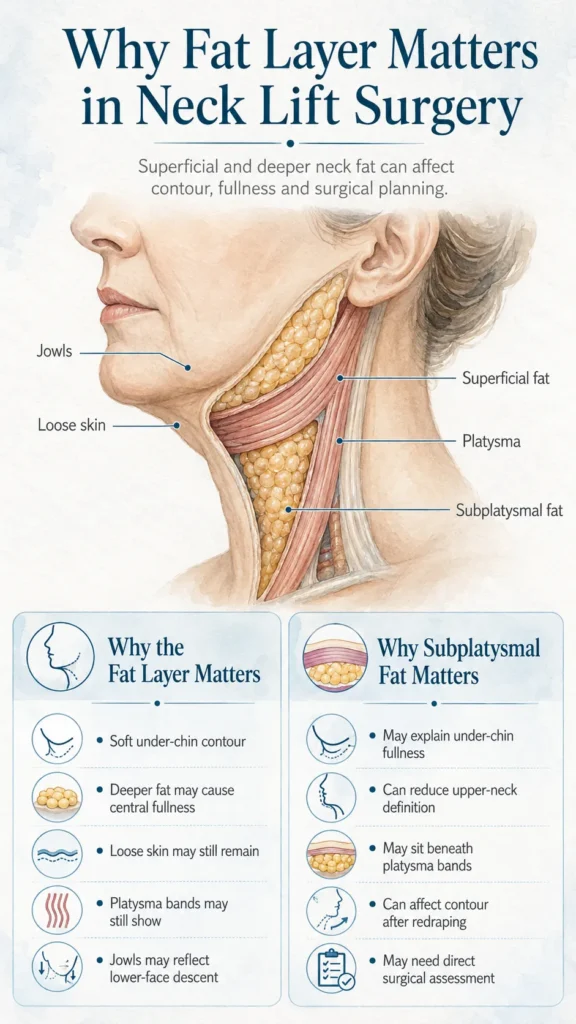
The fat layer matters because different layers require different techniques and carry different risks. Treating the wrong layer may lead to limited improvement, contour irregularity or unnecessary risk.
- Superficial fat can contribute to a soft under-chin contour.
- Deeper fat may contribute to central fullness beneath the muscle.
- Loose skin may remain even if fat is reduced.
- Platysma bands may remain if muscle laxity is not addressed.
- Jowls may remain if lower-face descent is the main issue.
Dr Michael Kernohan explains these differences during consultation so patients understand why a procedure must be matched to anatomy. This helps avoid the assumption that liposuction, skin removal or deeper fat management can all achieve the same outcome.
Why Can Subplatysmal Fat Matter During Neck Lift Surgery?
Subplatysmal fat can matter during neck lift surgery because it may contribute to fullness that is not fully addressed by skin tightening or superficial fat treatment. If deeper fullness is present and clinically relevant, it may need to be considered as part of the surgical plan.
- It may explain fullness under the chin.
- It may contribute to a less defined upper neck.
- It may sit beneath platysma bands.
- It may affect the neck contour after skin redraping.
- It may need direct surgical assessment rather than surface treatment.
The presence of subplatysmal fat does not mean it should always be removed. The decision depends on anatomy, safety, skin quality, nearby structures and the balance of the face and neck.
Can Subplatysmal Fat Be the Reason Liposuction Is Not Enough?
Yes, subplatysmal fat can be one reason liposuction alone may not be enough for selected patients. Liposuction usually targets selected superficial fat, not deeper fat beneath the platysma muscle.
- Liposuction may not address deeper central fullness.
- It may not correct platysma bands.
- It may not remove loose neck skin.
- It may not address jowls or lower-face descent.
- It may not suit patients with reduced skin elasticity.
This is why a consultation is needed before choosing a treatment. Dr Michael Kernohan assesses whether the concern is suitable for superficial fat treatment, neck lift surgery, deeper neck planning, combined surgery or another pathway.
How Does Dr Michael Kernohan Assess Deeper Neck Fullness?
Dr Michael Kernohan assesses deeper neck fullness by examining the neck, under-chin area, jawline and lower face together. The goal is to identify whether the concern is caused by skin, superficial fat, subplatysmal fat, platysma bands, deeper structures or a combination.
- The neck is assessed from the front and side.
- The under-chin area is examined for fullness and tissue quality.
- The platysma muscle is assessed for banding or laxity.
- The jawline and lower face are reviewed for jowls or tissue descent.
- Skin quality, thickness and elasticity are considered.
The assessment also includes medical history, medications, previous surgery, smoking or nicotine use and recovery capacity. These factors may affect whether deeper neck lift planning is appropriate.
What Patient History Matters During Assessment?
Patient history is important because neck fullness can be influenced by weight changes, previous procedures, medical conditions and skin quality. A careful history helps guide safer planning and avoids treating all neck fullness the same way.
- Weight gain, weight loss or weight fluctuation.
- Previous liposuction, neck lift or facial surgery.
- Previous injectables or skin treatments.
- Thyroid, salivary gland or neck surgery history.
- Blood-thinning medicines or supplements.
- Smoking, vaping or nicotine use.
Patients should tell Dr Michael Kernohan about all relevant treatments, even if they were performed years earlier. Scar tissue, altered anatomy and healing history may change the surgical plan.
When May Subplatysmal Fat Be Managed During Surgery?
Subplatysmal fat may be managed during surgery when it clearly contributes to the patient’s neck concern and when deeper access is appropriate. It should not be treated routinely in every neck lift patient.
- There is central fullness beneath the chin.
- The fullness appears deeper than superficial fat alone.
- Platysma bands or muscle laxity also need assessment.
- Skin-only planning is unlikely to address the concern.
- The patient is medically suitable for the planned operation.
- The patient understands the risks and limitations.
The aim is to manage the relevant anatomy without over-treating deeper tissues. Dr Michael Kernohan considers whether deeper fat management is necessary, reasonable and proportionate to the patient’s concern.
When May Deeper Fat Management Not Be Needed?
Deeper fat management may not be needed when the concern is mainly loose skin, superficial fat, jowls or skin quality. In these cases, addressing subplatysmal fat may not improve the main concern and may add unnecessary risk.
- The fullness is mainly superficial.
- The main concern is loose skin rather than deeper fullness.
- The main issue is jowls or lower-face descent.
- The concern relates mainly to skin texture or creasing.
- The patient’s anatomy does not support deeper tissue reduction.
Not every neck lift needs deeper fat management. A focused operation can be more appropriate when the concern is limited to other layers.
How Is Subplatysmal Fat Managed During Neck Lift Surgery?
Subplatysmal fat is usually managed through direct surgical access during a planned neck lift. This often involves an incision beneath the chin, although the exact approach depends on the patient’s anatomy and the broader surgical plan.
- The platysma muscle is identified and assessed.
- Deeper fullness is examined directly.
- Selected deeper fat may be reduced conservatively.
- Platysma repair or adjustment may be performed if needed.
- The skin is redraped after deeper planning is complete.
- Dressings or support may be used after surgery.
The procedure is not simply “fat removal.” It is layer-based neck surgery that may involve skin, muscle, fat and deeper support structures.
Why Is the Under-Chin Incision Sometimes Used?
An under-chin incision may be used when direct access to the central neck is needed. This can allow the surgeon to assess platysma bands, deeper fat and selected central neck structures more directly.
- It may help access the midline neck.
- It may allow platysma muscle repair.
- It may allow selected deeper fat management.
- It may help address central neck fullness.
- It may be combined with incisions around the ears depending on the plan.
The need for an under-chin incision depends on the surgical goal. Dr Michael Kernohan explains incision placement, scar position and the reason for each incision during consultation.
Why Is Conservative Planning Important?
Conservative planning is important because the deeper neck contains important structures and because removing too much tissue can create contour problems. The aim is to address selected fullness without creating unnecessary hollowness, irregularity or imbalance.
- Deeper neck structures sit close to the treatment area.
- Over-reduction may cause contour irregularity.
- Removing too much fat can make the neck look hollow or uneven.
- Skin quality affects how tissues settle after surgery.
- Revision surgery can be more complex than primary surgery.
More aggressive treatment is not always better. Dr Michael Kernohan’s planning focuses on anatomical assessment, proportionate tissue management and informed consent.
What Can Happen if Too Much Deeper Fat Is Removed?
Removing too much deeper fat may create irregularity, hollowing or an uneven neck contour. It may also make age-related skin or muscle changes more noticeable over time.
- The neck may appear uneven.
- Skin may not sit smoothly over deeper structures.
- Hollow areas may be difficult to correct.
- Asymmetry may become more noticeable.
- Further surgery may not always be suitable.
This is one reason deeper neck planning should be individualised. The goal is not to remove as much tissue as possible, but to treat the relevant cause of fullness while respecting the surrounding anatomy.
What Role Do the Platysma Muscle and Deeper Neck Structures Play?
The platysma muscle and deeper neck structures can strongly influence neck lift planning. Subplatysmal fat is only one layer, so Dr Michael Kernohan assesses the full neck rather than focusing on fat alone.
- The platysma muscle can form visible vertical bands.
- Subplatysmal fat can contribute to central fullness.
- Digastric muscles may affect the shape beneath the chin.
- Submandibular glands can contribute to fullness in selected patients.
- Jaw and chin structure influence how the neck appears.
- Skin laxity affects how the neck settles after surgery.
These structures sit close together, which is why neck lift planning needs careful assessment. Not all deeper fullness can or should be surgically reduced.
Can the Platysma Muscle Affect Under-Chin Fullness?
Yes, the platysma muscle can affect the appearance of the under-chin area. If the muscle separates, bows forward or forms bands, the neck may appear fuller or less defined even when fat is not the only concern.
- Platysma bands can create vertical lines in the neck.
- Muscle laxity may contribute to central neck fullness.
- The platysma may need repair or adjustment in selected patients.
- Skin-only treatment may not address muscle-related concerns.
- Fat treatment alone may not address platysma banding.
Dr Michael Kernohan assesses the platysma during consultation and surgical planning. This helps determine whether the plan should address skin, fat, muscle or several layers.
Can Deeper Neck Structures Always Be Reduced?
No, deeper neck structures cannot always be reduced, and they should not be treated without a clear reason. Some fullness may relate to normal anatomy, glands, muscle position, bone structure or other factors that need careful evaluation.
- Some structures are not suitable for surgical reduction.
- Some fullness is related to jaw or chin shape.
- Some gland-related fullness may not be appropriate to treat cosmetically.
- Some concerns may need medical review before cosmetic planning.
- Over-treatment can increase risk without addressing the main concern.
This is why a neck lift consultation is not only about choosing a procedure name. It is about identifying the safest and most suitable pathway for the patient’s anatomy.
Can Subplatysmal Fat Be Treated With Liposuction Alone?
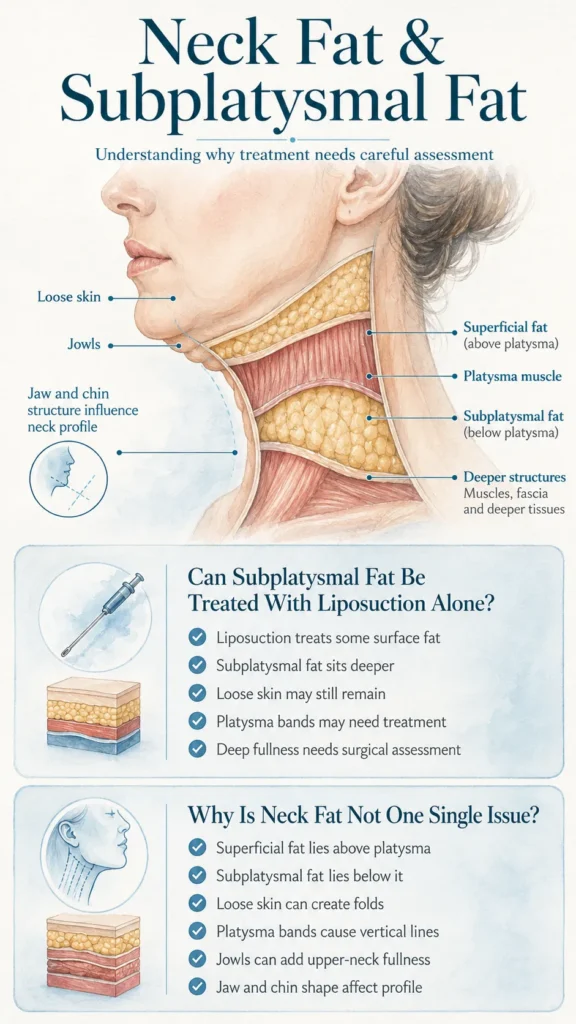
Subplatysmal fat is not usually treated with liposuction alone because it sits below the platysma muscle. Liposuction is more commonly used for selected superficial fat above the platysma, where the patient’s anatomy and skin quality are suitable.
- Liposuction may address selected superficial fat.
- Subplatysmal fat sits deeper than the usual liposuction plane.
- Loose skin may remain after fat reduction.
- Platysma bands may need separate treatment.
- Deeper neck fullness needs direct surgical assessment.
Liposuction alone may be suitable for some patients with good skin quality and superficial fullness. It is not a substitute for deeper neck lift planning when subplatysmal fat, platysma bands or loose skin are the main concerns.
Why Is “Neck Fat” Not One Single Issue?
Patients often use the phrase “neck fat” to describe several different concerns. In surgical planning, these concerns need to be separated because each has a different cause and treatment pathway.
- Superficial fat sits above the platysma.
- Subplatysmal fat sits below the platysma.
- Loose skin can create folds without much fat.
- Platysma bands can create visible vertical lines.
- Jowls can make the upper neck appear fuller.
- Jaw and chin structure can change the neck profile.
A useful surgical plan starts by identifying which layers are involved. Dr Michael Kernohan explains these differences so patients can understand why one treatment may suit one person but not another.
How Does Subplatysmal Fat Affect Neck Lift Planning After 40, 50 or 60?
Subplatysmal fat can affect neck lift planning at different ages, but age alone does not decide whether deeper fat management is needed. Genetics, weight history, skin quality, platysma bands and jawline structure can matter more than the patient’s decade.
- Patients in their 40s may have under-chin fullness with better skin elasticity.
- Patients in their 50s may have both neck fullness and jawline changes.
- Patients in their 60s may have more skin laxity and more detailed recovery planning needs.
- Deeper fullness can occur at different ages.
- Weight changes can affect both superficial and deeper neck fullness.
- Lower-face descent may become more relevant over time.
Dr Michael Kernohan assesses the actual anatomy rather than using age as a fixed guide. This helps determine whether a neck lift, deeper neck planning, combined face and neck lift, staged surgery or no surgery is more appropriate.
What Risks and Limitations Should Patients Understand?
Managing subplatysmal fat involves surgery in a deeper layer of the neck, so risks and limitations need to be discussed carefully. These risks may be different from those involved in superficial fat treatment alone.
- Bleeding or haematoma can occur after surgery.
- Infection or delayed wound healing is possible.
- Scars may be visible, raised, widened or slower to settle.
- Numbness, tingling or altered sensation may occur.
- Asymmetry or contour irregularity may remain.
- Over-reduction or under-reduction can occur.
- Residual fullness may remain if other structures contribute.
- Nerve-related movement changes are uncommon but important to discuss.
Surgery cannot guarantee a specific neck contour, and it cannot stop future age-related tissue changes. Dr Michael Kernohan discusses risks in relation to the patient’s anatomy, health, medications, smoking status and planned procedure.

What Are the Limitations of Deeper Fat Management?
Deeper fat management may address one cause of neck fullness, but it does not address every cause. If loose skin, jowls, platysma bands or deeper structures are also involved, the plan may need to address more than one layer.
- It does not tighten poor-quality skin by itself.
- It does not correct significant jowls.
- It does not replace platysma repair when muscle bands are the main issue.
- It may not address gland-related or bone-structure causes.
- It may not remove all fullness in the neck.
This is why patients should avoid focusing only on whether fat can be removed. The more important question is what is causing the fullness and which options are suitable.
What Is Recovery Like When Deeper Neck Fat Is Addressed?
Recovery after subplatysmal fat management depends on the extent of surgery and whether it is part of a broader neck lift or combined face and neck procedure. Deeper neck work may contribute to swelling, tightness, firmness and tenderness under the chin.
- Swelling may occur under the chin and along the upper neck.
- Bruising may be present around the neck or jawline.
- Tightness or firmness can occur during early healing.
- Altered sensation may occur near the chin, neck or ears.
- Dressings, drains or compression may be used if prescribed.
- Eating, talking and neck movement may feel restricted early.
- Activity restrictions are usually needed while healing begins.
The recovery timeline is different for each patient. Follow-up appointments allow Dr Michael Kernohan to monitor healing, swelling, scars and any concerns that arise.
What Aftercare May Be Needed?
Aftercare depends on the operation performed and the patient’s healing progress. Patients should follow their personalised instructions rather than relying on general advice online.
- Keep dressings and wounds managed as advised.
- Wear compression only if prescribed.
- Avoid strenuous activity until cleared.
- Sleep and rest positions should follow clinic advice.
- Attend scheduled follow-up appointments.
- Report sudden swelling, increasing pain, bleeding or breathing concerns promptly.
Good aftercare helps support healing, but it cannot remove all surgical risk. Patients should contact the clinic if symptoms change suddenly or do not match their post-operative instructions.
What Alternatives Should Patients Consider?
Alternatives should be considered before surgery, especially when the cause of neck fullness is uncertain or when risks outweigh the likely benefit. Alternatives may include no surgery, delayed surgery, superficial fat treatment, skin-focused care, staged surgery or a different surgical plan.
- No surgery may be suitable if the concern is mild.
- Delaying surgery may be appropriate if weight or health is changing.
- Skin care and sun protection may support skin quality.
- Superficial fat treatment may suit selected patients.
- Neck lift without deeper fat management may be suitable in some cases.
- Combined face and neck lift may be discussed if lower-face descent contributes.
- Medical review may be needed if neck fullness could have another cause.
Non-surgical treatments may help skin texture or selected surface concerns, but they do not replace surgery when deeper fat, muscle or loose skin is the main issue. Dr Michael Kernohan discusses alternatives as part of informed consent.
Download Dr Kernohan’s Facelift and Neck Lift Surgery Guide

Who May Be Suitable for Subplatysmal Fat Management During Neck Lift Surgery?
A patient may be suitable for subplatysmal fat management if deeper central neck fullness is confirmed and if surgery is appropriate for their health and anatomy. Suitability is based on examination rather than photos or the patient’s age alone.
- The patient has deeper fullness beneath the chin or central neck.
- The concern is not explained by loose skin alone.
- The patient is suitable for surgery and anaesthesia.
- Weight is reasonably stable.
- Smoking, vaping or nicotine use has been addressed.
- Expectations are realistic.
- The patient understands scars, risks, recovery and limitations.
Subplatysmal fat management is not routine for every neck lift patient. Dr Michael Kernohan will discuss it only when assessment suggests it is relevant and appropriate.
Who May Not Be Suitable?
Some patients may not be suitable for deeper fat management or may need another approach. This may include patients whose concern is mainly superficial fat, loose skin, jowls, skin quality or a medical issue rather than subplatysmal fat.
- The fullness is mainly superficial and suitable for another plan.
- The main concern is loose skin or jowls.
- The patient has high surgical or anaesthetic risk.
- Smoking or nicotine use cannot be stopped as advised.
- Weight is unstable.
- Expectations do not match what surgery can reasonably address.
- Recovery time and follow-up care are not practical.
Not being suitable for subplatysmal fat management does not mean there are no options. It may mean that a different procedure, staged plan, delayed surgery or no surgery is more appropriate.
Facelift Before and After Photos
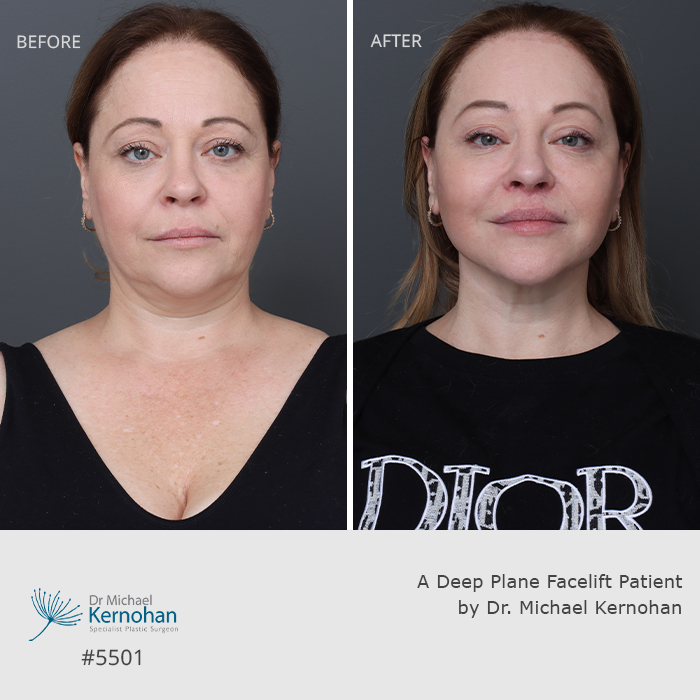
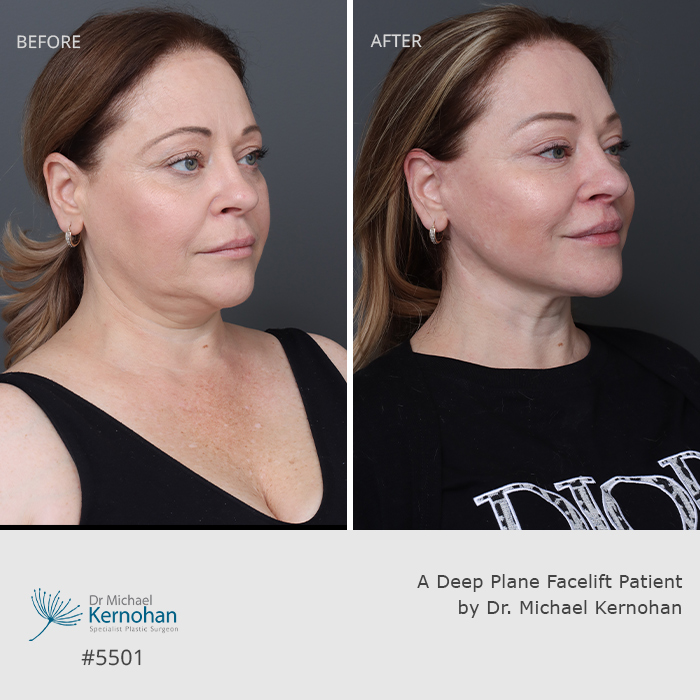
Disclaimer: All surgical or invasive procedures come with inherent risks, and results can vary widely between individuals due to factors like lifestyle, anatomy, overall health, weight, and nutrition. We encourage you to conduct thorough research and consider seeking a second opinion from a qualified healthcare provider.
Are Costs Relevant When Deeper Neck Lift Planning Is Needed?
Costs may be relevant when deeper neck lift planning is needed because procedure complexity can vary. However, cost should not determine whether deeper tissue is treated if the anatomy does or does not require it.
- Deeper neck planning may involve different operating time.
- Anaesthetic and theatre requirements may vary.
- Combined procedures may affect the overall plan.
- Dressings, garments and follow-up needs may differ.
- Staged surgery may involve different cost considerations.
- Individual information can only be provided after consultation.
Choosing a smaller procedure for cost reasons may leave deeper concerns untreated. Choosing a more involved procedure without a clear anatomical reason can also add unnecessary risk.
Summary
Subplatysmal fat is deeper fat located beneath the platysma muscle in the neck. It is different from superficial neck fat and may contribute to under-chin or central neck fullness in selected patients.
Managing subplatysmal fat requires careful assessment because it sits close to important neck structures and is only one part of neck anatomy. Loose skin, platysma bands, superficial fat, jowls, glands, muscle position and jawline structure may also contribute.
Not every patient needs subplatysmal fat management during neck lift surgery. Dr Michael Kernohan, Specialist Plastic & Reconstructive Surgeon in South West Sydney, assesses the neck, jawline, lower face, skin quality and medical history before discussing whether deeper neck planning, neck lift surgery, combined procedures, staged surgery or another pathway may be appropriate.

Subplatysmal Fat Management FAQs
Next Step: Discuss Subplatysmal Fat and Neck Lift Surgery With Dr Kernohan
If you are wondering whether your neck fullness is mainly “surface” fat or whether subplatysmal fat might be part of the story, a structured consultation is the most useful next step.
Meeting Dr Michael Kernohan, Specialist Plastic & Reconstructive Surgeon in Sydney, gives you the chance to describe what bothers you about your neck, have the superficial, platysmal and deep layers assessed in person, discuss when subplatysmal fat management is and is not indicated, and weigh potential contour benefits against added risks and recovery time.
You can bring old and recent profile photos, a list of medicines and details of any previous neck treatments. Dr Kernohan’s clinic has an online contact page and a complimentary photo assessment page where you can send enquiries, photo images, or appointment requests privately and securely. The aim is careful, evidence-informed planning so you can decide, at your own pace, whether a standard neck lift, a deeper approach, or no surgery at all is right for you.