

- Why Deep Neck Contouring Matters
- Take The Quiz
- Overview Of Neck Anatomy Relevant To Contouring
- Download Dr Kernohan’s Facelift Surgery Guide
- The Platysma Muscle And Its Role In Neck Shape
- Subplatysmal Fat: Contribution To Lower Neck Fullness
- Digastric Muscles And Cervicomental Angle Aesthetics
- Fascial Planes, Ligaments, And Neck Support
- Surgical Strategies For Deep Neck Contouring
- Combining Deep Neck Work With A Facelift
- Recovery Timeline After Deep Neck Contouring
- Facelift Before and After Photos
- Risks And Considerations For Deep Neck Surgery
- Is Deep Neck Contouring Right For You?
- Looking Forward: Precision Planning For Deeper, Longer-Lasting Results
- Next Step: Explore Deep Neck Contouring With Dr Kernohan’s Specialist Insight
- Medical References
- Further Reading
Why Deep Neck Contouring Matters
Many people seeking neck rejuvenation want more than just superficial tightening of the skin. The neck’s shape and balance depend on a complex interplay of deeper anatomy that includes muscles, fascia, fat compartments, and underlying skeletal support. When these elements are not fully considered, neck surgery may deliver limited improvement despite technically sound skin tightening.
Deep neck contouring refers to surgical strategies that go beneath the skin’s surface to reshape the underlying architecture. This may involve addressing the platysma muscle, modifying deep fat compartments, and managing connective tissue and glandular elements that influence neck definition. In patients with complex anatomy – such as pronounced subplatysmal fullness, strong platysma banding, or glandular prominence – deep contouring can yield more harmonious and durable results.
Dr Michael Kernohan, Specialist Plastic & Reconstructive Surgeon in Sydney, emphasises that effective deep neck contouring is not simply an “add‑on” to a neck lift – it requires extensive anatomical understanding, meticulous technique, and personalised planning. This article explains these deeper surgical approaches, why they are used, how they are performed, and what patients can realistically expect during recovery and long‑term healing.
Take The Quiz
Overview Of Neck Anatomy Relevant To Contouring
Understanding neck anatomy is foundational to deep neck contouring. The neck is composed of multiple tissue layers, each with structural and functional roles that influence how the neck looks at rest and in motion. These layers include:
- Skin and superficial fascia: The outer covering that loses elasticity with age.
- Platysma muscle: A thin sheet‑like muscle directly beneath the skin that affects vertical bands and surface tension.
- Deep fat compartments: Subplatysmal fat and other deeper deposits that shape fullness.
- Muscles such as digastrics: Muscles beneath the platysma that influence the cervicomental angle.
- Fascial layers and ligaments: Connective tissues that organise neck compartments and support structures.
- Bones and skeletal landmarks: The mandible and hyoid bone provide fixed reference points for contour.
These components do not act in isolation; changes in one layer often influence others. For example, loss of skin elasticity accentuates the visibility of deeper structures such as fat pads and muscular ridges. Likewise, strong neck muscles can create visible bands if the fascia and overlying soft tissues lack support.
Download Dr Kernohan’s Facelift Surgery Guide

The Platysma Muscle And Its Role In Neck Shape
The platysma is a thin, sheet‑like muscle that lies directly beneath the superficial fascia. It originates from the upper chest and shoulder area and ascends to insert along the lower jaw and lower face. Its fibres contribute to neck surface expression, moving with facial actions such as speaking or smiling.
With time and reduced skin elasticity, platysma fibres can separate centrally or tether to deeper tissues, leading to visible vertical “bands” or a “corded” appearance along the neck. This is a common sign of neck ageing and often a primary focus in deep neck contouring. Correcting the appearance of platysmal bands typically involves platysmaplasty, where the muscle is tightened, repositioned, or reshaped to reduce its prominence.
Because the platysma is closely associated with the cervical branch of the facial nerve, which controls muscle function, surgical work in this region demands precise anatomical knowledge and careful technique. A qualified surgeon must balance contour improvement with preservation of nerve integrity and muscle function, ensuring a smooth but natural neck appearance.
Subplatysmal Fat: Contribution To Lower Neck Fullness
Beneath the platysma lies a distinct layer of fat known as subplatysmal fat. While superficial fat lies just under the skin, subplatysmal fat is deeper, often contributing to fullness beneath the chin and along the border of the jaw. This deep compartment can be a significant contributor to an undefined neck contour even when skin laxity and superficial fat are addressed.
Subplatysmal fat does not automatically drain or reduce with superficial liposuction alone. In many patients, especially those with a thicker neck profile or a heavier submental area, targeted removal or contouring of this deeper fat compartment is essential for meaningful definition. Surgeons differentiate between superficial and subplatysmal layers during surgical planning so that the appropriate plane of contouring is selected.
This anatomical distinction underscores why some patients achieve only modest improvement with simple liposuction or skin tightening; deeper deposits require direct access and precise sculpting. Proper management of subplatysmal fat can create a cleaner, more angular jawline and neck angle – often referred to clinically as improved cervicomental definition.
Digastric Muscles And Cervicomental Angle Aesthetics
Beneath subplatysmal fat and deeper in the neck are several muscles that influence neck contour, notably the digastric muscles. These paired muscles lie beneath the jaw and above the hyoid bone and play a role in certain neck movements. From an aesthetic standpoint, they also help define the cervicomental angle – the angle between the underside of the chin and the upper neck.
In some individuals, prominent or high‑positioned digastric muscles can create a convex or “bulging” appearance in the submental region, even when other layers are optimised. This can be particularly noticeable in younger patients with strong muscle tone or in older individuals, where deeper tissue descent accentuates muscular contours.
Addressing the influence of the digastric muscles in deep neck contouring may involve careful release, repositioning, or contouring of adjacent tissue planes. While these surgical steps are not necessary in every case, recognising when these structures contribute to unwanted neck fullness is a hallmark of advanced surgical planning.
Fascial Planes, Ligaments, And Neck Support
The structural organisation of the neck is governed by a network of fascial layers and retaining ligaments that maintain the position of fat, muscle, and soft tissue. The superficial cervical fascia houses the platysma and associated subcutaneous fat, while the deep cervical fascia envelops muscles such as the sternocleidomastoid and the digastrics, as well as neurovascular bundles and glandular structures.
Ligamentous structures, such as the mandibular retaining ligament and the cervical ligaments, provide anchorage and maintain tissue positions. With age, these fascial systems weaken, leading to tissue descent and contour irregularities. In some cases, fascial laxity contributes more to neck fullness than actual fat volume or muscular prominence.
Surgical approaches must respect these fascial planes. Dissecting and repositioning tissue at the correct depth ensures both aesthetic success and anatomical safety. In deep neck contouring, preserving or selectively modifying fascial tension plays a role in enhancing jawline definition and achieving a long-lasting, balanced result.
Surgical Strategies For Deep Neck Contouring
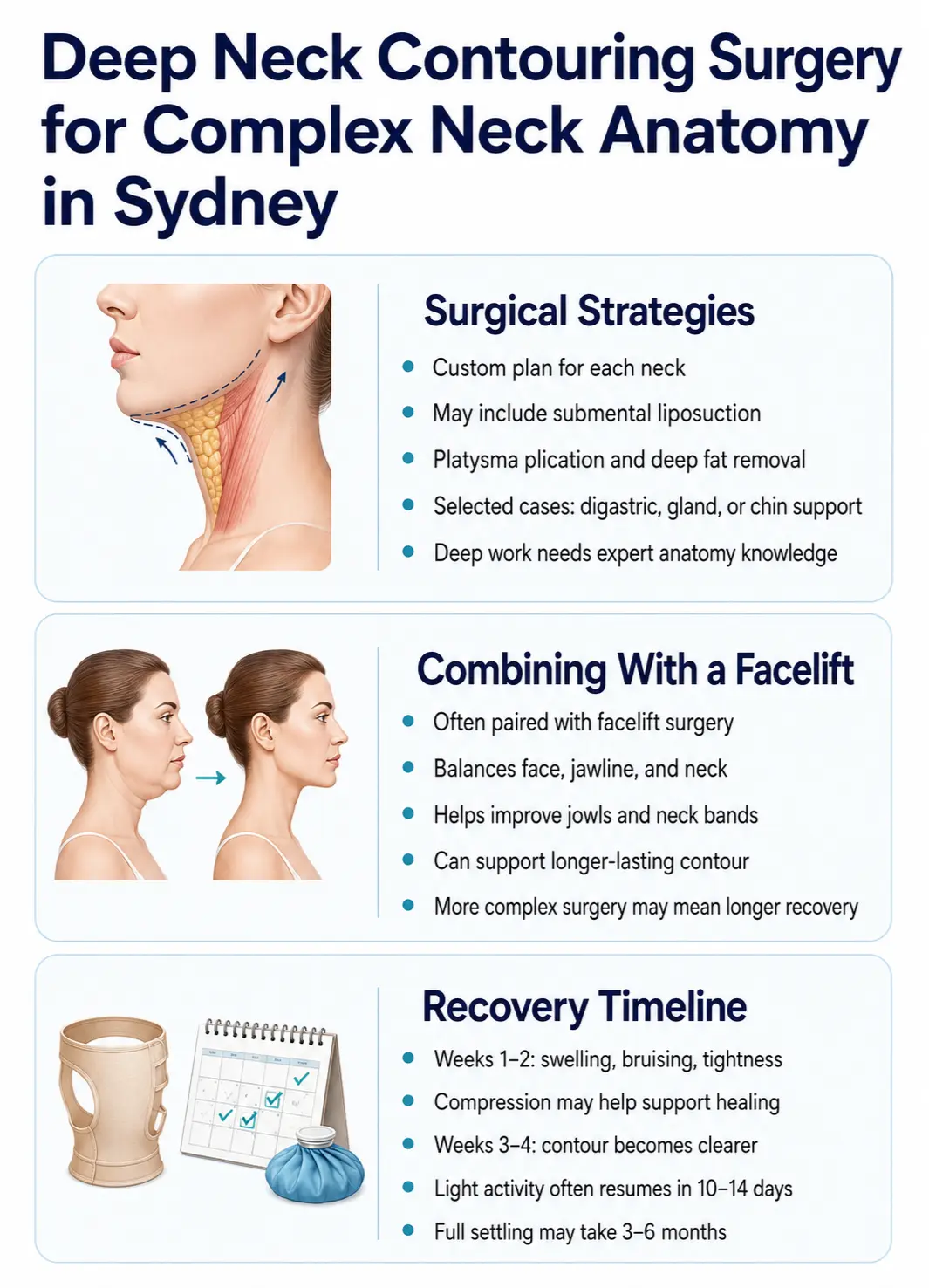
Deep neck contouring is never a single procedure – it’s a customised surgical plan based on individual anatomy and aesthetic priorities. Some patients may benefit from submental liposuction alone, while others require multilayered neck lifting that includes platysmaplasty, subplatysmal fat removal, and contouring of underlying structures such as the digastrics or glands.
The most commonly combined procedures include:
- Central and lateral platysma plication
- Subplatysmal fat excision
- Digastric muscle adjustment or contouring
- Submandibular gland management (in select patients)
- Chin augmentation or cervicomental angle reshaping
Each step must be tailored. Inexperienced handling of deeper tissues risks nerve damage, prolonged swelling, or contour irregularities. That’s why deep neck contouring should only be performed by qualified plastic surgeons with comprehensive knowledge of head and neck anatomy – such as Dr Michael Kernohan, who performs these procedures in Sydney with advanced planning and patient-specific strategies.
Combining Deep Neck Work With A Facelift
While deep neck contouring can be done as a standalone procedure, it’s often combined with a facelift to address facial and cervical ageing in a balanced way. The facelift repositions tissues in the mid and lower face, while the neck lift component refines the jawline and neck, especially when deep tissues are involved.
Combining these procedures helps avoid mismatches in tension or tissue quality between the face and neck. It also allows for more harmonious correction of jowls, chin blunting, and neck banding. Importantly, a deep neck approach enhances the longevity of facelift outcomes, as it addresses the structural factors that contribute to long-term sagging.
Patients should be aware that adding deep neck work increases surgical complexity and may involve a slightly longer recovery. However, the trade-off is often worth it, especially for those with significant neck concerns or suboptimal outcomes from earlier superficial procedures.
Recovery Timeline After Deep Neck Contouring
Recovery after deep neck surgery varies depending on the depth and number of tissue layers addressed. Most patients experience swelling, bruising, and a tight sensation in the neck during the first 2 weeks. Compression garments may be recommended to help control swelling and stabilise repositioned tissue.
By week 3–4, most of the initial swelling subsides, and visible improvements become clearer. Deep tissues, however, continue to remodel and settle for several months. Sensory changes in the skin or neck tightness may persist temporarily but generally improve with time.
Dr Kernohan provides a detailed recovery plan to help patients manage expectations and support healing. Gentle movement, sleep positioning, wound care, and avoiding strain are all part of a well-managed recovery. Patients are usually able to resume light activities within 10–14 days, although full healing may take 3–6 months depending on the extent of deep tissue work.
Facelift Before and After Photos
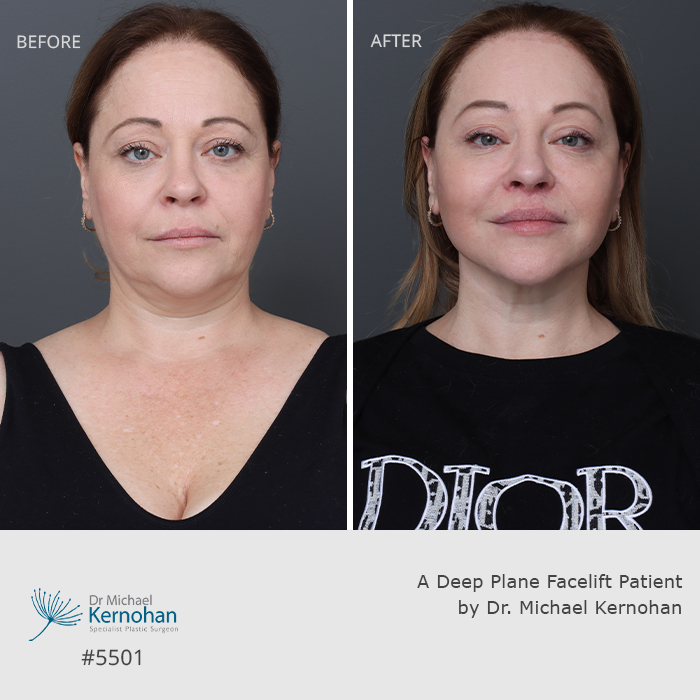
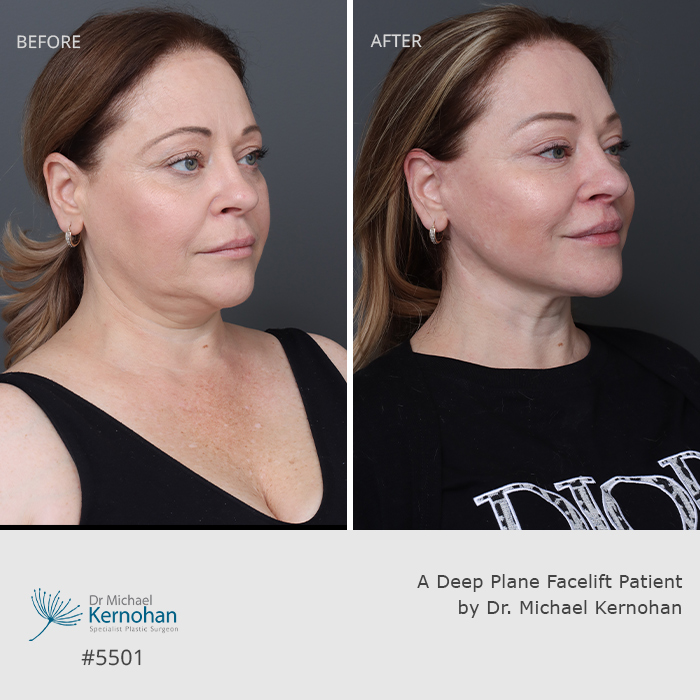
Disclaimer: All surgical or invasive procedures come with inherent risks, and results can vary widely between individuals due to factors like lifestyle, anatomy, overall health, weight, and nutrition. We encourage you to conduct thorough research and consider seeking a second opinion from a qualified healthcare provider.
Risks And Considerations For Deep Neck Surgery
Like all surgical procedures, deep neck contouring carries potential risks. Because deeper structures are involved – including nerves, glands, and muscular planes – the procedure should be approached with caution. Possible risks include:
- Numbness or temporary sensory changes
- Asymmetry or visible contour irregularities
- Prolonged swelling or bruising
- Injury to nearby nerves (rare in qualified hands)
- Glandular swelling or saliva leakage (in gland-related procedures)
Patient selection is also key. Not everyone requires deep plane work – and in some cases, superficial techniques alone are sufficient. Over-treatment of the neck can result in unnatural tension or hollowing. That’s why preoperative imaging and anatomical mapping are sometimes used to determine which structures are contributing most to the visible concerns.
Is Deep Neck Contouring Right For You?
The best candidates for deep neck contouring are individuals with:
- Submental fullness not resolved by liposuction alone
- Prominent vertical bands or platysmal separation
- A low or indistinct cervicomental angle
- Persistent neck heaviness despite weight stability or ageing
- Poor results from prior superficial neck treatments
During neck contouring consultation, Dr Michael Kernohan conducts a thorough facial and neck analysis – considering all tissue layers and patient goals. His planning process ensures that the surgical strategy aligns with individual anatomy and long-term expectations.
Looking Forward: Precision Planning For Deeper, Longer-Lasting Results
Deep neck contouring is a refined neck surgical approach that addresses not just the surface, but the layered structure of the neck. By targeting key anatomical contributors like the platysma, deep fat, and muscular relationships, it allows for more tailored, long-lasting results that support both facial balance and natural definition.
Dr Michael Kernohan, a Specialist Plastic & Reconstructive Surgeon in Sydney, has a special interest in complex facial and neck anatomy. His approach to deep neck contouring is rooted in anatomical clarity, surgical precision, and a deep understanding of facial harmony.
Whether you are considering your first neck procedure or seeking a revision to address unresolved fullness or banding, exploring the deep layers may be the key to unlocking the result you’ve been looking for.
Next Step: Explore Deep Neck Contouring With Dr Kernohan’s Specialist Insight
Anatomical depth matters when refining the neck’s shape and balance. Dr Michael Kernohan, Specialist Plastic & Reconstructive Surgeon in Sydney, applies advanced surgical knowledge to tailor deep neck contouring plans that consider muscles, fat compartments, fascia, and skeletal support. If you’re interested in precise neck contouring or want to understand how your unique anatomy influences your surgical options, reach out for a personalised consultation or submit your photos for an expert assessment.
Medical References
- Deep neck surgery in deep plane facelifts – learning from evidence and experience / Journal of Plastic, Reconstructive & Aesthetic Surgery / https://www.jprasurg.com/article/S1748-6815(25)00408-5/abstract
- The Mastoid Crevasse and 3-Dimensional Considerations in Deep Plane Neck Lifting / Aesthetic Surgery Journal / https://academic.oup.com/asj/article/44/2/NP132/7285194
- Deep Tissue Sculpture in Neck Rejuvenation: Review of 641 Consecutive Cases / Plastic and Reconstructive Surgery – Global Open / https://pmc.ncbi.nlm.nih.gov/articles/PMC11658757/
- Deep Neck Contouring: Indications and Techniques / Facial Plastic Surgery / https://www.thieme-connect.com/products/ejournals/abstract/10.1055/a-2201-5989
Further Reading
- Deep Plane Facelift NSW
- Read more about Partial Neck Lift Sydney
- Read more about Buccal Fat Removal Sydney
- Read more about Chin Surgery Sydney NSW
- Read Dr Kernohan’s Blog on Neck Lift Options – Types of Neck Lift Surgery
- Read Dr Kernohan’s Blog on How to Prepare for Necklift Surgery
- Read Dr Kernohan’s Blog on Managing and Treating Necklift Scars
- Can A Neck Lift Be Done Without A Facelift Blog

High-SMAS vs Deep-Plane Approaches in Neck Lift Surgery
Why Technique Matters In Neck Lift Surgery When planning a neck lift – especially in…

Incisions in a Neck Lift – Where They Are Placed and Why
When people start looking into neck lift surgery, one of the most common questions is,…

How Weight Changes Affect Neck Appearance
Many people in their 40s, 50s and 60s notice the same thing in photos: even…