

- Introduction
- At a Glance
- Why Might Men Need a Different Approach to Neck Lift Surgery?
- What Male Neck Concerns Are Commonly Assessed?
- Why Is The Cause Of The Concern Important?
- How Does Beard Growth Affect Neck Lift Planning?
- Can A Neck Lift Change Shaving Patterns?
- Video: What are the Pros and Cons of Neck Lift Surgery?
- How Do Hairline And Hairstyle Affect Incision Planning?
- Why Are Scars An Important Discussion For Men?
- How Does Male Skin Thickness Affect Surgery And Healing?
- What If The Main Concern Is Skin Texture?
- How Do Platysma Bands Affect Male Neck Lift Planning?
- What Is Platysmaplasty?
- What Role Does Under-Chin Fullness Play?
- Why Does Chin And Jaw Structure Matter?
- When May Liposuction Be Discussed For Men?
- When May Platysmaplasty Be Discussed For Men?
- When May A Direct Neck Lift Be Discussed For Men?
- Why Is The Front-Neck Scar Important In A Direct Neck Lift?
- When May A Facelift With Neck Lift Be More Appropriate?
- When Might A Neck Lift Alone Be Too Limited?
- How Does Dr Michael Kernohan Assess Male Neck Lift Patients?
- What Risks And Limitations Should Men Understand?
- Why Can Scarring Be A Different Risk For Men?
- What Is Recovery Like After Male Neck Lift Surgery?
- When Can Men Return To Work And Exercise?
- What Alternatives Should Men Consider?
- Face and Neck Lift Before and After Photos
- When Might No Surgery Be The Better Option?
- Who May Be Suitable For Male Neck Lift Surgery?
- Who May Not Be Suitable?
- Are Costs Relevant When Planning Male Neck Lift Surgery?
- Take the Quiz
- Summary
- FAQs About Male Neck Lift Considerations
- Next Step: Discuss Male Neck Lift Options With Dr Michael Kernohan
- Download Dr Michael Kernohan’s Facelift Surgery Guide
- Further Reading
Introduction
Dr Michael Kernohan is a Specialist Plastic & Reconstructive Surgeon in Sydney. Male neck lift surgery may require different planning because male skin, beard growth, hairline patterns, neck structure and scar visibility can affect technique choice.
Many men seek advice about under-chin fullness, loose neck skin, platysma bands, or a less defined jawline-neck transition. These concerns may come from skin, fat, muscle, glands, jaw structure, weight changes, ageing, or a combination of factors.
This article explains why neck lift planning can differ for men, what techniques may be discussed, how Dr Michael Kernohan assesses male neck concerns, and what patients should understand about risks, recovery, alternatives and suitability before deciding.
At a Glance
Why Can Neck Lift Techniques Differ For Men?
Neck lift techniques can differ for men because male patients may have thicker skin, beard-bearing skin, different hairline patterns, stronger neck muscles, a different chin and jaw structure, and different scar concealment needs. These factors can affect incision planning, tissue handling, recovery and what result is realistic.
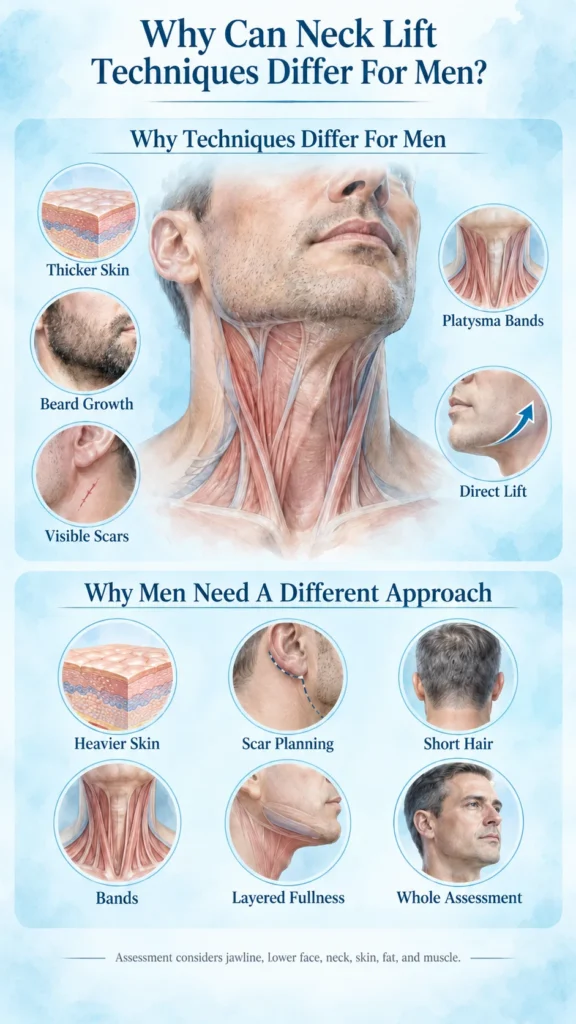
- Male skin can be thicker and may settle differently after surgery.
- Beard growth can affect incision placement and scar planning.
- Shorter hairstyles may make scars harder to conceal.
- Platysma bands and deeper under-chin fullness need careful assessment.
- A direct neck lift may be discussed in selected men, but it leaves a front-neck scar.
Some men may be assessed for a standard neck lift, while others may be assessed for liposuction, platysmaplasty, direct neck lift, facelift with neck lift, staged surgery, another pathway or no surgery. Dr Michael Kernohan assesses anatomy, health, expectations and recovery needs before discussing options.
Why Might Men Need a Different Approach to Neck Lift Surgery?
Male neck lift planning is not simply the same operation applied to a different patient group. Men can have different skin thickness, beard growth patterns, hairline changes and neck anatomy, which may affect incision placement, scar visibility and how tissues are managed during surgery.
- Male skin may be thicker and heavier.
- Beard-bearing skin can affect scar and incision planning.
- Short hairstyles may make scars more visible.
- Some men have more visible platysma bands.
- Under-chin fullness may involve several tissue layers.
A procedure label does not decide suitability. Dr Michael Kernohan assesses the lower face, jawline and neck together to identify whether the concern is mainly skin laxity, fat, muscle, deeper neck structure, jowls or a combination of factors.
What Male Neck Concerns Are Commonly Assessed?
Men may seek assessment for several different neck concerns, and not all of them come from the same tissue layer. Some concerns are age-related, while others relate to anatomy, weight changes, skin quality or previous procedures.
- Loose neck skin.
- Vertical platysma bands.
- Fullness under the chin.
- A less defined chin-to-neck angle.
- Jowls that affect the upper neck.
Some men also describe neck fullness that catches in shirt collars or looks more noticeable from the side profile. Dr Michael Kernohan assesses whether the concern is mainly neck-led, lower-face-led or related to deeper anatomy before discussing options.
Why Is The Cause Of The Concern Important?
The cause of the concern matters because different tissues respond to different treatments. A treatment that suits superficial under-chin fat may not suit loose skin, platysma bands, gland prominence or jaw structure.
- Liposuction may be discussed when fullness is mainly superficial fat.
- Platysmaplasty may be discussed when platysma bands are a key concern.
- Direct neck lift may be discussed in selected men with central skin laxity.
- Facelift with neck lift may be considered when jowls contribute.
- No surgery or delayed surgery may be more appropriate in some cases.
A careful assessment helps reduce the chance of choosing a procedure that does not address the main concern. Dr Michael Kernohan begins with anatomy and clinical suitability rather than assuming one technique will suit all men.
How Does Beard Growth Affect Neck Lift Planning?
Beard growth can affect male neck lift planning because some incision areas may sit near hair-bearing skin. This matters for shaving, scar placement and how hair-bearing skin may move during surgery.
- Beard growth may extend onto the lower face and neck.
- Incisions may pass near hair-bearing areas.
- Moving skin can change where beard-bearing skin sits.
- Clean-shaven men may notice scar texture more.
- Beards may conceal some scars, but not all scars.
Dr Michael Kernohan may ask about shaving habits, beard style and whether the patient usually has facial hair. These details can help guide incision planning and post-operative advice.
Can A Neck Lift Change Shaving Patterns?
A neck lift may change shaving patterns if hair-bearing skin is moved or if incisions sit near areas that are shaved regularly. This is not the same for every patient, but it should be discussed before surgery.
- Shaving may need to be avoided near incision areas during early healing.
- Altered sensation may affect shaving comfort for a period.
- Scar tenderness may make close shaving uncomfortable while healing progresses.
- Electric shaving may be preferred for a time if advised.
- Beard style may affect how scars are noticed or concealed.
Men who shave daily should ask where scars may sit and when shaving can resume. Men with beards should ask whether facial hair may affect scar visibility, wound care or long-term grooming habits.
Video: What are the Pros and Cons of Neck Lift Surgery?

How Do Hairline And Hairstyle Affect Incision Planning?
Hairline and hairstyle can affect incision planning because many men wear their hair short. Some men also have receding hairlines or less hair density around the ears, sideburns and back of the scalp, which can make some scars harder to conceal.
- Hair length around the ears matters.
- Hair density behind the ears can affect scar concealment.
- Receding hairlines may influence incision placement.
- Sideburn position should be reviewed.
- Short hairstyles can make scars easier to see.
A scar hidden by longer hair in one patient may be more visible in another patient with short hair. For this reason, scar placement should be discussed before surgery, not after surgery.
Why Are Scars An Important Discussion For Men?
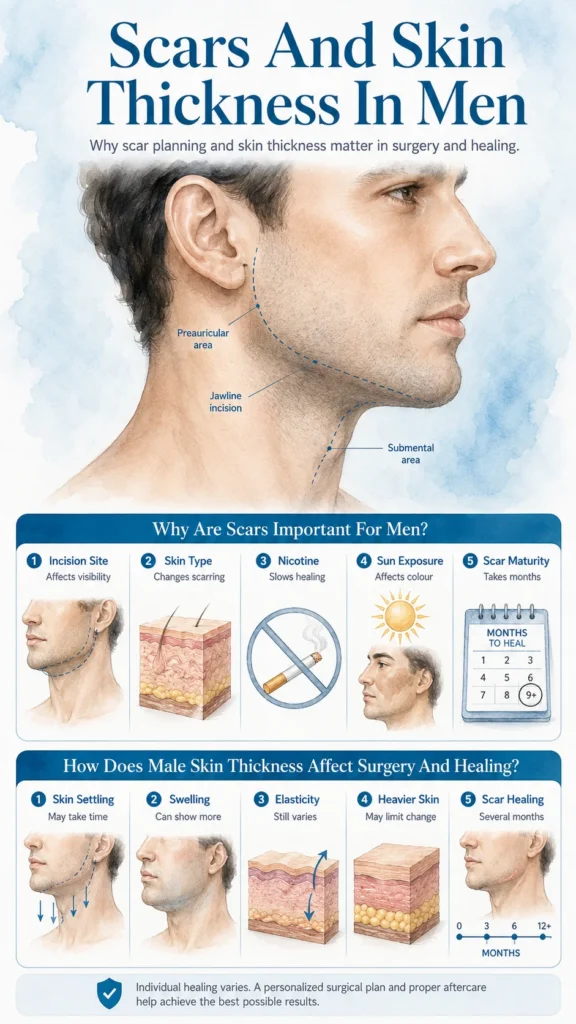
Scars are an important discussion because male hairstyles may provide less cover around the ears and neck. Some men also prefer very short hair, which can make incision lines easier to see.
- Scar visibility depends on incision location.
- Skin type can affect scar behaviour.
- Smoking or nicotine use can affect wound healing.
- Sun exposure can affect scar colour and skin quality.
- Scar maturation can take months.
No surgeon can guarantee that scars will be invisible. Dr Michael Kernohan discusses where scars may sit, how they may mature and what scar-related risks should be understood before deciding on surgery.
How Does Male Skin Thickness Affect Surgery And Healing?
Male skin can be thicker than female skin, although this varies between individuals. Thicker skin may behave differently during surgery and healing, including how swelling appears and how tissues settle.
- Thicker skin may take time to settle.
- Swelling may be more noticeable in some patients.
- Skin elasticity still varies widely between men.
- Heavier skin may influence how much change can be achieved.
- Scar maturation can take several months.
Thicker skin is not automatically better or worse. Dr Michael Kernohan assesses skin quality, sun exposure, nicotine use, weight history and general health when discussing what may be realistic.
What If The Main Concern Is Skin Texture?
Neck lift surgery does not treat every skin concern. It may address selected skin laxity, but it does not remove all wrinkles, pigmentation, sun damage or skin texture changes.
- Skin texture may need separate assessment.
- Pigmentation is not corrected by neck lift surgery.
- Sun-damaged skin may need skin-focused care.
- Fine surface lines may remain after surgery.
- Dermatology-led treatment may be more appropriate for some concerns.
A neck lift may not be the right operation if the patient’s main concern is surface skin texture rather than tissue laxity. This is part of informed consent and should be discussed before surgery.
How Do Platysma Bands Affect Male Neck Lift Planning?
The platysma is a thin sheet-like muscle in the neck, and visible bands can appear at the front of the neck over time. In men, these bands may be more noticeable in some cases because of neck muscle strength, skin thickness, weight changes or age-related tissue change.
- Platysma bands can appear as vertical lines or cords.
- Skin-only treatment may not address muscle bands.
- Platysmaplasty may be discussed in selected patients.
- Muscle work can affect tightness during recovery.
- Bands can remain partly visible or recur in some patients.
Dr Michael Kernohan assesses whether platysma bands are mild, moderate or part of broader neck laxity. This helps guide whether neck lift planning should include work on the platysma muscle.
What Is Platysmaplasty?
Platysmaplasty is surgery that addresses selected concerns related to the platysma muscle. It may be discussed when vertical bands or muscle-related neck changes are part of the patient’s concern.
- It may involve work through an incision under the chin.
- It may be combined with other neck lift components.
- It may help selected muscle-related neck concerns.
- It does not correct every cause of under-chin fullness.
- It may involve tightness during recovery.
Platysmaplasty should be discussed as part of a broader neck assessment rather than as a stand-alone label. Dr Michael Kernohan will explain whether platysma bands, skin laxity, fat, deeper anatomy or lower-face changes are contributing to the concern.
What Role Does Under-Chin Fullness Play?
Under-chin fullness is one of the most common reasons men ask about neck lift surgery. It can affect the side profile, jawline-neck transition and how the neck sits in collars.
- Superficial fat may contribute.
- Deeper subplatysmal fat may contribute.
- Platysma muscle position may contribute.
- Submandibular gland prominence may contribute.
- Chin and jaw projection may influence the side profile.
Because several tissue layers may contribute, one treatment does not suit every patient. Dr Michael Kernohan assesses the neck from the front, side and three-quarter views to identify the likely source of fullness.
Why Does Chin And Jaw Structure Matter?
Chin and jaw structure can affect how the neck looks. A smaller chin or less projected jaw may make under-chin fullness look more noticeable, even when fat or skin laxity is not the only issue.
- Chin projection can affect the side profile.
- Jawline shape can influence the face-neck transition.
- Hyoid position may affect the neck contour.
- Long-standing anatomy may differ from age-related change.
- Weight changes can alter soft tissue fullness.
A neck lift cannot change every feature of jaw structure. If the underlying shape of the chin or jaw contributes strongly, this needs to be discussed so expectations remain realistic.
When May Liposuction Be Discussed For Men?
Liposuction may be discussed in selected men when the main concern is superficial under-chin fat and skin quality is suitable. It is not a substitute for neck lift surgery when skin laxity, platysma bands or deeper fullness are the main issues.
- Fullness is mainly superficial fat.
- Skin laxity is limited.
- Platysma bands are not dominant.
- Skin elasticity is suitable.
- Weight is reasonably stable.
Liposuction may not be suitable when loose skin is significant, when the neck muscles or glands are contributing, or when the lower face and jowls are the main issue. Dr Michael Kernohan may discuss liposuction alone, liposuction with another procedure, or a different approach depending on the assessment.
When May Platysmaplasty Be Discussed For Men?
Platysmaplasty may be discussed when visible platysma bands or muscle-related neck changes are part of the patient’s concern. It is usually considered after assessing whether the neck issue is caused by skin, fat, muscle, deeper anatomy or a combination of these factors.
- Vertical neck bands are visible at rest or with movement.
- The platysma muscle contributes to the neck contour.
- Skin-only treatment is unlikely to address the concern.
- Under-chin access may be needed for selected muscle work.
- It may be combined with other neck lift components.
Platysmaplasty does not correct every cause of neck fullness or laxity. Dr Michael Kernohan explains where the muscle contributes, what the operation may involve, and what limitations should be understood before deciding.
When May A Direct Neck Lift Be Discussed For Men?
A direct neck lift may be discussed in selected men with central neck skin laxity who accept a visible scar on the front of the neck. This approach is not suitable for every patient and requires careful discussion about scar placement and expectations.
- It removes selected excess neck skin through a front-neck incision pattern.
- It may provide direct access to central neck structures in selected patients.
- It may suit some men with significant central neck skin laxity.
- It may be less suitable for men concerned about front-neck scar visibility.
- Scar quality can vary between patients.
A direct neck lift can be relevant for selected male patients, but it is not a default option. Dr Michael Kernohan assesses the neck, skin quality, beard pattern, scar risk and patient priorities before discussing whether this approach may be appropriate.
Why Is The Front-Neck Scar Important In A Direct Neck Lift?
The front-neck scar is important because it may be visible when the patient is clean-shaven, wears open-neck clothing or has limited beard coverage. Some men may accept this trade-off, while others may prefer an approach that places scars around the ears or hairline.
- Scar visibility depends on incision design and healing.
- Beard coverage may conceal some areas but not all scars.
- Short hair does not conceal a central neck scar.
- Scar colour and thickness may change during maturation.
- Sun exposure can affect scar appearance.
Patients considering a direct neck lift should understand this scar before surgery. Dr Michael Kernohan discusses scar location, scar care and the possibility that the scar may remain visible.
When May A Facelift With Neck Lift Be More Appropriate?
A facelift with neck lift may be more appropriate when lower-face laxity and neck changes both contribute to the concern. In these cases, neck-only surgery may not address jowls or the jawline-neck transition.
- Jowls affect the upper neck or jawline.
- Lower-face laxity is present with neck laxity.
- Platysma bands occur with broader tissue changes.
- Under-chin fullness is not the only concern.
- Treating one area alone may leave imbalance.
Combined planning may allow the lower face and neck to be addressed in a coordinated way. It may also involve broader recovery and risk planning, so suitability needs individual assessment.
When Might A Neck Lift Alone Be Too Limited?
A neck lift alone may be too limited when the main concern is partly caused by the lower face. If jowls or lower-face laxity are significant, neck-only surgery may leave the jawline concern unchanged.
- Jowls may continue to soften the jawline.
- Lower-face laxity may remain visible.
- Neck contour may improve while jawline concerns persist.
- A face-neck mismatch may remain.
- Further surgery may be considered later in selected patients.
This does not mean every man with jowls needs combined surgery. It means Dr Michael Kernohan should assess both the lower face and neck before recommending a neck-only approach.
How Does Dr Michael Kernohan Assess Male Neck Lift Patients?
Dr Michael Kernohan assesses male neck lift patients by looking at anatomy, health, expectations and recovery needs. The aim is to identify the tissue layers causing the concern before discussing a treatment pathway.
- The patient’s main concern is discussed in their own words.
- The neck is assessed from the front, side and three-quarter views.
- Jawline, chin position and lower-face support are reviewed.
- Skin quality, beard pattern and hairline are considered.
- Medical history, medications and nicotine use are discussed.
This assessment may lead to a discussion about liposuction, platysmaplasty, direct neck lift, standard neck lift, facelift with neck lift, staged surgery, another pathway or no surgery. The recommendation should be based on suitability, risks and realistic expectations.
What Risks And Limitations Should Men Understand?
Male neck lift surgery has risks and limitations, as with any operation. These should be discussed before surgery so patients understand what may occur and what surgery cannot guarantee.
- Bleeding or haematoma.
- Infection or delayed wound healing.
- Visible, widened or raised scars.
- Beard or hairline changes near incisions.
- Altered sensation, numbness or tightness.
- Asymmetry, residual fullness or residual bands.
Other risks may include skin healing concerns, nerve-related movement changes, anaesthetic risks and the need for further surgery in selected cases. Surgery cannot stop ageing or guarantee a specific appearance, and some concerns may remain because of deeper anatomy.
Why Can Scarring Be A Different Risk For Men?
Scarring can be a different risk for men because incision concealment may be affected by facial hair, shaving habits, short hairstyles and hairline position. A scar that is well covered in one patient may be more visible in another.
- Short hair may expose scars around the ears or behind the ears.
- Clean shaving may make scar texture easier to feel.
- Beard-bearing skin may move depending on the surgical plan.
- Scar colour may be affected by sun exposure.
- Scar maturation can take months.
Dr Michael Kernohan discusses likely scar placement before surgery. This helps patients decide whether the trade-offs of a particular technique are acceptable.
What Is Recovery Like After Male Neck Lift Surgery?
Recovery after male neck lift surgery varies depending on the technique used and the patient’s healing. Swelling, bruising, tightness and temporary sensation changes may occur after liposuction, platysmaplasty, direct neck lift, standard neck lift or combined surgery.
- Swelling and bruising may occur under the chin and along the neck.
- Tightness may be felt around the jawline, under the chin or central neck.
- Dressings, drains or compression may be used depending on the plan.
- Shaving near incisions may need to be delayed.
- Follow-up appointments are needed to monitor healing.
Recovery instructions should be followed closely. Dr Michael Kernohan provides guidance based on the procedure performed, the patient’s work demands, activity level and healing progress.
When Can Men Return To Work And Exercise?
Return to work and exercise depends on the operation, the patient’s job and how healing progresses. Desk-based work may require different planning from physically demanding work or public-facing roles.
- Swelling and bruising may affect social return.
- Physical work may require a longer break.
- Exercise and heavy lifting are usually restricted early.
- Driving should wait until it is safe and permitted.
- Follow-up review helps guide activity progression.
Patients should avoid setting a fixed return date without considering their own recovery. Dr Michael Kernohan will provide individual instructions about work, exercise, shaving and activity restrictions.
What Alternatives Should Men Consider?
Alternatives should be considered before deciding on male neck lift surgery. In some cases, surgery may not be needed, or another approach may better match the concern.
- No surgery or delaying surgery.
- Weight stability and general health planning.
- Skin care and sun protection.
- Dermatology-led care for texture or pigmentation.
- Liposuction for selected superficial under-chin fullness.
Other options may include platysmaplasty, direct neck lift, standard neck lift, facelift with neck lift, staged surgery, medical review or a second opinion. Dr Michael Kernohan discusses alternatives as part of informed consent.
Face and Neck Lift Before and After Photos
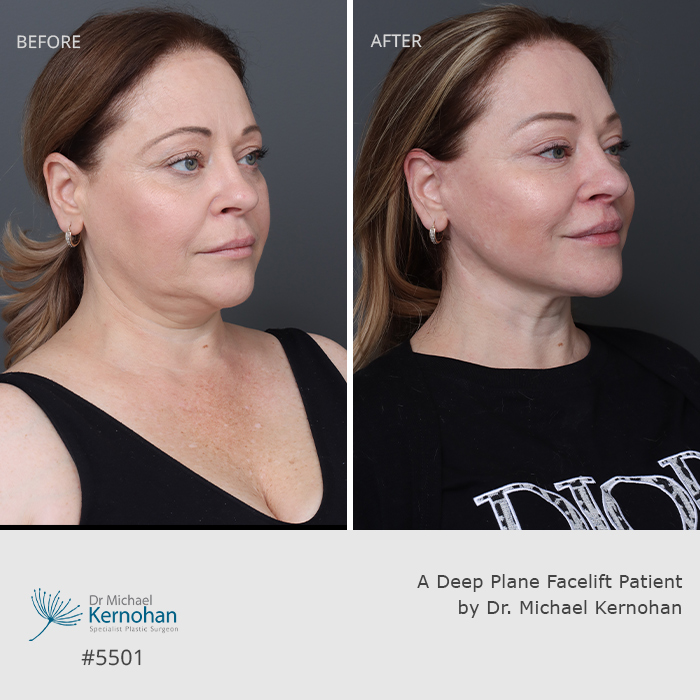
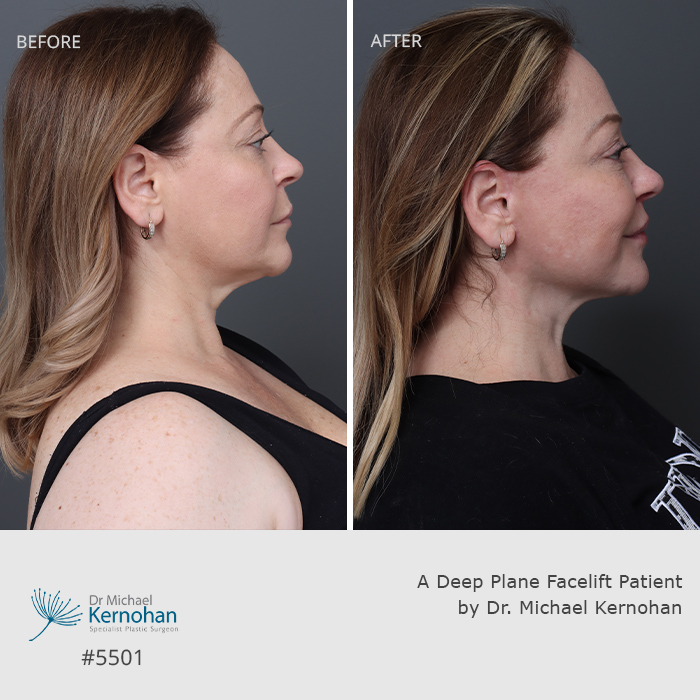
Disclaimer: All surgical or invasive procedures come with inherent risks, and results can vary widely between individuals due to factors like lifestyle, anatomy, overall health, weight, and nutrition. We encourage you to conduct thorough research and consider seeking a second opinion from a qualified healthcare provider.
When Might No Surgery Be The Better Option?
No surgery may be the better option when the concern does not match what surgery can reasonably address or when the risks outweigh the likely benefit. It may also be appropriate when the patient is not ready for recovery, scar care or follow-up.
- Medical risk is high.
- Expectations are not realistic.
- The main concern is skin texture rather than laxity.
- Weight is unstable.
- Smoking or nicotine use cannot be stopped as advised.
Choosing no surgery or delaying surgery can still be a responsible outcome of consultation. Dr Michael Kernohan may recommend review, monitoring, skin-focused care or medical assessment depending on the concern.
Who May Be Suitable For Male Neck Lift Surgery?
Men may be suitable for neck lift surgery when their concerns match what the procedure can address and they are medically suitable for surgery and anaesthesia. Suitability also depends on expectations, recovery capacity and willingness to follow aftercare.
- Loose neck skin is present.
- Platysma bands are visible.
- Under-chin fullness is suitable for neck assessment.
- Weight is reasonably stable.
- The patient understands scars, risks and recovery.
Suitability cannot be confirmed from photos alone. Dr Michael Kernohan assesses the neck, jawline, skin quality, deeper anatomy, health and lifestyle factors before discussing whether surgery may be appropriate.
Who May Not Be Suitable?
Some men may not be suitable for neck lift surgery, or may need to delay surgery until risks are better managed. This does not always mean surgery will never be possible, but it may mean another pathway is more appropriate now.
- Uncontrolled medical conditions.
- High anaesthetic risk.
- Smoking or nicotine use that cannot be stopped as advised.
- Unstable weight.
- Expectations surgery cannot meet.
Other reasons may include concerns better suited to skin-focused care, deeper anatomy that surgery may not safely address, lack of recovery support, or the need for further medical or psychological assessment. Dr Michael Kernohan will explain if surgery, delayed surgery, another pathway or no surgery is more appropriate.
Are Costs Relevant When Planning Male Neck Lift Surgery?
Costs may be relevant when planning male neck lift surgery, but they should not be the main reason to choose a technique. The surgical plan should be based on anatomy, risk, recovery and realistic expectations.
- Costs vary by technique and complexity.
- Liposuction, platysmaplasty, direct neck lift and standard neck lift may differ.
- Anaesthetic and facility fees may vary.
- Combined face and neck surgery may involve broader planning.
- Staged surgery may involve separate cost considerations.
Individual cost information is usually provided after consultation. Choosing a smaller procedure for cost reasons may be inappropriate if it does not address the main concern.
Take the Quiz
Summary
Male neck lift planning can differ because male anatomy, beard growth, hairstyle, skin thickness and scar visibility all matter. The right approach depends on the cause of the concern, not just the appearance of the neck from the outside.
Some men may be assessed for liposuction, platysmaplasty, direct neck lift, standard neck lift, facelift with neck lift, staged planning or no surgery. Dr Michael Kernohan, Specialist Plastic & Reconstructive Surgeon in Sydney, assesses each patient individually before discussing risks, recovery, alternatives and suitability.

FAQs About Male Neck Lift Considerations
Next Step: Discuss Male Neck Lift Options With Dr Michael Kernohan
A neck lift for men requires more than a standard surgical plan. Differences in skin thickness, muscle structure, and jawline proportions mean technique matters. Understanding these factors helps patients discuss what may be realistic for their anatomy and priorities.
Dr Michael Kernohan, Specialist Plastic & Reconstructive Surgeon in Sydney, provides detailed consultations focused on anatomical assessment and realistic planning. Exploring his clinic website contact page and photo assessment page gets the ball rolling in getting started with a neck lift. If you are considering neck lift surgery, a personalised discussion can help clarify whether this procedure suits your features and goals.
Begin with qualified guidance and make informed decisions with confidence.
Download Dr Michael Kernohan’s Facelift Surgery Guide

Further Reading
- Read Dr Michael Kernohan’s Procedure Page on Neck Lift Surgery
- Read Dr Michael Kernohan’s Blog about Female Vs Male Neck Lift: What’s Different?
- Read Dr Michael Kernohan’s Blog about Incisions in a Neck Lift – Where They Are Placed and Why
- Read Dr Michael Kernohan’s Blog about Managing Heavier Neck Fullness
- Read Dr Michael Kernohan’s Blog about Managing Subplatysmal Fat
- Read Dr Michael Kernohan’s Blog about Neck Lift Recovery
- Read Dr Michael Kernohan’s Procedure Page on Male Facelift

Neck Lift vs Lower Facelift – Which Option Is Right for Different Patients?
Dr Michael Kernohan is a Specialist Plastic & Reconstructive Surgeon in Sydney. A neck lift…

Managing Subplatysmal Fat During Neck Lift Surgery
Dr Michael Kernohan, Specialist Plastic & Reconstructive Surgeon in Sydney, assesses the neck in layers…

Managing the Heavier Neck – Options for Patients with Fullness Under the Chin
Introduction Dr Michael Kernohan, Specialist Plastic & Reconstructive Surgeon in Sydney, assesses a heavier-looking neck…