
- Introduction
- At a Glance
- What Is The Main Difference Between Facelift And Non-Surgical Tightening?
- Why Does Treatment Depth Matter?
- How Does Facial Ageing Affect Different Tissue Layers?
- Why Can Skin-Only Treatment Be Limited?
- What Does Facelift Surgery Address?
- What Are The Limits Of Facelift Surgery?
- What Does Non-Surgical Tightening Address?
- What Are The Limits Of Non-Surgical Tightening?
- Why Are These Options Not Interchangeable?
- Why Should Patients Avoid Choosing Based On Marketing Claims?
- When May Facelift Surgery Be More Appropriate?
- When Might Facelift Surgery Be Too Much?
- When May Non-Surgical Tightening Be More Appropriate?
- When Might Non-Surgical Tightening Be Too Limited?
- Can Non-Surgical Tightening Replace A Facelift?
- Can Surgical And Non-Surgical Options Be Combined?
- How Do Results Differ Over Time?
- How Does Recovery Compare?
- How Does Dr Michael Kernohan Assess Suitability?
- What Risks And Limitations Should Patients Understand?
- Why Is Informed Consent Important?
- What Is Recovery Like After Facelift Surgery?
- What Is Recovery Like After Non-Surgical Tightening?
- Facelift Before and After Photo
- What Alternatives Should Patients Consider?
- Who May Be Suitable For Facelift Surgery?
- Who May Be Suitable For Non-Surgical Tightening?
- Who May Not Be Suitable?
- Are Costs Relevant When Comparing Facelift And Non-Surgical Tightening?
- Take the Quiz
- Summary
- FAQs About Facelift vs Non‑Surgical Tightening
- Next Step: Discuss Facelift Vs Non-Surgical Tightening With Dr Kernohan
- Download Dr Michael Kernohan’s Facelift Surgery Guide
- Further Reading
Introduction
Dr Michael Kernohan is a Specialist Plastic & Reconstructive Surgeon in Sydney. Facelift surgery and non-surgical tightening are different treatment pathways, and the more suitable option depends on whether the concern comes from deeper tissue laxity, skin quality, facial structure or a combination of factors.
Facelift surgery may address selected deeper support layers in the lower face, jawline and neck. Non-surgical tightening usually focuses on skin firmness and mild laxity, so the two options should not be viewed as interchangeable.
This article explains the differences between facelift surgery and non-surgical tightening, when each may be considered, what Dr Michael Kernohan assesses, and what patients should understand about risks, recovery, alternatives and suitability before choosing a pathway.
At a Glance
Is Facelift Surgery Or Non-Surgical Tightening More Appropriate?
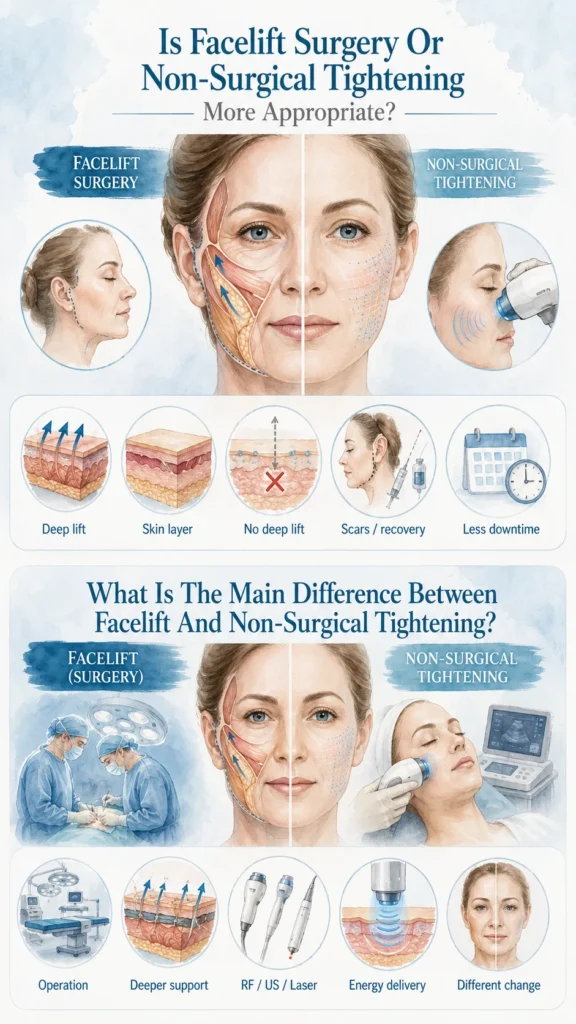
Facelift surgery may be more appropriate when lower-face, jawline or neck changes are caused by deeper tissue descent or excess skin. Non-surgical tightening may be considered when concerns are mild and mainly related to skin firmness or early laxity.
- Facelift surgery can address selected deeper facial support layers.
- Non-surgical tightening usually acts on skin and superficial tissue layers.
- Non-surgical tightening does not reposition deeper facial tissues in the way surgery can.
- Facelift surgery involves incisions, scars, anaesthesia and surgical recovery.
- Non-surgical treatments may involve less interruption to usual activities, but results are usually more limited and temporary.
- Some patients may use non-surgical treatments before or after surgery for skin quality, where suitable.
- Neither option stops ageing.
- Dr Michael Kernohan assesses the lower face, jawline, neck and skin quality before discussing options.
The right option depends on anatomy, health, expectations, degree of laxity and willingness to accept recovery and risk. A consultation helps clarify whether surgery, non-surgical care, staged planning, another pathway or no treatment may be more appropriate.
What Is The Main Difference Between Facelift And Non-Surgical Tightening?
The main difference is treatment depth. Facelift surgery may address selected deeper support layers and excess skin, while non-surgical tightening generally aims to improve skin firmness or mild laxity.
- Facelift surgery is an operation.
- It may involve deeper tissue support, skin removal and incision planning.
- Non-surgical tightening may include radiofrequency, ultrasound-based or laser-assisted treatments.
- Device-based treatments usually work through controlled energy delivery to the skin and superficial tissues.
- The likely degree of change is different between the two pathways.
A less invasive option does not always mean it is the right option for the concern. Dr Michael Kernohan assesses whether the visible change is mainly skin-related or whether deeper lower-face, jawline or neck support is involved.
Why Does Treatment Depth Matter?
Treatment depth matters because facial ageing does not happen in one layer only. Skin, fat, connective tissue, deeper support layers and facial structure can all change over time.
- Skin changes may involve texture, firmness and elasticity.
- Deeper tissue changes may affect jowls and jawline support.
- Neck laxity may involve skin, muscle and deeper structures.
- Surface treatments may not address deeper support layers.
- Surgery may not treat every skin texture or pigmentation concern.
The aim is to match the treatment to the tissue causing the concern. If the concern is deeper tissue laxity, a skin-focused treatment may not provide the level of change the patient expects.
How Does Facial Ageing Affect Different Tissue Layers?
Facial ageing can involve the skin, deeper soft tissues, fat compartments, connective tissue and bone support. This is why one treatment does not suit every patient or every concern.
- Collagen and elastin change over time.
- Sun exposure can affect skin quality.
- Fat compartments may shift or reduce.
- Ligaments and connective tissue can loosen.
- Bone support and facial structure influence the lower face and neck.
A patient may notice the change as jowls, neck laxity or skin looseness, but the cause may sit in several layers. Dr Michael Kernohan assesses these layers before discussing whether surgery or non-surgical care may be more suitable.
Why Can Skin-Only Treatment Be Limited?
Skin-only treatment can be limited when the main concern is caused by deeper tissue laxity. Tightening the surface cannot reposition deeper facial support layers in the way surgery may be able to in selected patients.
- Jowls often involve deeper lower-face support.
- Neck changes may involve platysma bands or deeper neck anatomy.
- Excess skin may not respond enough to device-based tightening.
- Facial structure may affect how laxity appears.
- More treatment sessions do not always overcome anatomical limits.
This does not mean non-surgical tightening has no role. It means the role should be matched to mild concerns, skin quality needs and realistic expectations.
What Does Facelift Surgery Address?
Facelift surgery may address selected lower-face, jawline and neck changes where deeper tissue laxity and excess skin are contributing. The exact surgical plan depends on the patient’s anatomy and whether neck lift planning is included.
- Lower-face laxity may be assessed.
- Jowls and jawline changes may be addressed.
- Selected neck concerns may be considered when neck lift planning is included.
- Deeper support layers such as the SMAS may be discussed where appropriate.
- Excess skin may be managed through incision planning.
Facelift surgery is not designed to treat every aspect of facial ageing. It does not stop ageing, remove every line, correct all pigmentation or replace skin-quality care.
What Are The Limits Of Facelift Surgery?
Facelift surgery has limits, even when it is suitable. It can address selected structural changes, but it cannot control future ageing or guarantee a specific long-term appearance.
- It does not stop collagen changes.
- It does not remove every fine line.
- It does not correct all sun damage or pigmentation.
- It does not prevent future skin laxity.
- It cannot guarantee symmetry.
- It involves scars, recovery and surgical risks.
Dr Michael Kernohan discusses these limits during consultation. This helps patients understand whether facelift surgery, non-surgical tightening, skin-focused treatment, staged planning or no treatment may be more appropriate.
What Does Non-Surgical Tightening Address?
Non-surgical tightening may address mild skin laxity or skin firmness concerns in selected patients. These treatments are usually considered when the concern is early, surface-level and not mainly caused by deeper tissue descent.
- Mild skin laxity may be treated in selected patients.
- Skin firmness may be the main focus.
- Early surface-level change may be suitable for discussion.
- Radiofrequency, ultrasound-based, laser-assisted or microneedling RF treatments may be considered.
- Results vary by device, settings, patient anatomy and skin response.
Non-surgical tightening does not remove significant excess skin. It also does not reposition deeper facial support layers, so it may not be suitable when jowls, lower-face laxity or neck descent are more developed.
What Are The Limits Of Non-Surgical Tightening?
Non-surgical tightening has limits because it works differently from surgery. It may stimulate a skin response in selected patients, but the degree of change is usually more limited and temporary.
- It does not remove excess skin.
- It does not reposition the SMAS or deeper support layers.
- It does not correct significant jowls.
- It may not address neck bands or deeper neck concerns.
- Repeat treatments may be needed.
- Results may vary between patients.
Patients should be cautious about expecting a device-based treatment to achieve a surgical level of change. Dr Michael Kernohan can discuss when referral for skin-focused care may be useful and when surgery may need to be considered instead.
Why Are These Options Not Interchangeable?
Facelift surgery and non-surgical tightening are not interchangeable because they target different tissues and involve different levels of treatment. Choosing between them is not simply a choice between more or less recovery.
- Surgery may address selected deeper structural concerns.
- Non-surgical tightening usually addresses skin and superficial tissue response.
- Surgery involves incisions, scars, anaesthesia and recovery.
- Non-surgical treatment may involve milder recovery but also more limited change.
- Both options have risks and limitations.
A treatment with less recovery is not always the right treatment if it cannot address the concern. A surgical procedure is also not appropriate for every patient, especially if the concern is mild or mainly skin-quality related.
Why Should Patients Avoid Choosing Based On Marketing Claims?
Patients should avoid choosing based on marketing claims because treatment names can make options sound more similar than they are. Terms such as tightening, lifting or firming may be used broadly, but they do not always describe the same anatomical effect.
- Treatment names may not explain tissue depth.
- Before-and-after images may not match the patient’s anatomy.
- Device settings and practitioner experience vary.
- Surgery and non-surgical treatments have different risk profiles.
- A personal assessment is needed before choosing a pathway.
Dr Michael Kernohan encourages patients to focus on anatomy, suitability, risks and realistic expectations. The question is not which option sounds more appealing, but which option matches the concern safely and appropriately.
When May Facelift Surgery Be More Appropriate?
Facelift surgery may be more appropriate when the concern involves lower-face laxity, jowls, jawline changes or neck laxity that cannot be addressed by skin-focused treatment alone. Suitability also depends on health, recovery capacity and expectations.
- Jowls affect the jawline.
- Lower-face laxity is moderate or more developed.
- Neck changes are present and neck lift planning may be relevant.
- Excess skin is part of the concern.
- Deeper tissue descent is contributing.
- The patient is medically suitable for surgery and anaesthesia.
Facelift surgery should not be chosen only because a patient wants a stronger change. Dr Michael Kernohan assesses whether surgery is suitable, what it may reasonably address, and what risks and recovery issues apply.
When Might Facelift Surgery Be Too Much?
Facelift surgery may be more than is needed when the concern is mild or mainly related to skin surface quality. It may also be unsuitable if medical risk, nicotine use or expectations make surgery inappropriate.
- Skin texture is the main concern.
- Laxity is mild and not structural.
- The patient is not ready for recovery.
- Smoking or nicotine use cannot be stopped as advised.
- Medical risks are not controlled.
- Expectations do not match what surgery can achieve.
In these cases, another pathway may be more appropriate. Dr Michael Kernohan may discuss delaying surgery, non-surgical treatment, skin-focused care, referral or no treatment.
When May Non-Surgical Tightening Be More Appropriate?
Non-surgical tightening may be more appropriate when concerns are mild and mainly related to skin firmness or early laxity. It may also be discussed when a patient is not ready for surgery or is not medically suitable for an operation.
- Mild skin laxity is present.
- Skin firmness is the main concern.
- The patient understands results are usually more limited.
- The patient accepts that repeat treatments may be needed.
- There is no significant excess skin or deeper tissue descent.
- The patient prefers a pathway with less interruption to usual activities.
Non-surgical tightening should still be approached with realistic expectations. It is a treatment option, not a replacement for proper assessment or informed consent.
When Might Non-Surgical Tightening Be Too Limited?
Non-surgical tightening may be too limited when the concern is caused by deeper tissue descent, excess skin, jowls or neck laxity. In these situations, a device-based treatment may not address the main anatomical cause.
- Jowls are moderate or more developed.
- The jawline is affected by deeper tissue laxity.
- Neck skin laxity is significant.
- Platysma bands are visible.
- Excess skin is present.
- The patient expects a surgical level of change.
Dr Michael Kernohan may explain that non-surgical tightening is unlikely to meet the patient’s aims if the concern is mainly structural. In some cases, surgery, staged planning, another pathway or no treatment may be discussed.
Can Non-Surgical Tightening Replace A Facelift?
Non-surgical tightening usually cannot replace facelift surgery when the main concern is deeper tissue laxity, jowls, neck laxity or excess skin. It may help selected mild skin firmness concerns, but it does not reposition deeper facial support layers in the way surgery may in suitable patients.
- It may help mild skin laxity in selected patients.
- It cannot remove significant excess skin.
- It cannot reposition the SMAS or deeper support layers.
- It may not address moderate or more developed jowls.
- It may not treat neck bands or deeper neck concerns.
Non-surgical tightening can still have a role for some patients, especially when concerns are early or skin-focused. Dr Michael Kernohan can help clarify whether the concern is likely to respond to skin-focused treatment or whether surgical assessment is more appropriate.
Can Surgical And Non-Surgical Options Be Combined?
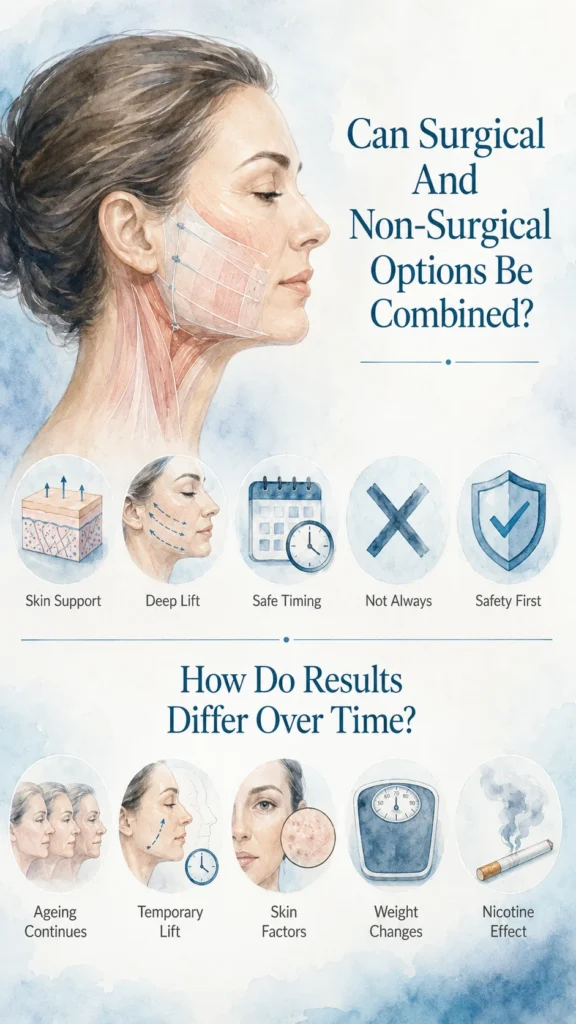
Surgical and non-surgical options may be combined in selected patients, but timing and suitability matter. Some treatments may be considered before surgery, while others may be discussed after healing has progressed.
- Non-surgical treatments may support selected skin quality concerns.
- Facelift surgery may address deeper structural concerns.
- Timing after surgery should be guided by the treating clinician.
- Not every device treatment is suitable after facelift surgery.
- Combined planning should be based on anatomy and safety, not trends.
Patients should avoid arranging device-based treatments too soon after surgery unless cleared by their treating team. Dr Michael Kernohan can discuss whether staged care, referral for skin-focused treatment, surgery alone or no treatment may be more appropriate.
How Do Results Differ Over Time?
Results differ over time because facelift surgery and non-surgical tightening work at different tissue depths. Facelift results may remain noticeable for several years in suitable patients, while non-surgical tightening results are usually more limited and may need repeat treatments.
- Facelift surgery does not stop ageing.
- Non-surgical tightening results are usually temporary.
- Skin quality, genetics and sun exposure affect both pathways.
- Weight changes can affect the lower face and neck.
- Smoking, vaping or nicotine use can affect tissue behaviour.
The longer-term outcome depends on anatomy, treatment choice, healing and future ageing. A larger procedure does not guarantee a fixed result, and a smaller treatment may not meet expectations if deeper laxity is present.
How Does Recovery Compare?

Recovery after facelift surgery is usually more involved than recovery after non-surgical tightening because surgery involves incisions, tissue handling and a healing period. Non-surgical tightening may involve less interruption to usual activities, but this does not mean it creates the same degree of change.
- Facelift surgery may involve swelling, bruising and incision care.
- Activity restrictions are usually needed after surgery.
- Facelift scars mature over months.
- Non-surgical tightening may cause redness, swelling or tenderness.
- Device-related side effects vary depending on the treatment.
Recovery should not be the only reason to choose a treatment. The more important question is whether the treatment can reasonably address the patient’s concern.
How Does Dr Michael Kernohan Assess Suitability?
Dr Michael Kernohan assesses suitability by looking at the patient’s anatomy, health, skin quality and expectations. The aim is to understand what tissue layers are contributing before discussing surgery, non-surgical care, staged planning or no treatment.
- The patient’s main concern is discussed in their own words.
- The lower face, jawline and neck are assessed.
- Skin quality and elasticity are reviewed.
- The degree of tissue laxity is considered.
- Medical history, medications and allergies are discussed.
- Smoking, vaping or nicotine use is reviewed.
- Previous surgery, injectables or device treatments are considered.
This assessment helps separate skin-focused concerns from deeper structural concerns. After review, Dr Michael Kernohan may discuss facelift surgery, non-surgical tightening, skin-focused care, referral, delaying treatment or no treatment.
What Risks And Limitations Should Patients Understand?
Facelift surgery and non-surgical tightening both have risks and limitations. The risks differ because the treatments work in different ways and at different tissue depths.
Facelift surgery risks may include:
- Bleeding or haematoma.
- Infection.
- Delayed wound healing.
- Scarring.
- Altered sensation or numbness.
- Facial nerve-related movement changes.
- Asymmetry.
- Hairline or ear-area changes.
- Skin healing concerns.
- Anaesthetic risks.
Non-surgical tightening risks may include:
- Redness or swelling.
- Tenderness or sensitivity.
- Pigment change.
- Burns or blisters in rare cases.
- Prolonged swelling.
- Uneven response.
- Limited or temporary effect.
- Need for repeat treatments.
Neither pathway can stop ageing or guarantee a specific appearance. Dr Michael Kernohan discusses the risks and limits of surgery, and may recommend referral to an appropriate clinician if a skin-focused treatment is more suitable.
Why Is Informed Consent Important?
Informed consent is important because patients need to understand what a treatment can and cannot do before deciding. This includes the likely benefits, risks, recovery, alternatives and limitations.
- The proposed treatment should be explained clearly.
- Risks and complications should be discussed.
- Recovery expectations should be realistic.
- Alternatives, including no treatment, should be reviewed.
- Patients should have time to ask questions.
Informed consent is not just a form. It is a discussion that helps the patient make a decision based on their anatomy, health and expectations.

What Is Recovery Like After Facelift Surgery?
Recovery after facelift surgery varies between patients and depends on the procedure performed. Patients should expect swelling, bruising, incision care and activity restrictions during early healing.
- Swelling and bruising may affect the lower face, jawline and neck.
- Incisions need care while healing.
- Tightness or altered sensation may occur.
- Time away from work or usual activities may be needed.
- Follow-up appointments are important.
Scars and deeper tissues continue to settle over months. Dr Michael Kernohan provides post-operative instructions based on the surgical plan and the patient’s healing progress.
What Is Recovery Like After Non-Surgical Tightening?
Recovery after non-surgical tightening depends on the device, treatment depth, treatment settings and skin response. Some patients may have redness or swelling, while others may have tenderness, sensitivity or temporary changes in skin colour.
- Redness may occur after some treatments.
- Swelling or tenderness may occur.
- Skin sensitivity may last for a period.
- Some treatments require repeat sessions.
- Sun protection and skin care may be advised.
Patients should follow the instructions provided by the treating clinician. Even when recovery is shorter than surgery, non-surgical treatment still has risks and should be performed by an appropriately trained practitioner.
Facelift Before and After Photo
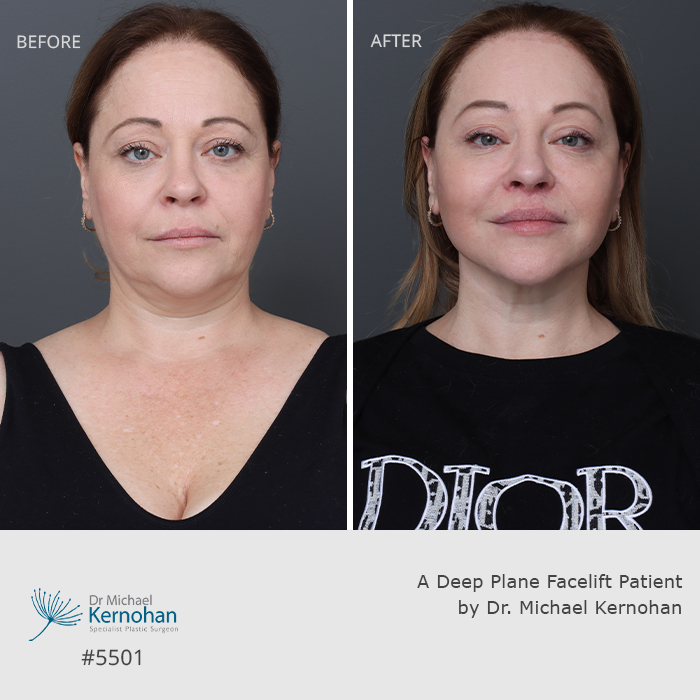
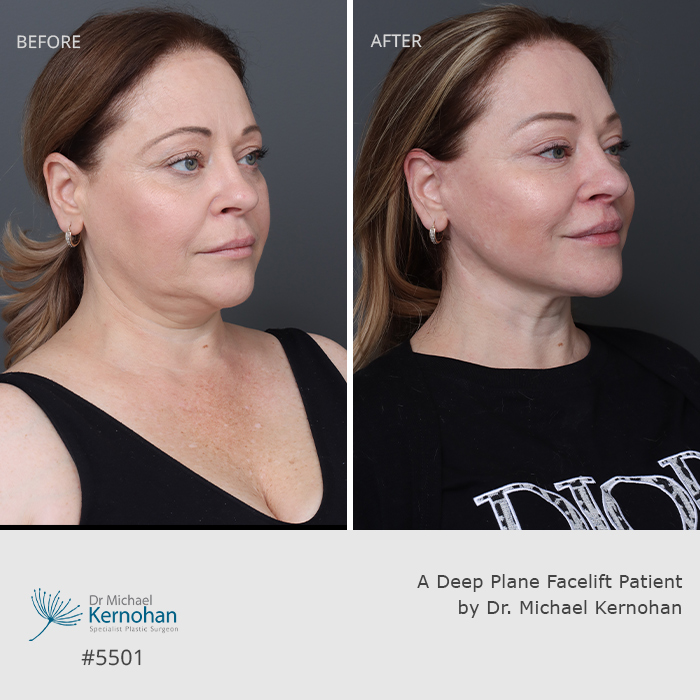
Disclaimer: All surgical or invasive procedures come with inherent risks, and results can vary widely between individuals due to factors like lifestyle, anatomy, overall health, weight, and nutrition. We encourage you to conduct thorough research and consider seeking a second opinion from a qualified healthcare provider.
What Alternatives Should Patients Consider?
Alternatives should be considered before choosing facelift surgery or non-surgical tightening. In some cases, delaying treatment, choosing skin-focused care, or choosing no treatment may be more appropriate.
- No treatment.
- Delaying treatment.
- Skin care and sun protection.
- Dermatology-led treatment for texture or pigmentation.
- Non-surgical tightening in selected patients.
- Facelift surgery.
- Facelift with neck lift where appropriate.
- Staged treatment planning.
- Second opinion if unsure.
Some patients may need more than one opinion, especially if the concern is unclear or expectations are uncertain. Dr Michael Kernohan discusses alternatives as part of informed consent before any surgical recommendation is made.
Who May Be Suitable For Facelift Surgery?
Patients may be suitable for facelift surgery when their concerns involve deeper lower-face, jawline or neck changes that are unlikely to respond to skin-focused treatment alone. Suitability also depends on health, recovery capacity and expectations.
- Lower-face laxity is present.
- Jowls affect the jawline.
- Neck changes may need combined planning.
- Excess skin is part of the concern.
- The patient is medically suitable for surgery and anaesthesia.
- Smoking, vaping or nicotine use can be stopped as advised.
- The patient understands scars, risks and recovery.
Suitability cannot be confirmed from a short description or photo alone. Dr Michael Kernohan assesses the face, jawline, neck, skin quality and medical history before discussing whether surgery may be appropriate.
Who May Be Suitable For Non-Surgical Tightening?
Patients may be suitable for non-surgical tightening when concerns are mild and mainly related to skin firmness or early laxity. They should understand that the degree of change is usually more limited than surgery.
- Mild laxity is present.
- Skin firmness is the main concern.
- Deeper tissue descent is not the dominant issue.
- The patient is not ready or suitable for surgery.
- The patient accepts that repeat treatments may be needed.
- Expectations are realistic.
A non-surgical pathway may be useful for selected patients, but it should not be chosen because surgery is being avoided at all costs. The treatment still needs to match the concern.
Who May Not Be Suitable?
Some patients may not be suitable for facelift surgery, non-surgical tightening or either pathway. This may relate to medical risk, skin condition, expectations or the nature of the concern.
- Uncontrolled medical conditions.
- High anaesthetic risk for surgery.
- Smoking or nicotine use that cannot be stopped before surgery as advised.
- Active skin infection or untreated skin disease in the treatment area.
- Expectations that non-surgical tightening will equal surgery.
- Expectations that surgery will remove every line or stop ageing.
- Need for further medical or psychological assessment.
In some cases, no treatment or delayed treatment may be the most appropriate option. Dr Michael Kernohan will explain if surgery is unsuitable and may recommend another pathway or referral where needed.
Are Costs Relevant When Comparing Facelift And Non-Surgical Tightening?
Costs are relevant when comparing treatment pathways, but they should not be the main reason to choose one option over another. A lower-cost treatment may not address deeper tissue laxity, and a higher-cost procedure does not guarantee a specific outcome.
- Facelift surgery usually has higher upfront costs.
- Surgery may involve surgeon, anaesthetist, facility and follow-up fees.
- Non-surgical treatments may have lower per-session costs.
- Repeat non-surgical treatments may be needed.
- Costs vary by treatment type, complexity and provider.
- Individual cost information should be provided after consultation.
The more important question is whether the option is suitable for the concern. Dr Michael Kernohan discusses treatment suitability before cost should guide decision-making.
Take the Quiz
Summary
Facelift surgery and non-surgical tightening are different pathways. Facelift surgery may address selected deeper structural concerns in the lower face, jawline and neck, while non-surgical tightening usually focuses on mild skin laxity or skin firmness.
The options differ in treatment depth, risks, recovery, likely degree of change, longevity and cost. Some patients may be suited to surgery, some may be suited to non-surgical care, and others may be better served by staged planning, referral, delayed treatment or no treatment.
Dr Michael Kernohan, Specialist Plastic & Reconstructive Surgeon in Sydney, assesses anatomy, skin quality, health and expectations before discussing options. This helps patients understand which pathway may be appropriate and what limits should be considered.

FAQs About Facelift vs Non‑Surgical Tightening
Next Step: Discuss Facelift Vs Non-Surgical Tightening With Dr Kernohan
Choosing between a facelift and non‑surgical tightening depends on a number of factors, including degree of facial ageing, tissue laxity, lifestyle preferences and long‑term goals.
Dr Michael Kernohan offers personalised consultations in Sydney to guide patients through these choices with clinical clarity and tailored advice. His clinic website has pages and resources for scheduling an appointment or requesting a photographic assessment securely. Thoughtful planning and informed choice are key steps in your facial rejuvenation journey.
Download Dr Michael Kernohan’s Facelift Surgery Guide
Further Reading
- Read Dr Michael Kernohan’s Procedure Page on Facelift Surgery Sydney
- Read Dr Michael Kernohan’s Procedure Page on Medispa / Non-Surgical Treatments
- Read Dr Michael Kernohan’s Procedure Page on Deep Plane Facelift NSW
- Read Dr Michael Kernohan’s Procedure Page on Partial Facelift Surgery NSW
- Read Dr Michael Kernohan’s Blog about SMAS vs Deep Plane Facelift
- Read Dr Michael Kernohan’s Support Page on Facelift Risks and Complications
- Read Dr Michael Kernohan’s Support Page on Facelift Recovery
- Read Dr Michael Kernohan’s Procedure Page on CoolPeel CO2 Laser

Facelift Vs Non‑Surgical Tightening: What’s Right For Your Facial Goals
Introduction Dr Michael Kernohan is a Specialist Plastic & Reconstructive Surgeon in Sydney. Facelift surgery…
How to Choose a Facelift Surgeon in Sydney
Dr Michael Kernohan, Specialist Plastic & Reconstructive Surgeon in Sydney, understands that choosing a facelift…

Male Neck Lift Considerations – Why Techniques Differ for Men
Introduction Dr Michael Kernohan is a Specialist Plastic & Reconstructive Surgeon in Sydney. Male neck…