

- At a Glance
- Why Does Choosing a Facelift Surgeon Matter?
- What Qualifications Should a Facelift Surgeon Have in Australia?
- What Does “Specialist Plastic & Reconstructive Surgeon” Mean?
- How Can Patients Check a Surgeon’s Registration?
- What Should Happen During a Facelift Consultation?
- What Questions Should Patients Ask Before Facelift Surgery?
- Why Should the Face and Neck Be Assessed Together?
- How Important Are Before-And-After Photos?
- Facelift Before and After Photos
- Different Facelift Approaches May Be Discussed
- What Red Flags Should Patients Look Out For?
- How Do Australian Cosmetic Surgery Standards Affect Patients?
- What Role Do Communication and Informed Consent Play?
- What Risks and Limitations Should Be Discussed?
- What Is Recovery Planning Like With a Facelift Surgeon?
- Why Is Aftercare Important When Choosing a Facelift Surgeon?
- What Alternatives Should Patients Consider Before Facelift Surgery?
- Who May Be Suitable for Facelift Surgery?
- Who May Not Be Suitable for Facelift Surgery?
- Are Costs Relevant When Choosing a Facelift Surgeon?
- Take the Quiz
- Summary
- FAQs About Choosing a Facelift Surgeon
- Download Dr Kernohan’s Facelift Surgery Guide
- Book A Consultation With Dr Michael Kernohan
- Further Reading
Dr Michael Kernohan, Specialist Plastic & Reconstructive Surgeon in Sydney, understands that choosing a facelift surgeon can feel difficult for many patients. There may be several doctors to compare, many procedure names to understand, and a large amount of online information to sort through.
Facelift surgery involves the lower face, jawline, neck, skin, deeper facial support layers, blood supply, scars and facial nerves. Because of this, the decision should not be based on advertising, social media images or price alone.
A careful choice starts with checking qualifications, specialist registration, communication style, surgical planning, facility standards and aftercare. Patients should also feel able to ask questions, take time to decide and seek another opinion if they feel unsure.
This article explains what to consider when choosing a facelift surgeon in Australia. It is general information only and does not replace a consultation with Dr Michael Kernohan.
At a Glance
How Do I Choose a Facelift Surgeon?
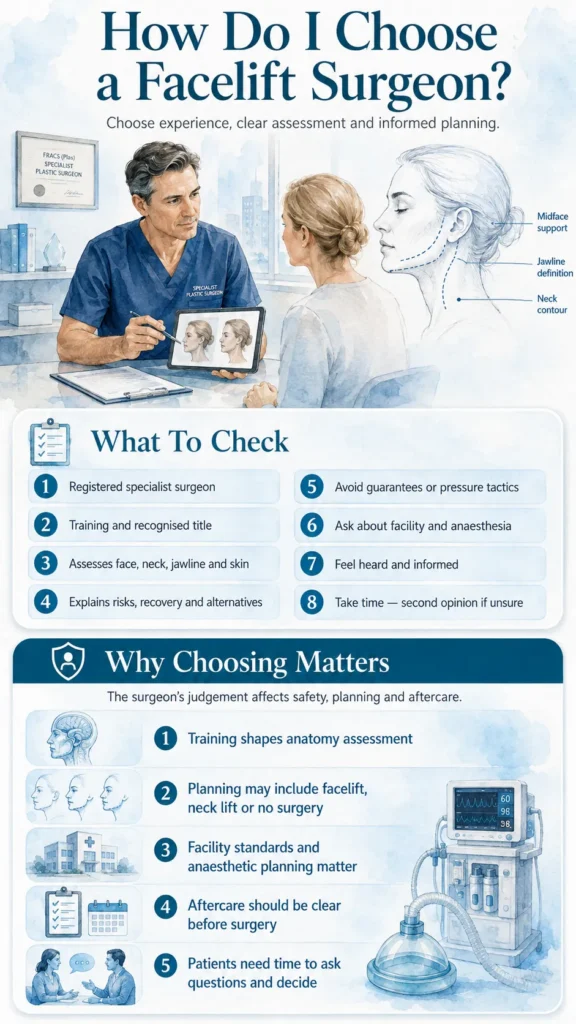
- Choose a facelift surgeon by checking their specialist registration, surgical training, experience with face and neck anatomy, consultation process, facility access, informed consent approach, and how clearly they explain risks, recovery and alternatives.
- Check whether the doctor is a registered specialist surgeon.
- Confirm their training and recognised specialist title.
- Ask how they assess the face, neck, jawline and skin quality.
- Review whether the consultation includes risks, recovery and alternatives.
- Be cautious of guaranteed results, pressure tactics or promotional claims.
- Ask where the surgery is performed and who provides anaesthesia.
- Consider whether you feel heard, informed and able to ask questions.
- Take time to decide and consider a second opinion if uncertain.
A good consultation should help you understand your anatomy and options, not pressure you into surgery. Dr Michael Kernohan encourages patients to make decisions after they understand the likely benefits, limits, risks, recovery and alternatives.
Why Does Choosing a Facelift Surgeon Matter?
Choosing a facelift surgeon matters because facelift surgery is a surgical procedure, not a surface skin treatment. It involves the skin, deeper support layers, facial movement, scars, healing and recovery planning.
- The surgeon’s training affects how anatomy is assessed.
- The consultation should include the face, jawline, neck and skin quality.
- Surgical judgement affects whether facelift, neck lift, combined planning or no surgery is discussed.
- Facility standards and anaesthetic planning are important.
- Aftercare should be clear before surgery takes place.
- Patients should have time to ask questions and consider their decision.
A facelift surgeon should explain what surgery may address and what it cannot address. Dr Michael Kernohan, Specialist Plastic & Reconstructive Surgeon in Sydney, bases facelift planning on anatomy, health, expectations and informed consent.
What Qualifications Should a Facelift Surgeon Have in Australia?
Patients should check qualifications carefully before choosing a facelift surgeon in Australia. Marketing terms, social media content and procedure names do not replace recognised medical registration and surgical training.
- The doctor should be registered with AHPRA.
- Patients can check whether specialist registration applies.
- The surgeon should be clear about their training and field of specialty.
- The surgeon should explain where surgery is performed.
- Anaesthetic arrangements should be discussed clearly.
- Patients should be cautious if qualifications are vague or hard to verify.
Checking credentials is a practical step, not a formality. It helps patients understand who is providing their care and whether the doctor has recognised specialist training relevant to surgery.
What Does “Specialist Plastic & Reconstructive Surgeon” Mean?

A Specialist Plastic & Reconstructive Surgeon is a doctor with recognised specialist surgical training in plastic and reconstructive surgery. This training includes anatomy, wound healing, scars, tissue handling and complex surgical planning.
- The title relates to recognised specialist surgical training.
- It includes training in skin, soft tissue, scars and reconstruction.
- It is relevant to facial and neck surgery planning.
- It does not remove the need for a personal consultation.
- Patients should still ask about the surgeon’s experience with the procedure being considered.
Title clarity helps patients compare providers more accurately.
Dr Michael Kernohan is a Specialist Plastic & Reconstructive Surgeon in Sydney. During consultation, he can explain how this training relates to facelift and neck lift planning.
How Can Patients Check a Surgeon’s Registration?
Patients can check a surgeon’s registration through the AHPRA public register. This is a useful way to confirm a doctor’s name, registration type and specialist registration where applicable.
- Search the doctor’s full name on the AHPRA public register.
- Check the registration type listed.
- Look for specialist registration if relevant.
- Review the field of specialty.
- Check whether any conditions or limitations are listed.
- Ask the clinic for clarification if anything is unclear.
Patients should not rely only on website wording or social media descriptions. Taking a few minutes to check official registration can make the decision process clearer.
What Should Happen During a Facelift Consultation?
A facelift consultation should be a structured medical appointment, not a sales-style discussion. It should include a review of the patient’s concerns, health history, facial anatomy, neck anatomy, risks, alternatives and recovery planning.
- The surgeon should ask what concerns the patient most.
- Medical history, medications and allergies should be reviewed.
- Smoking, vaping and nicotine use should be discussed.
- The face, neck, jawline and skin quality should be assessed.
- Procedure options should be explained in plain language.
- Scars, recovery, risks and limitations should be discussed.
- Alternatives, including no surgery, should be included.
A consultation should help patients understand whether surgery is appropriate, not simply which procedure name to choose. Dr Michael Kernohan uses the consultation to assess anatomy and explain options based on the patient’s individual situation.
What Questions Should Patients Ask Before Facelift Surgery?
Patients should feel comfortable asking direct questions before facelift surgery. A useful consultation should give enough information to help the patient compare options and understand what is involved.
- Are you a registered specialist surgeon?
- What is your specialist training?
- Where would the surgery be performed?
- Who provides the anaesthetic?
- What procedure may suit my anatomy?
- Do I need neck lift planning as well?
- What scars should I expect?
- What are the main risks in my case?
- What is the recovery plan?
- What alternatives should I consider?
- What should I do if I have concerns after surgery?
Good questions often lead to a clearer consultation. If a patient feels rushed, dismissed or unable to ask questions, it may be worth taking more time before deciding.
Why Should the Face and Neck Be Assessed Together?
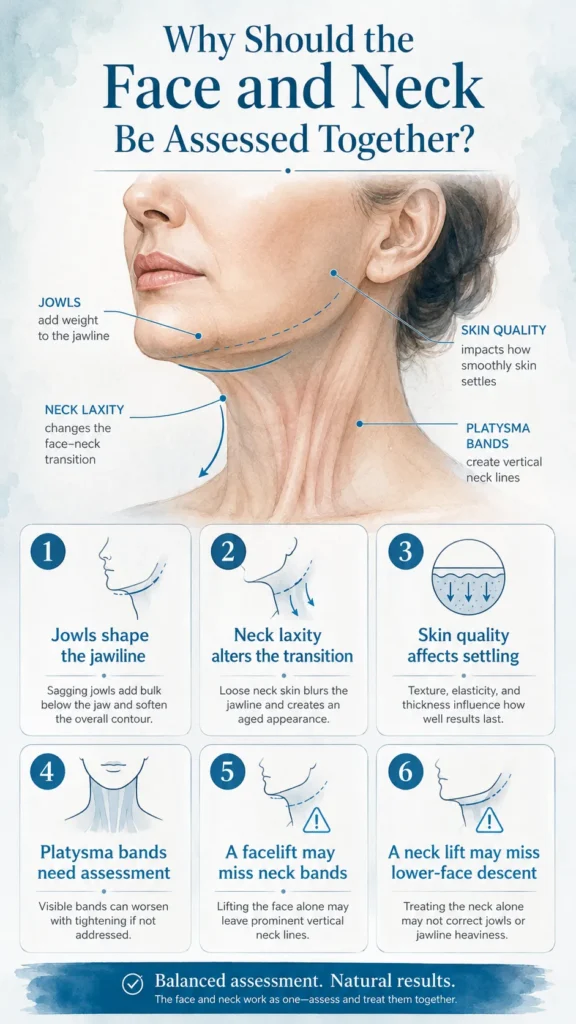
The face and neck should often be assessed together because lower-face and neck changes can overlap. A concern that seems to be only in the jawline may involve the neck, and a neck concern may partly come from lower-face tissue descent.
- Jowls can affect the jawline and upper neck.
- Neck laxity can affect the face-neck transition.
- Skin quality influences how tissues may settle.
- Platysma bands may need separate neck assessment.
- A facelift alone may not address neck bands.
- A neck lift alone may not address lower-face descent.
This is why Dr Michael Kernohan assesses the lower face, jawline and neck together during facelift planning. The aim is to avoid choosing a procedure that does not match the actual cause of the concern.
How Important Are Before-And-After Photos?
Before-and-after photos can be useful, but they should not be the only reason to choose a facelift surgeon. Photos may show examples of a surgeon’s general approach, but they cannot predict an individual patient’s outcome.
- Ask whether photos show similar anatomy and procedure type.
- Lighting, angles, facial expression and camera distance can affect photos.
- Results vary between patients.
- Photos do not replace a physical examination.
- Patients should avoid expecting another person’s result.
- Photos should be viewed as part of a broader decision process.
A careful consultation is more important than comparing images alone. Dr Michael Kernohan can explain why different anatomy, skin quality, age, recovery and procedure planning may lead to different outcomes.
Facelift Before and After Photos
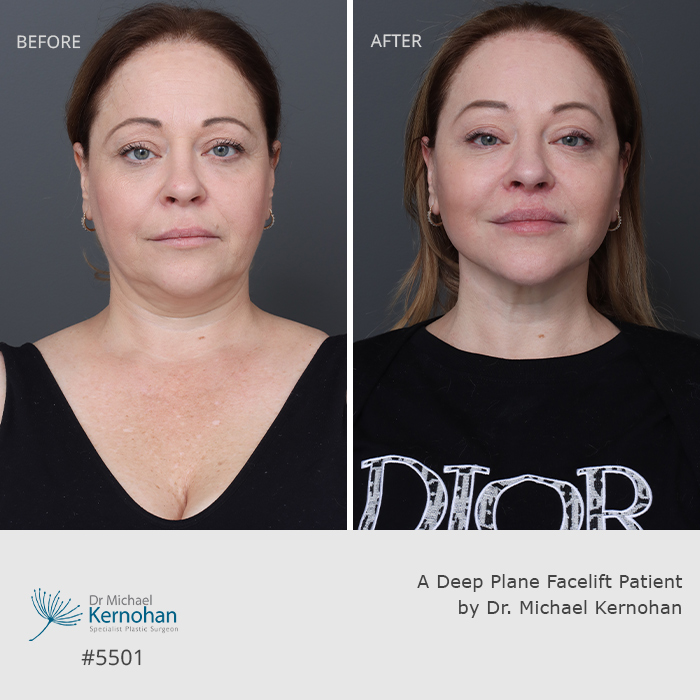
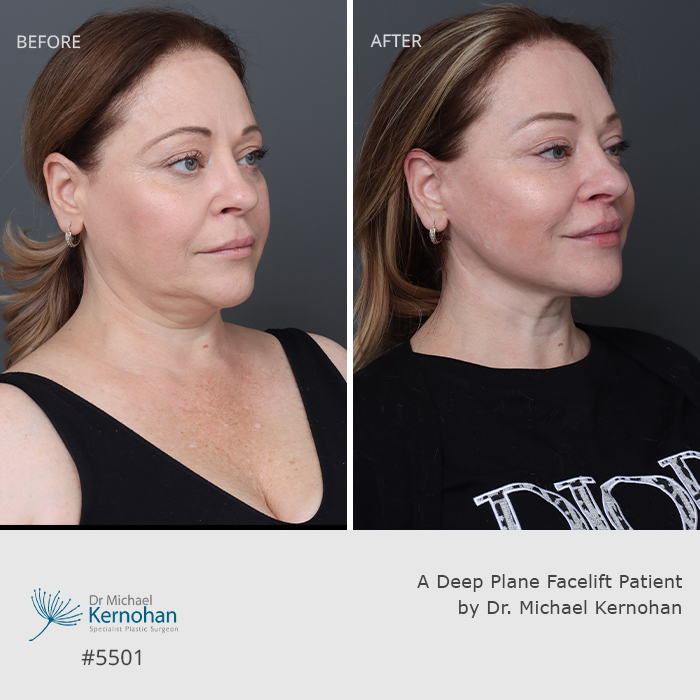
Disclaimer: All surgical or invasive procedures come with inherent risks, and results can vary widely between individuals due to factors like lifestyle, anatomy, overall health, weight, and nutrition. We encourage you to conduct thorough research and consider seeking a second opinion from a qualified healthcare provider.
Different Facelift Approaches May Be Discussed
During consultation, a surgeon may discuss different facelift approaches, such as SMAS, deep plane, partial facelift or combined face-and-neck surgery, depending on the areas being assessed. The technique name alone does not determine suitability, so the discussion should focus on anatomy, risks, recovery and the proposed surgical plan.
For more detail on facelift procedures, see our Facelift Surgery Sydney page and SMAS vs Deep Plane Facelift guide.
What Red Flags Should Patients Look Out For?
Patients should be cautious if the consultation or advertising feels pressured, unclear or unrealistic. A responsible surgical discussion should include limitations, risks, recovery and alternatives.
- Guaranteed results.
- Pressure to book quickly.
- Discount-led decision-making.
- Vague or unclear qualifications.
- Little or no discussion of risks.
- No discussion of alternatives.
- Unclear aftercare arrangements.
- Surgery performed in unclear settings.
- Refusal to answer questions.
- Heavy reliance on social media images.
Feeling uncertain after a consultation is a valid reason to pause. Patients can ask more questions, request written information or seek another opinion before deciding.
How Do Australian Cosmetic Surgery Standards Affect Patients?
Australian cosmetic surgery standards are designed to support informed decision-making, safer care and clearer communication. Patients considering facelift surgery should expect a careful consultation process, clear information and time to consider their decision.
- The surgeon should explain the procedure in plain language.
- Risks, recovery, limitations and alternatives should be discussed.
- Patients should be given time to ask questions.
- Written information should support the consent process.
- Facility and anaesthetic arrangements should be clear.
- Advertising should not create unrealistic expectations.
- Patients can seek a second opinion if uncertain.
These standards help patients make decisions based on information rather than pressure. Dr Michael Kernohan, Specialist Plastic & Reconstructive Surgeon in Sydney, discusses facelift surgery in the context of anatomy, safety, recovery and informed consent.
What Role Do Communication and Informed Consent Play?
Communication and informed consent are central to choosing a facelift surgeon. A patient should understand the likely procedure, scars, recovery, risks, alternatives and limitations before deciding whether to proceed.
- The surgeon should listen to the patient’s main concerns.
- The explanation should match the patient’s anatomy.
- Risks should be discussed clearly.
- Recovery should be described realistically.
- Alternatives, including no surgery, should be included.
- The patient should feel able to pause or ask more questions.
Informed consent is not just a form signed before surgery. It is a process that helps patients decide whether the procedure is suitable for their health, goals and circumstances.
What Risks and Limitations Should Be Discussed?
A facelift surgeon should discuss both general surgical risks and patient-specific risks. The discussion should also include what surgery cannot reliably change.
- Bleeding or haematoma can occur after facelift surgery.
- Infection or delayed wound healing is possible.
- Scars may be visible, raised, widened or slower to settle than expected.
- Numbness, tingling or altered sensation may occur.
- Facial nerve-related movement changes are uncommon but important to discuss.
- Asymmetry or residual laxity may remain.
- Skin healing problems can occur, especially in higher-risk patients.
- Anaesthetic risks should be explained.
- Surgery cannot stop future ageing.
- Revision surgery may not always be suitable.
The risks are not the same for every patient. Dr Michael Kernohan considers medical history, medications, smoking or nicotine use, skin quality, previous surgery and procedure extent when discussing individual risk.
What Is Recovery Planning Like With a Facelift Surgeon?
Recovery planning should be discussed before surgery. Patients should understand the expected early recovery, follow-up schedule, activity limits and signs that should prompt contact with the clinic.
- Swelling and bruising are expected after surgery.
- Tightness, firmness or altered sensation may occur.
- Dressings, drains or support garments may be used depending on the plan.
- Activity restrictions are usually needed during early healing.
- Time away from work depends on the procedure and job demands.
- Wound and scar care should be explained.
- Follow-up appointments should be arranged.
- Patients should know how to contact the clinic if concerns arise.
Recovery varies between patients. Dr Michael Kernohan provides post-operative instructions based on the procedure performed, the patient’s health and how healing progresses.
Why Is Aftercare Important When Choosing a Facelift Surgeon?
Aftercare is an important part of facelift planning because healing continues after the operation. Patients should understand who will review them, when appointments are scheduled and what to do if symptoms change.
- Follow-up care allows wounds and scars to be checked.
- Swelling, bruising and sensation changes can be monitored.
- Early concerns can be assessed.
- Activity restrictions can be adjusted as healing progresses.
- Patients can ask questions during recovery.
- Scar care advice may change over time.
A surgeon’s aftercare process should be clear before surgery. Patients should avoid choosing a surgeon without understanding how post-operative review and support are provided.
What Alternatives Should Patients Consider Before Facelift Surgery?
Alternatives should be discussed before facelift surgery so patients can compare options. The right pathway may be no surgery, delayed surgery, skin-focused care, neck lift planning, combined surgery or staged surgery.
- No surgery may be appropriate if the concern is mild or the risks are not acceptable.
- Delaying surgery may be sensible if timing, health or expectations need more planning.
- Skin care and sun protection may support skin quality.
- Dermatology-led treatments may help texture or pigmentation concerns.
- A neck lift alone may be considered when the concern is mainly in the neck.
- Facelift with neck lift may be discussed when the lower face and neck both contribute.
- Staged surgery may be appropriate for some patients.
Non-surgical treatments may support skin quality, but they do not replace facelift surgery when deeper tissue laxity is the main concern. A consultation helps clarify which options are reasonable for the patient’s anatomy.
Who May Be Suitable for Facelift Surgery?
A patient may be suitable for facelift surgery if their concern matches what the procedure can address and they are medically suitable for surgery and anaesthesia. Suitability depends on anatomy, health, recovery capacity and expectations.
- The patient has lower-face laxity or jowls suitable for facelift assessment.
- Neck concerns may also be present and require combined planning.
- The patient is in suitable general health for surgery.
- Weight is reasonably stable.
- Smoking, vaping or nicotine use has been discussed and managed.
- The patient understands scars, recovery, risks and limitations.
- The patient can attend follow-up appointments.
- Expectations are realistic and based on personal anatomy.
Suitability cannot be confirmed from photos alone. Dr Michael Kernohan assesses the face, neck, jawline, skin quality, medical history and patient priorities before discussing whether facelift surgery is appropriate.
Who May Not Be Suitable for Facelift Surgery?
Some patients may not be suitable for facelift surgery, or may need to delay surgery until risks are better managed. This may include patients with medical risks, unrealistic expectations or concerns better addressed by another pathway.
- Uncontrolled medical conditions may need review first.
- High anaesthetic risk may make surgery unsuitable.
- Smoking or nicotine use can increase wound-healing risks.
- Unstable weight may affect planning and longer-term outcomes.
- Skin texture concerns may need dermatology-led treatment instead.
- Expectations that surgery cannot reasonably meet may make surgery unsuitable.
- Patients who feel pressured or uncertain should take more time.
- Patients not ready for recovery or follow-up care may need to delay surgery.
Not being suitable for facelift surgery at one point does not always mean surgery will never be an option. Dr Michael Kernohan may recommend medical review, waiting, another procedure, staged planning, skin-focused care or no surgery depending on the situation.
Are Costs Relevant When Choosing a Facelift Surgeon?
Costs are relevant for planning, but they should not be the main reason to choose a facelift surgeon. A lower fee does not replace credential checks, facility standards, anaesthetic planning, informed consent and aftercare.
- Costs vary depending on procedure type and complexity.
- Surgeon, anaesthetist and facility fees may differ.
- Combined procedures may involve different planning.
- Aftercare inclusions may vary between clinics.
- Staged surgery may involve different cost considerations.
- Individual cost information should be provided after consultation.
Patients should compare more than the quoted amount. It is more useful to understand what is included, where surgery is performed, who provides anaesthesia, what aftercare is provided and whether the recommended plan matches the patient’s anatomy.
Take the Quiz
Summary
Choosing a facelift surgeon should be based on credentials, communication, surgical planning, facility standards, aftercare and informed consent. Patients should feel able to ask questions, check registration, compare information and take time before deciding.
A facelift consultation should include assessment of the lower face, jawline, neck, skin quality, medical history and expectations. It should also include discussion of risks, recovery, scars, alternatives and whether surgery is suitable.
Dr Michael Kernohan, Specialist Plastic & Reconstructive Surgeon in Sydney, provides consultation-based advice for patients considering facelift surgery. The aim is to help patients understand their anatomy, options and responsibilities before deciding whether surgery, another pathway or no surgery may be appropriate.

FAQs About Choosing a Facelift Surgeon
Download Dr Kernohan’s Facelift Surgery Guide
Book A Consultation With Dr Michael Kernohan
If you’re exploring facelift options, the first step is a detailed consultation with a qualified specialist. Dr Michael Kernohan welcomes patients from across Sydney and offers personalised guidance based on your anatomy, goals, and lifestyle.
To schedule a consultation or request a photographic assessment, contact the clinic today. Whether you are in the early stages of planning or ready to take the next step, Dr Kernohan’s team is here to help you make informed, confident decisions about your facial surgery journey.
Further Reading
- Read Dr Michael Kernohan’s Procedure Page on Facelift Surgery
- Read Dr Michael Kernohan’s Procedure Page on Deep Plane Facelift
- Read Dr Michael Kernohan’s Procedure Page on Partial Facelift
- Read Dr Michael Kernohan’s Procedure Page on Neck Lift Surgery
- Read Dr Michael Kernohan’s Guide to Plastic Surgery Risks and Complications
- Read Dr Michael Kernohan’s Blog about SMAS vs Deep Plane Facelift
- Read Dr Michael Kernohan’s Blog about How to Prepare for a Facelift Safely
- Read Dr Michael Kernohan’s Blog about Facelift Under General Anaesthesia

What is a Ponytail Facelift?
A Less Invasive Facelift for Natural-Looking Results The ponytail facelift is a cutting-edge, short scar…

How to Sleep after a Facelift
What to Expect & How to Sleep After Your Facelift Procedure If you are considering…

Facelift for Men: What You Need to Know
Your Guide to Facelift Surgery for Men Today, it’s increasingly common for men to undergo…