
- Introduction
- Quick Answer Box
- What Does A Facelift Mainly Address?
- What Are The Limits Of Facelift Surgery?
- What Does Brow Lift Surgery Address?
- How Can Brow Position Affect The Eyelids?
- What Does Eyelid Surgery Address?
- Why Is Eye Health Important Before Eyelid Surgery?
- Why Are These Procedures Sometimes Discussed Together?
- Why Should Procedure Choice Be Anatomy-Led?
- When May Facelift And Brow Lift Be Combined?
- When Might Facelift And Brow Lift Not Be Combined?
- Download Dr Kernohan’s Face and Neck Surgery Guide
- When May Facelift And Eyelid Surgery Be Combined?
- What Should Be Reviewed Before Combining Facelift And Eyelid Surgery?
- When May Brow Lift And Eyelid Surgery Be Discussed Together?
- When May Combined Facial Surgery Be Too Much?
- When May Staged Surgery Be More Appropriate?
- Facelift Before and After Photos
- How Does Dr Michael Kernohan Assess Combined Facial Surgery?
- What Risks And Limitations Should Patients Understand?
- Why Is Eye Health Important In Combined Planning?
- What Is Recovery Like After Combined Facial Surgery?
- How Long Does Recovery Take?
- What Alternatives Should Patients Consider?
- Who May Be Suitable For Combined Facial Surgery?
- Who May Not Be Suitable?
- Are Costs Relevant When Combining Facial Procedures?
- Take the Quiz
- Summary
- Combining Facelift With Brow Lift Or Eyelid Surgery FAQs
- Next Step: Achieve Holistic Facial Rejuvenation With Dr Kernohan’s Guidance
- Further Reading
Introduction
Dr Michael Kernohan is a Specialist Plastic & Reconstructive Surgeon in Sydney. Facelift surgery may be combined with brow lift or eyelid surgery in selected patients when concerns involve more than one facial region.
A facelift mainly addresses the lower face, jowls, jawline and selected neck concerns when neck lift planning is included. Brow lift surgery addresses selected brow position and forehead-related concerns, while eyelid surgery, or blepharoplasty, addresses selected upper or lower eyelid concerns.
This article explains when combined facial surgery may be considered, when staged surgery may be more appropriate, what Dr Michael Kernohan assesses, and what patients should understand about risks, recovery, alternatives and suitability before deciding.
Quick Answer Box
✓ Can Facelift Surgery Be Combined With Brow Lift Or Eyelid Surgery?
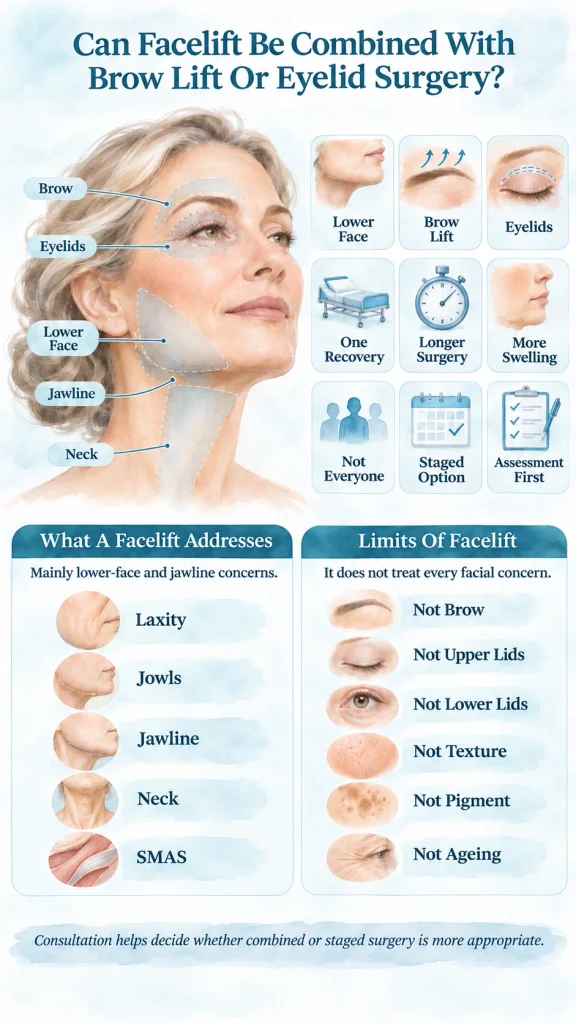
Facelift surgery may be combined with brow lift or eyelid surgery in selected patients when the lower face, brow or eyelids are all contributing to the patient’s concern. Combined surgery depends on anatomy, health, procedure extent, anaesthetic planning, recovery capacity and risk profile.
Key points:
- Facelift surgery mainly addresses lower-face laxity, jowls and jawline concerns
- Brow lift surgery addresses selected brow position and forehead-related concerns
- Eyelid surgery addresses selected upper or lower eyelid concerns
- Combining procedures may reduce the number of separate recovery periods for some patients
- Combined surgery can increase operative time, swelling and recovery planning
- Not every patient is suitable for combined facial surgery
- Staged surgery may be safer or more practical in some cases
- Dr Michael Kernohan assesses anatomy, health, expectations and recovery support before discussing options
Some patients may be better suited to one procedure alone, staged surgery, another pathway or no surgery. A consultation helps clarify which regions are contributing and which plan may be appropriate.
What Does A Facelift Mainly Address?
A facelift mainly addresses selected lower-face and jawline concerns. It may be considered when jowls, lower-face laxity or changes around the jawline are the main concerns.
- Lower-face laxity may be assessed
- Jowls along the jawline may be addressed
- Jawline support may be part of the surgical plan
- Selected neck concerns may be included if neck lift planning is needed
- Deeper support layers such as the SMAS may be considered where appropriate
Facelift surgery does not treat every part of the face. It does not correct brow position, and it does not address all eyelid concerns.
What Are The Limits Of Facelift Surgery?
Facelift surgery has limits because it focuses mainly on the lower face and related neck concerns. Patients sometimes expect it to address the whole face, but the upper face and eyelids often require separate assessment.
- It does not lift the brow
- It does not remove upper eyelid skin excess
- It does not correct lower eyelid fat or skin concerns
- It does not treat every skin texture or pigmentation issue
- It cannot stop ageing
Understanding these limits helps patients avoid choosing the wrong procedure. Dr Michael Kernohan explains what a facelift may reasonably address and what may need a different discussion.
What Does Brow Lift Surgery Address?
Brow lift surgery addresses selected concerns related to brow position and forehead tissue. It may be discussed when the brow position contributes to heaviness around the upper eye area or forehead region.
- Brow position is assessed
- Forehead tissue position may be reviewed
- Brow heaviness may be assessed separately from eyelid skin
- Incision placement and scar planning are part of the discussion
- Facial symmetry is considered
Brow lift surgery does not address lower-face laxity, jowls or jawline concerns. It also does not replace eyelid surgery when true eyelid skin or fat is the main issue.
How Can Brow Position Affect The Eyelids?
Brow position can affect how the upper eyelids appear. A low or heavy brow may make the upper eyelid area look fuller, even when eyelid skin is not the only issue.
- Brow descent may add heaviness above the eyes
- Upper eyelid skin may look more prominent when the brow sits low
- Eyelid surgery alone may not address brow-related heaviness
- Brow lift alone may not remove true eyelid skin excess
- Careful assessment helps avoid treating the wrong area
This is why Dr Michael Kernohan assesses the brow and eyelids together. The goal is to identify whether the concern is brow-led, eyelid-led or a combination of both.
What Does Eyelid Surgery Address?
Eyelid surgery, also called blepharoplasty, addresses selected upper or lower eyelid concerns. It may be considered when eyelid skin, fat or tissue position contributes to the patient’s concern.
- Upper eyelid surgery may address selected excess upper eyelid skin
- Lower eyelid surgery may address selected lower eyelid skin or fat concerns
- Eye health and eyelid support need assessment
- Dry eye symptoms should be discussed
- Previous eye surgery or laser vision correction should be reported
Eyelid surgery does not treat jowls or jawline laxity. It also does not replace brow lift surgery if brow position is the main reason the upper eyelid area appears heavy.
Why Is Eye Health Important Before Eyelid Surgery?
Eye health is important because eyelid surgery occurs close to the eyes and can affect comfort during recovery. Dry eye symptoms, irritation, previous eye procedures or eyelid support concerns may change the surgical discussion.
- Dry eye symptoms should be disclosed
- Contact lens use should be discussed
- Previous eye surgery should be reported
- Vision concerns may need review
- Ophthalmology assessment may be needed in selected patients
Dr Michael Kernohan will ask about eye symptoms before discussing eyelid surgery. In some cases, further eye assessment may be recommended before proceeding.
Why Are These Procedures Sometimes Discussed Together?
These procedures are sometimes discussed together because facial ageing can affect more than one region at the same time. A patient may have lower-face laxity, brow heaviness and eyelid concerns, but each area may need a different type of assessment.
- Lower-face changes may involve jowls and jawline support
- Brow position may affect the upper eye area
- Eyelid skin or fat may create separate concerns
- Treating only one area may leave other concerns unchanged
- Combined planning may reduce the number of separate recovery periods in selected patients
Combined surgery is not appropriate for everyone. Dr Michael Kernohan considers whether one procedure, combined surgery or staged surgery is more suitable based on anatomy, health and recovery needs.
Why Should Procedure Choice Be Anatomy-Led?
Procedure choice should be anatomy-led because facial regions are connected but not interchangeable. A facelift, brow lift and eyelid surgery each work on different areas and tissue layers.
- A facelift does not treat brow position
- A brow lift does not treat jowls
- Eyelid surgery does not address lower-face laxity
- Brow position can affect eyelid appearance
- Neck and jawline concerns may need separate planning
A personal assessment helps clarify which region is causing the visible concern. This helps reduce the risk of treating one area while leaving the main concern unchanged.
When May Facelift And Brow Lift Be Combined?

Facelift and brow lift surgery may be combined when both lower-face concerns and brow position contribute to the patient’s concerns. This may apply when lower-face laxity and brow heaviness are both present and the patient is medically suitable for a combined procedure.
- Lower-face laxity or jowls are present
- Brow position contributes to upper-face heaviness
- The patient is suitable for surgery and anaesthesia
- Operative time and procedure extent are appropriate
- Recovery support is available
- The patient understands scars, risks and recovery
Combined facelift and brow lift surgery may reduce the need for separate operations in selected patients. It may also increase swelling, recovery planning and surgical complexity, so it requires careful discussion.
When Might Facelift And Brow Lift Not Be Combined?
Facelift and brow lift surgery may not be combined if the patient’s health, recovery support or risk profile does not support a broader operation. They may also not be combined if only one region is contributing to the concern.
- Brow position is not a main concern
- Lower-face laxity is not significant
- Medical risk is higher
- Smoking or nicotine use has not stopped as advised
- Recovery support is limited
- The patient feels unsure or rushed
In these situations, one procedure alone, staged surgery, delayed surgery or no surgery may be more appropriate. Dr Michael Kernohan will explain the reasoning behind the recommendation.
Download Dr Kernohan’s Face and Neck Surgery Guide
When May Facelift And Eyelid Surgery Be Combined?
Facelift and eyelid surgery may be combined when lower-face concerns and eyelid concerns are both present. This may apply when jowls or jawline changes are present alongside upper or lower eyelid concerns that are suitable for blepharoplasty assessment.
- Lower-face laxity or jowls are present.
- Upper eyelid skin excess may be present.
- Lower eyelid concerns may need assessment.
- Eye health is suitable for eyelid surgery.
- The patient is medically suitable for combined surgery.
- Recovery support and time away from work can be arranged.
Combined facelift and eyelid surgery may be considered when it fits the patient’s anatomy and health. Dr Michael Kernohan will still assess whether staged surgery or one procedure alone would be more appropriate.
What Should Be Reviewed Before Combining Facelift And Eyelid Surgery?
Several issues should be reviewed before combining facelift and eyelid surgery. This is because eyelid surgery involves delicate tissues around the eyes, while facelift surgery involves the lower face, jawline and sometimes neck.
- Dry eye symptoms
- Previous eye procedures
- Eyelid position and support
- Skin quality
- Facial asymmetry
- Medical history and medicines
- Anaesthetic planning
- Recovery support
Patients should report eye symptoms even if they seem mild. This helps Dr Michael Kernohan decide whether eyelid surgery can be considered or whether further review is needed first.
When May Brow Lift And Eyelid Surgery Be Discussed Together?
Brow lift and eyelid surgery may be discussed together when both brow position and eyelid tissue contribute to the concern. This is important because a low brow can make the upper eyelid area appear heavier, while true eyelid skin excess may still remain even after brow position is addressed.
- Brow position can affect the upper eyelid area
- Upper eyelid skin may need separate assessment
- Brow lift alone may not address true eyelid skin excess
- Eyelid surgery alone may not address brow-related heaviness
- Eye shape, eyelid support and facial symmetry should be reviewed
Careful assessment helps avoid treating the wrong area or over-treating one region. Dr Michael Kernohan assesses the brow, forehead and eyelids together before discussing whether brow lift, eyelid surgery, combined planning, staged surgery or no surgery may be appropriate.
When May Combined Facial Surgery Be Too Much?
Combined facial surgery may be too much when the overall procedure length, recovery demands or risk profile are not suitable. Combining procedures can be appropriate in selected patients, but more surgery is not always the better choice.
- Medical or anaesthetic risk may be higher
- Longer operative time may not be suitable
- Recovery support may be limited
- Smoking or nicotine use may increase wound-healing risk
- Eye symptoms may need further review before eyelid surgery
- The patient may feel unsure or rushed
A smaller or staged plan may be more appropriate in these situations. Dr Michael Kernohan may recommend one procedure, delayed surgery, staged surgery, another pathway or no surgery depending on the patient’s health, anatomy and priorities.
When May Staged Surgery Be More Appropriate?
Staged surgery may be more appropriate when treating all areas at once would create unnecessary risk or recovery demands. It allows one region to heal before the next procedure is considered.
- Several regions need assessment, but risk is higher
- The patient wants separate recovery periods
- Eye surgery needs further review
- Previous facial surgery affects planning
- Work, family or support needs make one larger recovery difficult
- The surgeon wants to assess healing before further surgery
Staging is not a lesser option. For some patients, it is a careful planning choice that allows Dr Michael Kernohan to review healing, reassess remaining concerns and adjust the next step if needed.
Facelift Before and After Photos
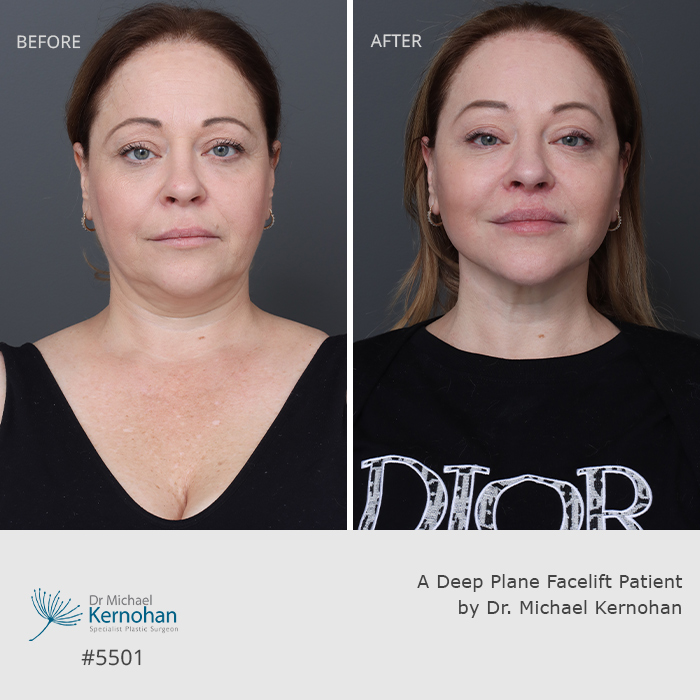
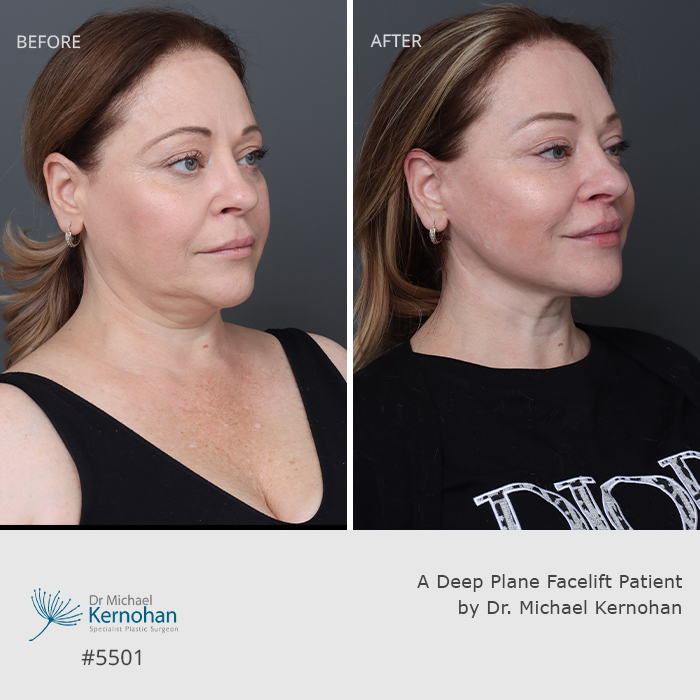
Disclaimer: All surgical or invasive procedures come with inherent risks, and results can vary widely between individuals due to factors like lifestyle, anatomy, overall health, weight, and nutrition. We encourage you to conduct thorough research and consider seeking a second opinion from a qualified healthcare provider.
How Does Dr Michael Kernohan Assess Combined Facial Surgery?
Dr Michael Kernohan assesses combined facial surgery by reviewing each facial region separately and then considering how the regions relate to each other. This helps determine whether one procedure, combined surgery or staged surgery may be suitable.
- The patient’s main concern is discussed in their own words
- The lower face, jawline and neck are assessed
- Brow position and forehead anatomy are reviewed
- Upper and lower eyelid tissue are assessed
- Eye symptoms, dry eye history and previous eye procedures are discussed
- Skin quality, scars and facial asymmetry are considered
- Previous surgery, injectables or device-based treatments are reviewed
- Medical history, medications and allergies are discussed
- Smoking, vaping or nicotine use is reviewed
- Anaesthetic and recovery planning are considered
The assessment may lead to discussion of facelift surgery, brow lift surgery, eyelid surgery, combined surgery, staged surgery, referral for eye assessment, another pathway or no surgery. The recommendation should be based on anatomy, health, risks, recovery and realistic expectations.
What Risks And Limitations Should Patients Understand?
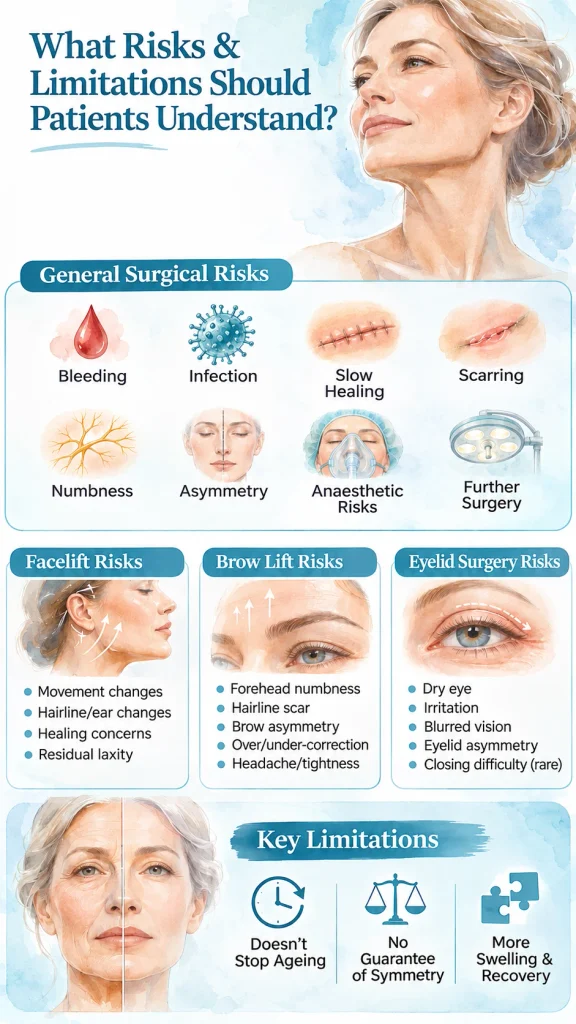
Combined facial surgery involves general surgical risks as well as procedure-specific risks. These should be discussed clearly before any decision is made.
General surgical risks may include:
- Bleeding or haematoma
- Infection
- Delayed wound healing
- Scarring
- Altered sensation or numbness
- Asymmetry
- Anaesthetic risks
- Need for further surgery in selected cases
Facelift-related risks may include facial nerve-related movement changes, hairline or ear-area changes, skin healing concerns, residual laxity or visible scarring around the ears or hairline.
Brow lift-related risks may include forehead or scalp numbness, hairline or scalp scar concerns, brow asymmetry, over-correction or under-correction, headache or tightness during recovery.
Eyelid surgery-related risks may include dry eye symptoms, irritation, blurred vision during early recovery, eyelid asymmetry, lower eyelid position changes, difficulty closing the eyes in rare cases, and the need for ophthalmology review in selected patients.
Surgery cannot stop ageing or guarantee symmetry. Treating one region may not address concerns in another region, and combining procedures can increase swelling, bruising and recovery planning.
Why Is Eye Health Important In Combined Planning?
Eye health is especially important when eyelid surgery is considered with a facelift or brow lift. Even mild dry eye symptoms or previous eye procedures may affect planning and recovery.
- Dry eye symptoms should be disclosed
- Contact lens use should be discussed
- Previous laser eye surgery should be reported
- Eye irritation or watering should be reviewed
- Eyelid support and eye closure should be assessed
In some patients, further assessment by an eye specialist may be recommended before eyelid surgery is planned. This helps ensure that eyelid-related risks are understood before combined surgery is considered.
What Is Recovery Like After Combined Facial Surgery?
Recovery after combined facial surgery can be more involved than recovery after one procedure alone. Swelling, bruising and tightness may affect several facial regions at the same time.
- Facelift swelling may involve the lower face, jawline and neck
- Brow lift recovery may involve forehead tightness or scalp numbness
- Eyelid swelling may affect reading, screen use or public-facing work early
- Bruising can move downward with gravity
- Incision care may involve multiple areas
- Activity restrictions are usually required
- Follow-up appointments are important
Recovery should be planned before surgery, especially if the patient works in a public-facing role or has caregiving responsibilities. Dr Michael Kernohan provides instructions based on the procedures performed and the patient’s healing progress.
How Long Does Recovery Take?
Recovery time varies depending on the combination of procedures, the patient’s health and the type of work or activities they need to return to. Patients should avoid comparing their recovery with another person’s timeline.
- Swelling and bruising are usually more noticeable early
- Eyelid swelling may settle at a different rate from facelift swelling
- Scars continue to mature over months
- Tightness or numbness may take time to improve
- Exercise and heavy lifting should wait until cleared
- Final assessment should wait until tissues have settled
Patients should not judge the final result too early. Follow-up appointments help monitor healing, scar maturation and whether any symptoms need further review.
What Alternatives Should Patients Consider?
Alternatives should be considered before choosing combined facial surgery. In some cases, one procedure alone, staged surgery, delayed surgery or no surgery may be more appropriate.
- No surgery
- Delaying surgery
- Facelift surgery alone
- Brow lift surgery alone
- Upper eyelid surgery alone
- Lower eyelid surgery alone
- Staged surgery
- Skin care and sun protection
- Dermatology-led treatment for skin texture or pigmentation
- Non-surgical options in selected patients
- Ophthalmology review if eye symptoms are present
- Second opinion if unsure
Alternatives are part of informed consent. Dr Michael Kernohan discusses reasonable options so patients understand that combined surgery is not the only pathway.
Who May Be Suitable For Combined Facial Surgery?
Patients may be suitable for combined facial surgery when concerns in more than one facial region are present and the patient is medically suitable for a broader operation. Suitability also depends on expectations, recovery support and the ability to follow post-operative instructions.
- Lower-face laxity is present with brow or eyelid concerns
- The patient is suitable for surgery and anaesthesia
- Smoking, vaping or nicotine use can be stopped as advised
- Health is stable
- The patient understands scars, risks and recovery
- Time away from work and home support can be arranged
- Expectations are realistic
Suitability cannot be confirmed from photos alone. Dr Michael Kernohan assesses the lower face, jawline, neck, brow, eyelids, eye symptoms and medical history before discussing whether combined surgery may be appropriate.
Who May Not Be Suitable?
Some patients may not be suitable for combined facial surgery, or may need to delay surgery until risks are better managed. This may relate to medical risk, eye health, recovery support or expectations.
- Uncontrolled medical conditions
- High anaesthetic risk
- Smoking or nicotine use that cannot be stopped as advised
- Active eye disease or significant dry eye symptoms needing review
- Expectations surgery cannot meet
- Lack of recovery support
- Not ready for a broader recovery period
- Concerns better suited to one procedure alone
- Need for further medical, psychological or eye assessment
In some cases, delayed surgery, staged surgery, one procedure alone or no surgery may be more appropriate. Dr Michael Kernohan will explain the reasoning if combined surgery is not recommended.
Are Costs Relevant When Combining Facial Procedures?
Costs may be relevant when combining facial procedures, but cost should not be the main reason to combine surgery. The surgical plan should be based on anatomy, safety planning, recovery and realistic expectations.
- Costs vary by procedure combination and complexity
- Facelift, brow lift and eyelid surgery each involve different planning
- Combined surgery may affect operating time, anaesthetic fees and facility fees
- Follow-up, medicines and scar care may vary
- Staged surgery may involve separate costs and recovery periods
- Time away from work and home support may affect practical planning
Individual cost information is usually provided after consultation. Combining procedures may reduce the number of separate recovery periods for selected patients, but it is not suitable for everyone.
Take the Quiz
Summary
Facelift, brow lift and eyelid surgery address different facial regions. A facelift mainly addresses the lower face, jowls and jawline, while brow lift surgery addresses selected brow position and forehead-related concerns, and eyelid surgery addresses selected upper or lower eyelid concerns.
Combined surgery may be considered when more than one region contributes to the patient’s concern and when health, recovery support and risk profile allow it. Staged surgery may be more appropriate for some patients.
Dr Michael Kernohan, Specialist Plastic & Reconstructive Surgeon in Sydney, assesses each patient individually before recommending a pathway. The consultation includes discussion of anatomy, eye health, risks, recovery, alternatives and whether one procedure, combined surgery, staged surgery or no surgery may be appropriate.

Combining Facelift With Brow Lift Or Eyelid Surgery FAQs
Next Step: Achieve Holistic Facial Rejuvenation With Dr Kernohan’s Guidance
Comprehensive facial rejuvenation can involve more than one region – and thoughtful planning helps ensure balanced outcomes. Dr Michael Kernohan, Specialist Plastic & Reconstructive Surgeon in Sydney, offers personalised consultations that align anatomy, surgical options and recovery planning. Explore the Contact Page or the Photo Assessment page to conveniently send your enquiries online or schedule an appointment. Connect with the team to discuss whether combining a facelift with brow lift or eyelid surgery aligns with your goals and begin your journey with clarity and confidence.
Your surgical plan deserves specialist insight – book a consultation with Dr Kernohan.
Further Reading
- Read Dr Michael Kernohan’s Procedure Page on Trifecta Lift
- Read Dr Michael Kernohan’s Procedure Page on Deep Plane Facelift
- Read Dr Michael Kernohan’s Procedure Page on Partial Facelift Surgery
- Read Dr Michael Kernohan’s Procedure Page on Revision Blepharoplasty
- Read Dr Michael Kernohan’s Recovery Guide to Facelift Recovery Timeline and Tips
- Read Dr Michael Kernohan’s Patient Guide to How to Prepare for Surgery
- Read Dr Michael Kernohan’s Blog about What Are Hooded Eyes?
- Read Dr Michael Kernohan’s Blog about Isolated Neck Lift or Combined Procedures
- Read Dr Michael Kernohan’s Blog about How to Reduce Swelling and Bruising After Eyelid Surgery

Combining Facelift With Brow Lift Or Eyelid Surgery
Introduction Dr Michael Kernohan is a Specialist Plastic & Reconstructive Surgeon in Sydney. Facelift surgery…

Cervicofacial Liposuction – When It’s Combined With Facelift Surgery
Introduction Dr Michael Kernohan is a Specialist Plastic & Reconstructive Surgeon in Sydney. Cervicofacial liposuction…

Anatomical Layers Of The Face – What Surgeons Work With
Introduction Dr Michael Kernohan is a Specialist Plastic & Reconstructive Surgeon in Sydney. Facelift planning…