
- Introduction
- At a Glance
- What Is Cervicofacial Liposuction?
- Why Is Cervicofacial Liposuction Different From General Weight Loss?
- What Does Facelift Surgery Address?
- What Are The Limits Of Facelift Surgery Alone?
- When May Cervicofacial Liposuction Be Combined With Facelift Surgery?
- What Does Combined Planning Aim To Do?
- What Areas Can Be Assessed For Liposuction?
- Why Can Under-Chin Fullness Have Different Causes?
- Why Is Skin Quality Important?
- Can Liposuction Make Loose Skin More Noticeable?
- Why Is Neck Anatomy Important?
- How Do Jowls Affect The Decision?
- When May Liposuction Alone Be More Appropriate?
- When Might Liposuction Alone Be Too Limited?
- When May Facelift Surgery Alone Be More Appropriate?
- When May Neck Lift Planning Be Needed?
- When May Staged Surgery Be Discussed?
- How Does Dr Michael Kernohan Assess Combined Procedure Suitability?
- What Risks And Limitations Should Patients Understand?
- Why Can Combined Surgery Increase Complexity?
- What Is Recovery Like After Cervicofacial Liposuction With Facelift Surgery?
- How Long Does Swelling Take To Settle?
- What Alternatives Should Patients Consider?
- When Might No Surgery Be More Appropriate?
- Facelift Before and After Photos
- Who May Be Suitable For Cervicofacial Liposuction With Facelift Surgery?
- Who May Not Be Suitable?
- Are Costs Relevant When Planning Combined Surgery?
- Take the Quiz
- Summary
- FAQs About Cervicofacial Liposuction Combined With Facelift
- Next Step: Explore Your Neck Contouring Options With Dr Kernohan
- Download Dr Kernohan’s Facelift Surgery Guide
- Further Reading
Introduction
Dr Michael Kernohan is a Specialist Plastic & Reconstructive Surgeon in Sydney. Cervicofacial liposuction may be combined with facelift surgery in selected patients when localised fat in the lower face, jawline or neck contributes to the concern.
Cervicofacial liposuction and facelift surgery address different tissue concerns. Liposuction removes selected fat beneath the skin, while facelift surgery may address lower-face laxity, jowls, excess skin and deeper support layers.
This article explains when combined planning may be considered, when liposuction alone or facelift surgery alone may be more appropriate, what Dr Michael Kernohan assesses, and what patients should understand about risks, recovery, alternatives and suitability before deciding.
At a Glance
When Is Cervicofacial Liposuction Combined With Facelift Surgery?
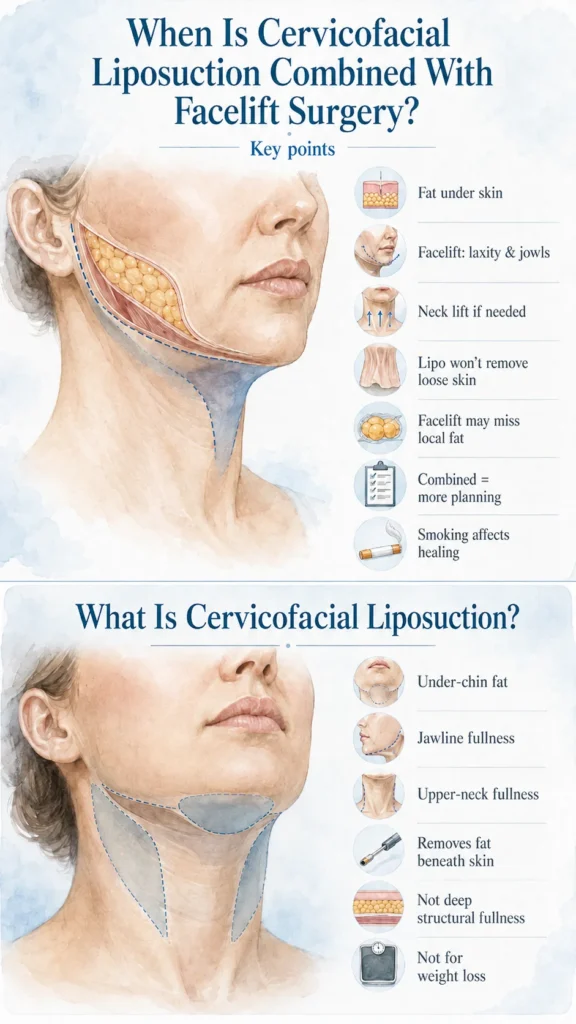
Cervicofacial liposuction may be combined with facelift surgery when selected fat deposits in the lower face, jawline, under-chin area or neck are present alongside deeper tissue laxity or excess skin. The decision depends on skin quality, fat distribution, neck anatomy, jowls, tissue blood supply, health, smoking or nicotine use, and recovery capacity.
Key points:
- Cervicofacial liposuction removes selected fat beneath the skin.
- Facelift surgery may address lower-face laxity, jowls and deeper support layers.
- Neck lift planning may be needed if the neck contributes.
- Liposuction alone does not remove significant loose skin.
- Facelift surgery alone may not address all localised fat fullness.
- Combined surgery may increase procedure complexity and recovery planning.
- Smoking, vaping or nicotine use can affect wound healing.
- Dr Michael Kernohan assesses whether liposuction alone, facelift alone, combined surgery, staged planning, another pathway or no surgery may be appropriate.
A combined approach is not chosen simply because both procedures can be done together. It should only be discussed when the patient’s anatomy, health and recovery needs support that plan.
What Is Cervicofacial Liposuction?
Cervicofacial liposuction is liposuction performed in selected areas of the lower face and neck. The word “cervico” refers to the neck region, while “facial” refers to the face.
- It may assess selected fat beneath the chin.
- It may assess localised fat along the jawline.
- It may assess selected upper-neck fullness.
- It removes fat beneath the skin, not deeper structural fullness.
- It is not a weight-loss procedure.
Cervicofacial liposuction is not suitable for every type of lower-face or neck fullness. Dr Michael Kernohan assesses whether the fullness is caused by superficial fat, deeper neck structures, skin laxity, jowls or several factors together.
Why Is Cervicofacial Liposuction Different From General Weight Loss?
Cervicofacial liposuction is different from general weight loss because it targets selected localised fat deposits rather than overall body weight. It cannot replace weight stability, general health care or broader surgical assessment.
- Weight changes can affect the face and neck.
- Localised fat may remain despite stable weight.
- Internal or deeper fullness may not respond to liposuction.
- Skin quality affects whether fat removal is appropriate.
- Weight stability helps with surgical planning.
Patients should not view liposuction as a substitute for weight management. Dr Michael Kernohan considers weight stability and overall health before discussing whether liposuction has a role.
What Does Facelift Surgery Address?
Facelift surgery may address selected lower-face and jawline concerns caused by tissue laxity, jowls and deeper support changes. It is different from liposuction because it may involve deeper tissue support and excess skin management.
- Lower-face laxity may be assessed.
- Jowls along the jawline may be addressed.
- Deeper support layers such as the SMAS may be considered.
- Excess skin may be managed through incision planning.
- Neck lift planning may be included where relevant.
Facelift surgery is not designed to remove every area of fat fullness. If selected localised fat also contributes to the concern, cervicofacial liposuction may be discussed as part of a broader plan.
What Are The Limits Of Facelift Surgery Alone?

Facelift surgery has limits because it does not treat every type of fullness, skin concern or volume issue. It may address selected structural changes, but some localised fat areas may need separate assessment.
- It does not stop ageing.
- It does not treat all skin texture or pigmentation concerns.
- It does not remove every type of under-chin fullness.
- It may not fully address superficial fat in selected areas.
- It cannot guarantee a specific appearance.
Dr Michael Kernohan discusses these limits during consultation. This helps patients understand whether facelift surgery alone, liposuction alone, combined planning, staged surgery or no surgery may be more appropriate.
When May Cervicofacial Liposuction Be Combined With Facelift Surgery?
Cervicofacial liposuction may be combined with facelift surgery when localised fat and deeper tissue laxity are both contributing to the concern. This may occur when under-chin fullness, lower-face fullness or jawline fat sits alongside jowls or lower-face laxity.
- Localised fat is present in a suitable area.
- Lower-face laxity or jowls are also present.
- Skin quality supports the surgical plan.
- Neck anatomy has been assessed.
- Patient health supports combined surgery.
- Tissue blood supply and wound healing risk are considered.
Combined surgery is not automatically more appropriate than one procedure alone. Dr Michael Kernohan considers whether adding liposuction is likely to help, whether it adds unnecessary risk, and whether staged surgery would be safer or more suitable.
What Does Combined Planning Aim To Do?
Combined planning aims to address different tissue concerns in one coordinated surgical plan. Liposuction may address selected fat beneath the skin, while facelift surgery may address lower-face support, jowls and excess skin where appropriate.
- Liposuction may reduce selected superficial fullness.
- Facelift surgery may address tissue laxity.
- Neck lift planning may address neck skin or platysma bands.
- Incision planning may need to account for all procedures.
- Recovery planning may be broader than one procedure alone.
The goal is not to treat more areas simply because they are nearby. The goal is to match the surgical plan to the patient’s anatomy while considering risk, recovery and realistic expectations.
What Areas Can Be Assessed For Liposuction?
Several lower-face and neck areas may be assessed for cervicofacial liposuction, but not every area is suitable for every patient. Suitability depends on whether the fullness is superficial, accessible and appropriate to treat.
- Under-chin area.
- Upper neck.
- Jawline area.
- Lower-face fullness.
- Selected areas beside the jaw or neck.
- Areas affected by previous surgery or scars.
Some areas may be avoided or treated cautiously because of nerves, blood supply, skin quality or deeper anatomy. Dr Michael Kernohan examines the face and neck before discussing which areas may or may not be suitable.
Why Can Under-Chin Fullness Have Different Causes?
Under-chin fullness can have different causes, which is why liposuction does not suit every patient. The visible fullness may come from superficial fat, deeper fat, muscle, glands, skin laxity, jaw structure or a combination of these factors.
- Superficial fat may be suitable for liposuction in selected patients.
- Deeper subplatysmal fat may need different planning.
- Platysma bands may require neck lift assessment.
- Submandibular gland prominence may contribute to fullness.
- Chin and jaw position can affect the side profile.
This distinction matters because removing superficial fat will not correct every type of fullness. Dr Michael Kernohan assesses the likely source before discussing treatment options.
Why Is Skin Quality Important?
Skin quality is important because liposuction removes fat but does not remove significant loose skin. If the skin does not have enough elasticity, fat removal may make laxity more noticeable.
- Skin elasticity varies between patients.
- Loose skin may not retract after fat removal.
- Sun exposure can affect skin quality.
- Smoking or nicotine use can affect healing.
- Weight change can affect skin behaviour.
Facelift or neck lift planning may be needed if skin laxity is significant. Dr Michael Kernohan assesses skin quality before deciding whether liposuction alone, facelift alone or combined surgery may be suitable.
Can Liposuction Make Loose Skin More Noticeable?
Liposuction can make loose skin more noticeable in some patients if fat is removed from an area where the skin does not contract well. This is why skin quality and tissue laxity must be assessed before treatment is recommended.
- Reduced skin elasticity may limit the result.
- Existing looseness may remain after fat removal.
- Neck skin may need direct assessment.
- Jowls may not improve with fat removal alone.
- A neck lift or facelift may be more relevant in selected patients.
Patients should not expect liposuction to behave like skin-removal surgery. If skin laxity is the main concern, Dr Michael Kernohan may discuss facelift surgery, neck lift planning, staged treatment or no surgery instead.
Why Is Neck Anatomy Important?
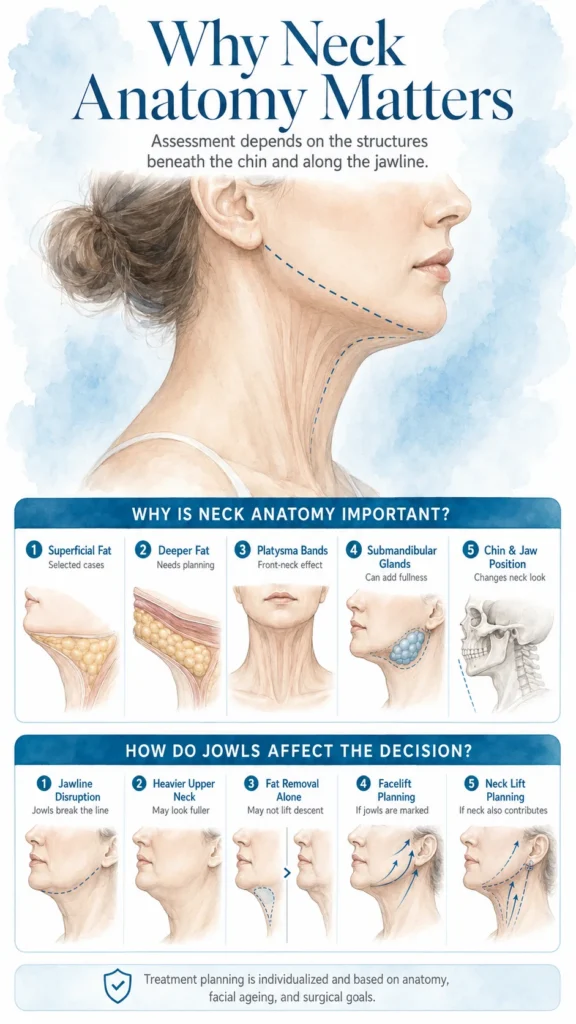
Neck anatomy is important because neck fullness is not always caused by superficial fat. The under-chin and upper-neck region includes skin, fat, muscle, glands, nerves, vessels and deeper structural features.
- Superficial fat may be treated in selected cases.
- Deeper fat may need different planning.
- Platysma bands may affect the front of the neck.
- Submandibular glands may contribute to fullness.
- Chin and jaw position can change how the neck looks.
A careful neck assessment helps reduce the chance of choosing the wrong treatment. Dr Michael Kernohan assesses the lower face, jawline and neck together because these areas often influence each other.
How Do Jowls Affect The Decision?
Jowls can affect the decision because they are usually related to lower-face tissue laxity rather than fat alone. Liposuction does not reliably correct jowls if deeper support and skin laxity are the main causes.
- Jowls can interrupt the jawline.
- They may make the upper neck look heavier.
- Fat removal alone may not address lower-face descent.
- Facelift planning may be needed if jowls are significant.
- Neck lift planning may be needed if the neck also contributes.
When jowls and localised fat are both present, combined planning may be discussed. Dr Michael Kernohan assesses whether the concern is fat-led, laxity-led, neck-led or a combination of factors.
When May Liposuction Alone Be More Appropriate?
Liposuction alone may be more appropriate when the concern is mainly localised superficial fat and skin laxity is limited. It may be considered when jowls, deeper tissue descent and neck bands are not the dominant issue.
- Fullness is mainly superficial fat.
- Skin quality is suitable.
- Skin laxity is limited.
- Jowls are mild or not the main concern.
- Neck bands are not dominant.
- Weight is stable.
Liposuction alone is not suitable for every patient with under-chin or jawline fullness. Dr Michael Kernohan may discuss liposuction alone only if the anatomy supports that pathway and the patient understands the limits.
When Might Liposuction Alone Be Too Limited?
Liposuction alone may be too limited when the main concern is loose skin, jowls, platysma bands or deeper neck fullness. In these situations, removing fat may not address the tissue causing the visible concern.
- Loose neck skin is present.
- Jowls affect the jawline.
- Platysma bands are visible.
- Fullness comes from deeper structures.
- Skin laxity may worsen after fat removal.
- The patient expects a facelift-level change.
Dr Michael Kernohan explains these limits before recommending any procedure. In some cases, facelift surgery, neck lift planning, staged treatment or no surgery may be more appropriate.
When May Facelift Surgery Alone Be More Appropriate?
Facelift surgery alone may be more appropriate when the main concern is lower-face laxity, jowls or excess skin rather than localised fat. In these cases, adding liposuction may not address the main issue and may increase complexity without clear benefit.
- Jowls are the main concern.
- Lower-face laxity affects the jawline.
- Skin laxity is more important than fat fullness.
- Fat distribution does not suit liposuction.
- Tissue blood supply or healing risk needs cautious planning.
- Patient health does not support a broader combined operation.
A focused facelift plan may be more suitable than combining procedures when fat is not the main contributor. Dr Michael Kernohan assesses whether liposuction would add value or whether facelift surgery alone, neck lift planning, staged surgery or another pathway is more appropriate.
When May Neck Lift Planning Be Needed?
Neck lift planning may be needed when the neck contributes to the concern through loose skin, platysma bands, under-chin fullness or a less defined jawline-neck transition. Liposuction alone may be too limited when the concern involves more than superficial fat.
- Loose neck skin is present.
- Platysma bands are visible.
- Under-chin fullness involves deeper anatomy.
- Jowls and neck laxity overlap.
- The jawline-neck transition is affected.
- Facelift surgery alone may not address central neck concerns.
Neck lift planning can be discussed as part of combined face and neck assessment. Dr Michael Kernohan considers whether the concern is lower-face-led, neck-led, fat-led or caused by several connected factors.
When May Staged Surgery Be Discussed?
Staged surgery may be discussed when it is safer or more practical to separate procedures rather than combine them. This can allow healing to be assessed before a second procedure is considered.
- Surgical risk is higher.
- Treatment areas are larger.
- Tissue blood supply is a concern.
- The patient has a smoking or nicotine history.
- Previous facelift, neck lift or liposuction may affect planning.
- The patient prefers separate recovery periods.
Staged surgery is not a lesser option. For some patients, it may provide a more cautious pathway and allow Dr Michael Kernohan to reassess healing, remaining concerns and suitability before further treatment is discussed.
How Does Dr Michael Kernohan Assess Combined Procedure Suitability?
Dr Michael Kernohan assesses combined procedure suitability by examining the lower face, jawline, neck, skin quality, fat distribution and deeper anatomy. The aim is to identify which tissue layers are contributing before recommending any procedure.
- The patient’s main concern is discussed in their own words.
- The face and neck are assessed from front, side and three-quarter views.
- Lower-face laxity and jowls are reviewed.
- Under-chin fullness and neck anatomy are assessed.
- Skin quality and elasticity are considered.
- Fat distribution is examined.
- Platysma bands and deeper neck structures are reviewed.
- Previous surgery, injectables or device-based treatments are discussed.
- Medical history, medicines and allergies are reviewed.
- Smoking, vaping or nicotine use is discussed.
- Recovery support and time away from work are considered.
This assessment may lead to discussion of liposuction alone, facelift surgery alone, facelift with liposuction, neck lift planning, staged surgery, another pathway or no surgery. The recommendation should be based on anatomy, health, risks, recovery and realistic expectations.
What Risks And Limitations Should Patients Understand?
Cervicofacial liposuction with facelift surgery has risks and limitations, as with any surgical procedure. Combining procedures may increase complexity, so patients should understand what each part of the plan can and cannot address.
- Bleeding or haematoma.
- Infection.
- Seroma or fluid collection.
- Delayed wound healing.
- Scarring.
- Altered sensation or numbness.
- Asymmetry.
- Contour irregularity.
- Residual fullness or laxity.
- Skin healing concerns.
- Facial nerve-related movement changes.
- Marginal mandibular nerve weakness affecting lower lip movement.
- Hairline or ear-area changes if facelift incisions are used.
- Anaesthetic risks.
- Need for further surgery in selected cases.
Liposuction cannot treat every cause of fullness, and facelift surgery cannot stop ageing or guarantee a specific appearance. Dr Michael Kernohan explains these risks and limits before any decision is made.
Why Can Combined Surgery Increase Complexity?
Combined surgery can increase complexity because more than one tissue concern is being addressed at the same time. Liposuction and facelift surgery work in different tissue layers and may affect swelling, bruising, blood supply and recovery planning.
- Liposuction treats selected fat beneath the skin.
- Facelift surgery may involve deeper support layers and skin management.
- Neck lift planning may involve platysma and central neck assessment.
- Blood supply and wound healing need careful planning.
- Swelling may settle at different rates in different areas.
- Recovery may be broader than one procedure alone.
Combined surgery may still be appropriate for selected patients. The key question is whether the combined plan is justified by the patient’s anatomy and risk profile.
What Is Recovery Like After Cervicofacial Liposuction With Facelift Surgery?
Recovery after cervicofacial liposuction with facelift surgery varies depending on the areas treated and whether neck lift planning is included. Patients may experience swelling, bruising, tightness, firmness and altered sensation around the lower face, jawline and neck.
- Swelling and bruising may occur around the lower face and neck.
- Tightness or firmness can occur after liposuction and facelift surgery.
- Numbness or altered sensation may take time to settle.
- Incision care is needed if facelift or neck lift incisions are used.
- Compression, dressings or support garments may be advised.
- Activity restrictions usually apply during early recovery.
- Follow-up appointments are important.
Swelling from liposuction and facelift surgery may settle at different rates. Dr Michael Kernohan provides recovery instructions based on the procedure performed and the patient’s healing progress.
How Long Does Swelling Take To Settle?
Swelling after combined cervicofacial liposuction and facelift surgery can change over weeks and months. Early swelling may be more noticeable, while deeper firmness and tissue settling can take longer.
- Swelling may be uneven at first.
- Bruising may move downward with gravity.
- Firmness can occur in liposuction-treated areas.
- Neck tightness may be present if neck lift planning is included.
- Scars mature over months.
- Final assessment should wait until tissues have settled.
Patients should avoid judging the final outcome too early. Follow-up appointments help monitor healing, scar maturation and whether any symptoms need further review.
What Alternatives Should Patients Consider?
Alternatives should be discussed before choosing cervicofacial liposuction with facelift surgery. In some cases, one procedure alone, staged care, delayed surgery or no surgery may be more appropriate.
- No surgery.
- Delaying surgery.
- Weight stability and general health planning.
- Skin care and sun protection.
- Dermatology-led treatment for skin texture or pigmentation.
- Liposuction alone in selected patients.
- Facelift surgery alone.
- Neck lift surgery.
- Facelift with neck lift.
- Staged surgery.
- Medical review if neck fullness may have another cause.
- Second opinion if unsure.
Non-surgical treatments may help selected skin concerns, but they do not remove excess skin or reposition deeper facial support layers. Dr Michael Kernohan discusses alternatives as part of informed consent.
When Might No Surgery Be More Appropriate?
No surgery may be more appropriate when the concern does not match what surgery can reasonably address or when the risks outweigh the likely benefit. It may also be appropriate when the patient is not ready for recovery, scars or follow-up care.
- Medical risk is high.
- Smoking or nicotine use cannot be stopped as advised.
- Weight is unstable.
- The main concern is skin texture rather than tissue laxity or fat.
- The fullness comes mainly from deeper anatomy that liposuction cannot treat.
- Expectations do not match what surgery can achieve.
Choosing no surgery or delaying surgery can be a responsible outcome of consultation. Dr Michael Kernohan may recommend reassessment, another pathway or medical review depending on the patient’s circumstances.
Facelift Before and After Photos
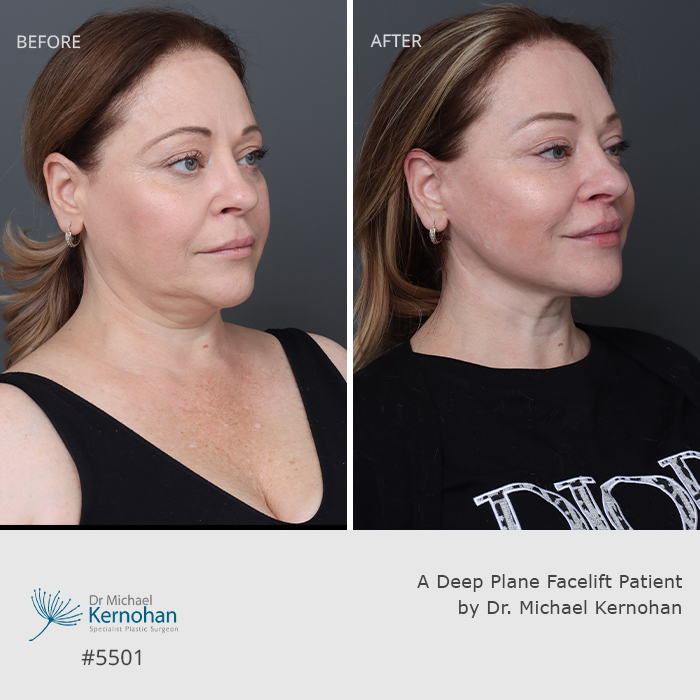
Disclaimer: All surgical or invasive procedures come with inherent risks, and results can vary widely between individuals due to factors like lifestyle, anatomy, overall health, weight, and nutrition. We encourage you to conduct thorough research and consider seeking a second opinion from a qualified healthcare provider.
Who May Be Suitable For Cervicofacial Liposuction With Facelift Surgery?
Patients may be suitable for cervicofacial liposuction with facelift surgery when both localised fat and lower-face laxity contribute to the concern. Suitability also depends on skin quality, health, recovery capacity and expectations.
- Localised fat is present in the lower face, jawline or under-chin area.
- Lower-face laxity or jowls are also present.
- Skin quality and tissue blood supply support combined planning.
- Weight is reasonably stable.
- General health is suitable for surgery and anaesthesia.
- Smoking, vaping or nicotine use can be stopped as advised.
- The patient understands scars, swelling, risks and recovery.
- Time away from work and home support can be arranged.
Suitability cannot be confirmed from photos alone. Dr Michael Kernohan assesses the face, neck, skin quality, fat distribution, medical history and expectations before discussing whether combined surgery may be suitable.
Who May Not Be Suitable?
Some patients may not be suitable for combined cervicofacial liposuction and facelift surgery, or may need to delay surgery until risks are better managed. This may relate to health, tissue quality, deeper anatomy, expectations or recovery support.
- Uncontrolled medical conditions.
- High anaesthetic risk.
- Smoking or nicotine use that cannot be stopped as advised.
- Unstable weight.
- Expectations that liposuction will remove loose skin.
- Significant neck fullness from deeper glands, muscle or jaw structure.
- Skin laxity that may worsen after fat removal.
- Active infection or untreated skin disease.
- Lack of recovery support.
- Need for further medical or psychological assessment.
In some cases, liposuction alone, facelift surgery alone, neck lift planning, staged surgery, delayed surgery or no surgery may be more appropriate. Dr Michael Kernohan will explain the reasoning behind the recommendation.
Are Costs Relevant When Planning Combined Surgery?
Costs may be relevant when planning combined surgery, but they should not be the main reason to choose one procedure over another. The surgical plan should be based on anatomy, safety planning, recovery and realistic expectations.
- Costs vary by procedure type and complexity.
- Adding liposuction may affect surgical time and planning.
- Facelift, neck lift and combined surgery may differ.
- Anaesthetic and facility fees may vary.
- Garments, dressings, medicines and follow-up needs may vary.
- Time away from work and home support may affect practical planning.
- Staged surgery may involve separate costs and recovery periods.
Individual cost information is usually provided after consultation. A lower-cost option may not address the concern, while a broader procedure does not guarantee a specific outcome.
Take the Quiz
Summary
Cervicofacial liposuction and facelift surgery address different tissue concerns. Liposuction removes selected superficial fat, while facelift surgery may address lower-face laxity, jowls, excess skin and deeper support layers.
Combined surgery may be considered when localised fat and tissue laxity are both present and when skin quality, neck anatomy, blood supply, health and recovery capacity support that plan. Some patients may be better suited to liposuction alone, facelift surgery alone, neck lift planning, staged care, delayed surgery or no surgery.
Dr Michael Kernohan, Specialist Plastic & Reconstructive Surgeon in Sydney, assesses each patient individually before recommending a pathway. The consultation includes discussion of anatomy, risks, recovery, alternatives and whether expectations match what surgery can reasonably address.

FAQs About Cervicofacial Liposuction Combined With Facelift
Next Step: Explore Your Neck Contouring Options With Dr Kernohan
Cervicofacial liposuction can enhance the contouring effects of a facelift when combined thoughtfully. Dr Michael Kernohan, Specialist Plastic & Reconstructive Surgeon in Sydney, provides detailed consultations that consider anatomy, expectations, and safety. His online Contact Page and Photo Assessment features allow for convenient appointment setting and enquiries. Contact the clinic to discuss whether a combined procedure aligns with your goals and to begin planning with confidence.
Your contouring journey starts with specialist insight – book a consultation today.
Download Dr Kernohan’s Facelift Surgery Guide
Further Reading
- Read Dr Michael Kernohan’s Procedure Page on Chin Liposuction
- Read Dr Michael Kernohan’s Procedure Page on Partial Neck Lift Sydney
- Read Dr Michael Kernohan’s Procedure Page on Deep Plane Facelift NSW
- Read Dr Michael Kernohan’s Procedure Page on Partial Facelift Surgery NSW
- Read Dr Michael Kernohan’s Blog about Deep Neck Anatomy Explained – How the Platysma, Digastrics and Deep Fat Compartments Affect Neck Shape
- Read Dr Michael Kernohan’s Blog about How Weight Changes Affect Neck Appearance

Combining Facelift With Brow Lift Or Eyelid Surgery
Introduction Dr Michael Kernohan is a Specialist Plastic & Reconstructive Surgeon in Sydney. Facelift surgery…

Cervicofacial Liposuction – When It’s Combined With Facelift Surgery
Introduction Dr Michael Kernohan is a Specialist Plastic & Reconstructive Surgeon in Sydney. Cervicofacial liposuction…

Anatomical Layers Of The Face – What Surgeons Work With
Introduction Dr Michael Kernohan is a Specialist Plastic & Reconstructive Surgeon in Sydney. Facelift planning…