

- Take The Quiz
- Deriving the Context of “How Long Does a Neck Lift Last?”
- Download Dr Kernohan’s Facelift Surgery Guide
- What Research and Experience Suggest About Neck Lift Longevity
- Factors That Influence How Long a Neck Lift Lasts
- How a Neck Lift Ages Over Time
- Facelift Before and After Photos
- Revision and Secondary Neck Lift or Lower Face/Neck Surgery
- Steps Patients Can Take to Support Neck Lift Longevity
- What to Expect at a Neck Lift Consultation in Sydney
- Is a Neck Lift Right for You If You Are Focused on Longevity?
- Neck Lift Longevity FAQs
- Next Step: Book a Consultation With Dr Kernohan
- Further Reading
“How long will it last?” is one of the first questions people ask about neck lift surgery.
In Sydney, Dr Michael Kernohan, Specialist Plastic & Reconstructive Surgeon, explains that a neck lift changes the current shape of the neck and jawline, but the neck still ages over time. The tissues continue to change, just from a new starting point.
On his neck lift page, Dr Kernohan notes that neck lift results can last around 10 years or more, with lifestyle and environment playing a role. Other surgical centres and review sites commonly quote average figures of about 10–15 years for many neck lifts, again with wide variation between individuals.
This article looks at what that means in everyday terms, and how this may apply to patients in Sydney who are considering neck lift surgery. It is general information only and does not replace a personal consultation.
Take The Quiz
Deriving the Context of “How Long Does a Neck Lift Last?”
✓ Change over time, not a fixed expiry date
When people ask how long a neck lift lasts, they often hope for one clear number. In reality, there are a few different ideas behind the question:
- How long until the early swelling has settled and the neck looks more stable?
- How long until the neck begins to loosen again?
- How long until someone feels they might want more treatment?
Clinical information from neck lift providers and professional resources suggests that many patients still see improvement in neck contour for many years, often a decade or more, compared with how their neck looked before surgery. But the neck will continue to age.
A neck lift does not stop ageing. It changes where you are on that curve and then time continues from there.
✓ The neck ages differently from the face
The skin of the neck is thin and exposed, and is prone to sun, movement and gravity. Dr Kernohan’s neck lift information notes that the neck is often one of the first areas to show lines, loose skin and bands.
This means that:
- Some people notice neck changes earlier than facial changes
- Others feel their neck has aged faster than their face and consider neck lift alone
How long a neck lift “lasts” is linked to how quickly your neck tends to change in general.
Download Dr Kernohan’s Facelift Surgery Guide
What Research and Experience Suggest About Neck Lift Longevity
✓ Short- to medium-term (1–5 years)
In the first year after neck lift surgery, swelling settles, scars begin to soften, and the new neck contour becomes clearer. Many patients reach a fairly stable appearance by around 6–12 months.
Over the next few years, most people:
- Maintain better definition under the chin
- See a smoother transition between jawline and neck
- Notice that vertical bands or heavy folds are reduced compared with before surgery
Clinic summaries and patient education sites commonly indicate that these changes remain visible for several years, with many people continuing to see benefit at 5 years and beyond.
✓ Longer term (5–10+ years)
Longer-term data on neck lift alone are more limited than for combined facelift–neck lift surgery, but similar principles apply.
Multiple neck lift and lower face sources suggest that:
- For many patients, improvement can still be seen 10 or more years later
- The exact degree varies; some notice only a gentle softening, others see a more obvious return of looseness
Dr Kernohan’s own patient information states that neck lift results “can last approximately 10 years or more”, with lifestyle and environmental factors influencing the course.
✓ Partial / mini neck lift versus full neck lift
On his partial (mini) neck lift page, Dr Michael Kernohan explains that a less extensive neck lift, suitable for mild neck changes, may have a shorter average duration. He notes that partial neck lift results often last around 5–8 years, with smoking and large weight shifts potentially shortening that timeframe.
In general:
- A full neck lift that addresses skin, muscle and deep fat is often expected to last longer
- A partial or mini neck lift may be helpful for earlier changes but is less extensive, so the effect may not last as long
Factors That Influence How Long a Neck Lift Lasts
✓ Age at the time of surgery
Age alone does not decide the result, but it matters.
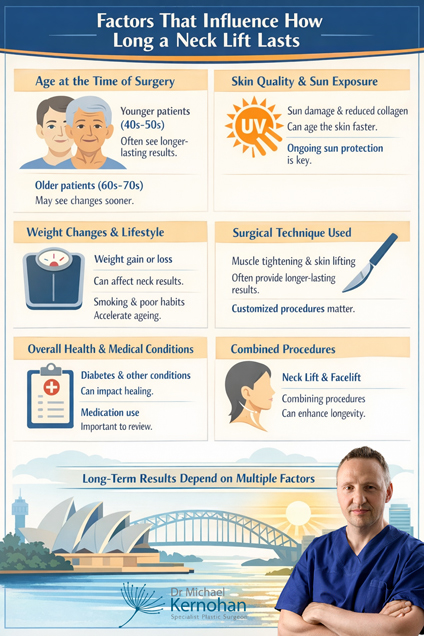
People who have neck lift surgery in their 40s or 50s often have stronger ligaments and better skin elasticity. This can help the neck hold its shape over a longer period. Those having surgery in their 60s or 70s can still see useful change, but pre-existing skin looseness and sun damage may mean ageing changes appear sooner over the next decade.
In Sydney, Dr Michael Kernohan looks at both age and overall health when talking about how long a neck lift may last.
✓ Skin quality, sun and collagen
Neck skin is thin and often receives more sun than we realise. Over time, ultraviolet exposure and smoking reduce collagen and elastin, the fibres that support the skin.
This means that:
- Fine lines and crepiness can return faster in skin that has had a lot of sun
- Thick, sun-damaged skin may not behave in the same way as protected skin after surgery
Medical sources on neck and face surgery emphasise ongoing sun protection and skin care as part of maintaining surgical results.
✓ Weight changes and lifestyle
The neck is sensitive to weight shifts. After neck lift surgery, large changes in weight can:
- Make the neck look fuller again if weight increases
- Reveal more looseness if a lot of weight is lost
Lifestyle factors such as smoking, high sun exposure and very limited sleep are also linked to faster visible ageing of skin and soft tissues.
✓ Technique used for the neck lift
“Neck lift” is a broad term. A tailored plan may include:
- Platysmaplasty – tightening or repositioning the thin neck muscle that can form bands
- Cervicoplasty – removing excess skin from the neck
- Neck liposuction – addressing localised fat under the chin and along the jawline
A neck lift can also be combined with a facelift to address the lower face and neck together.
Approaches that tighten both the muscle layer and the skin tend to offer more durable support to the neck than skin-only tightening.
When you see Dr Michael Kernohan in Sydney, he will explain which tissues he plans to work on (skin, fat, platysma, or a combination) and how that may relate to longer-term behaviour.
✓ General health and medical conditions
Medical conditions such as diabetes, connective tissue disease or autoimmune conditions can influence healing and tissue strength over time. Certain medicines, including long-term steroids, may also affect skin quality.
During consultation, Dr Kernohan reviews your medical history and, when needed, coordinates with your GP or other specialists so that health is optimised before neck lift surgery.
How a Neck Lift Ages Over Time
– Early phase – the first year
In the early months after a neck lift:
- Swelling and bruising gradually settle
- Tightness and altered sensation around the neck and jaw typically improve
- Scars begin to fade, although they can take 12–18 months to reach a more settled appearance
By around one year, most people have a clearer sense of their ongoing neck contour. Follow-up visits with Dr Michael Kernohan in Sydney are used to track these changes and answer questions.
– Years 1–5
In this period, many patients:
- Maintain a clearer angle between the jawline and neck
- Notice that vertical neck bands remain softer than before surgery
- See that the overall neck outline still looks improved compared with pre-operative photos
Normal ageing continues, and fine lines or mild looseness can slowly increase again, especially if skin care and sun protection are inconsistent.
– Beyond 5–10 years
Over longer timeframes:
- The skin and deeper tissues of the neck continue to respond to gravity and time
- The neck may gradually develop some looseness again, especially with weight changes or major life events
- Many patients still see a difference compared with how they think they would have looked without surgery, but this is hard to measure exactly
Information from Dr Kernohan and other surgical centres suggests that many people feel their neck lift remains helpful for about 10 years, and sometimes longer, before they consider further surgery or other options.
Facelift Before and After Photos

Revision and Secondary Neck Lift or Lower Face/Neck Surgery
✓ When might someone consider further surgery?
There is no fixed timetable. People might start thinking about further treatment if:
- Neck skin again looks loose in everyday photos
- Bands or fullness under the chin become more noticeable
- They feel the earlier improvement no longer matches how they feel internally
Some case series on revision lower face and neck surgery report intervals of roughly 8–12 years between the first and later operations, but this varies widely, and many people never seek another procedure.
✓ How a second neck lift differs from the first
A secondary neck lift can be more complex because scar tissue and altered anatomy are present. The surgeon must consider previous incisions, changes to blood supply and the current state of the platysma and surrounding tissues.
In Sydney, Dr Michael Kernohan will carefully assess whether another neck lift, a combined facelift–neck lift, or a more limited procedure is appropriate, or whether non-surgical options might be a better choice.
Steps Patients Can Take to Support Neck Lift Longevity
✓ Skin care and sun protection
Long-term care of the neck skin is one of the most practical ways to support the result:
- Use broad-spectrum sunscreen on the neck and chest each day
- Seek shade and wear clothing that covers the neck when you can
- Follow a skin care plan recommended by your treating team
Neck lift guidance from various clinics stresses that ongoing sun protection plays a large role in how the skin looks years after surgery.
✓ Neck posture and daily habits
Modern life often involves long periods looking down at phones or laptops. Over time, this can contribute to visible folds and banding in the neck.
Simple changes such as raising screens closer to eye level and taking short breaks to stretch may help the neck area as a whole, although they cannot replace surgery.
✓ Healthy lifestyle and follow-up
Maintaining a stable weight, staying active, not smoking and moderating alcohol intake can all affect how tissues behave over time.
Regular follow-up with Dr Michael Kernohan allows you to:
- Discuss any concerns early
- Review photographs over time
- Consider whether small supportive treatments may help your skin
What to Expect at a Neck Lift Consultation in Sydney
✓ Role of a Specialist Plastic & Reconstructive Surgeon
In Australia, a Specialist Plastic & Reconstructive Surgeon has completed accredited specialist training and holds recognised specialist registration. Professional organisations such as the Australian Society of Plastic Surgeons list Dr Kernohan as a Plastic, Reconstructive and Cosmetic Surgeon with this background.
✓ How Dr Michael Kernohan approaches neck lift longevity discussions
During a neck lift consultation in Sydney, you can expect:
- A careful review of your medical history and medicines
- Examination of your neck, jawline and, where relevant, the lower face
- Discussion of how quickly your neck seems to have changed over recent years
- Explanation of what a full versus partial neck lift might involve in your case, including likely duration based on your health and skin
Dr Kernohan’s published information emphasises counselling patients on both long-term benefits and risks of surgery.
✓ Questions to ask about neck lift longevity
Common questions to bring include:
- How long do neck lift results usually remain noticeable for someone my age and health?
- Which tissues will you address in my neck, and how does that affect long-term behaviour?
- How might weight changes, sun exposure and other factors influence my result?
- If I want to avoid further surgery later, what are realistic expectations?
Writing these down before your visit can help you cover what matters most to you.
Is a Neck Lift Right for You If You Are Focused on Longevity?
Reflecting on your goals and time frame
It may help to think about:
- How much your neck shape is affecting your daily life right now
- Whether you are medically fit for surgery and recovery
- How you would feel if the main benefits were most noticeable over the next 5–10 years, with gradual change after that
There is no single “correct” answer. Some people value an improvement now, even knowing that ageing will continue. Others prefer to wait or explore non-surgical approaches first.
Matching expectations to the likely course
For patients in Sydney, Dr Michael Kernohan aims to match the proposed neck lift to the pattern of ageing in the neck, overall health, and how long the person would like the result to remain noticeable.
The goal is to reach a shared understanding of what neck lift surgery can and cannot achieve over time.

Neck Lift Longevity FAQs
Next Step: Book a Consultation With Dr Kernohan
If you are considering neck lift surgery and want a realistic idea of how long it may last for you, a personalised assessment is the most useful step.
A consultation with Dr Michael Kernohan, Specialist Plastic & Reconstructive Surgeon in Sydney, gives you the chance to:
- Discuss what is bothering you about your neck and jawline
- Review your medical history, skin quality and lifestyle factors
- Hear how different neck lift approaches (full or partial, with or without facelift) may behave over time in your situation
- Plan for recovery and the years ahead, rather than focusing only on the early result
You can bring photographs, a list of medicines and written questions to help guide the conversation. The aim is careful, honest planning so you can decide whether neck lift surgery is suitable for you and what you can reasonably expect over the short and longer term.
Further Reading
- Read more about Neck Lift Sydney
- Read more about Deep Plane Facelift NSW
- Read more about Partial Facelift Surgery NSW
- Read Dr Kernohan’s Blog on Neck Lift Options – Types of Neck Lift Surgery
- Read Dr Kernohan’s Blog on How to Prepare for Necklift Surgery
- Read Dr Kernohan’s Blog on Managing and Treating Necklift Scars
- Read Dr Kernohan’s Blog on Neck Lift Recovery Tips for a Better Result

High-SMAS vs Deep-Plane Approaches in Neck Lift Surgery
Why Technique Matters In Neck Lift Surgery When planning a neck lift – especially in…

Incisions in a Neck Lift – Where They Are Placed and Why
When people start looking into neck lift surgery, one of the most common questions is,…
How Weight Changes Affect Neck Appearance
Many people in their 40s, 50s and 60s notice the same thing in photos: even…