

- How Do Limited Abdominoplasty and Full Abdominoplasty Compare?
- What Is the Main Difference Between Limited Abdominoplasty and Full Abdominoplasty?
- Who Is Best Suited to Limited Abdominoplasty or Full Abdominoplasty?
- What Are the Potential Advantages of Limited Abdominoplasty?
- What Are the Potential Advantages of Full Abdominoplasty?
- What Are the Possible Disadvantages of Limited Abdominoplasty?
- Tummy Tuck- Abdominoplasty Before and After Photos
- What Are the Possible Disadvantages of Full Abdominoplasty?
- How Does Recovery Compare Between Limited Abdominoplasty and Full Abdominoplasty?
- How Long Do Limited Abdominoplasty and Full Abdominoplasty Results Last?
- How Do Costs Compare Between Limited Abdominoplasty and Full Abdominoplasty?
- Take the Quiz
- What Does Dr Michael Kernohan Recommend When Comparing Limited and Full Abdominoplasty?
- FAQs About Mini Tummy Tuck Vs Full Tummy Tuck
- Download Dr Michael Kernohan’s Abdominoplasty Surgery Guide
- Book a Consultation With Dr Kernohan to Discuss Your abdominoplasty Options
- Further Reading
Dr Michael Kernohan, Specialist Plastic & Reconstructive Surgeon in Sydney, assesses whether limited abdominoplasty or full abdominoplasty may be more appropriate based on each patient’s anatomy. A limited approach may suit selected patients with lower abdominal skin excess, while full abdominoplasty may be more suitable when excess skin, tissue laxity or muscle separation involves a broader area.
Patients often compare these procedures because they want to understand whether a smaller operation can address their concerns. The answer depends on the location of excess skin, the amount of abdominal wall laxity, whether the navel needs repositioning, and whether muscle repair is required.
A limited abdominoplasty is sometimes described online using shorter marketing terms like mini, but the more accurate wording is a lower-abdominal procedure with a more restricted surgical field. A full abdominoplasty usually involves broader abdominal skin and tissue adjustment, and may include repositioning of the navel and repair of muscle separation where clinically appropriate.
This article compares limited and full abdominoplasty in practical terms. It explains who may suit each approach, the advantages and disadvantages, recovery considerations, longevity, cost factors and how Dr Michael Kernohan approaches surgical recommendations.
How Do Limited Abdominoplasty and Full Abdominoplasty Compare?
| Feature | Limited Abdominoplasty | Full Abdominoplasty |
|---|---|---|
| Main focus | Lower abdominal skin excess below the navel | Broader abdominal skin excess above and below the navel |
| Navel repositioning | Usually not required | Often required |
| Muscle repair | Limited or not required in many cases | May be included when muscle separation is present |
| Incision length | Often shorter, depending on anatomy | Usually longer, depending on skin excess |
| Best suited for | Selected patients with mild lower abdominal laxity | Patients with more widespread abdominal laxity or skin excess |
| Recovery | May be less involved in selected cases | Often more involved due to broader tissue work |
| Longevity | Depends on skin quality, weight stability and suitability | Depends on skin quality, muscle repair, weight stability and future changes |
| Key limitation | May under-treat upper abdominal laxity or muscle separation | More extensive procedure with broader recovery and risk discussion |
A limited procedure is not automatically better because it is smaller. A full abdominoplasty is not automatically better because it is more comprehensive.
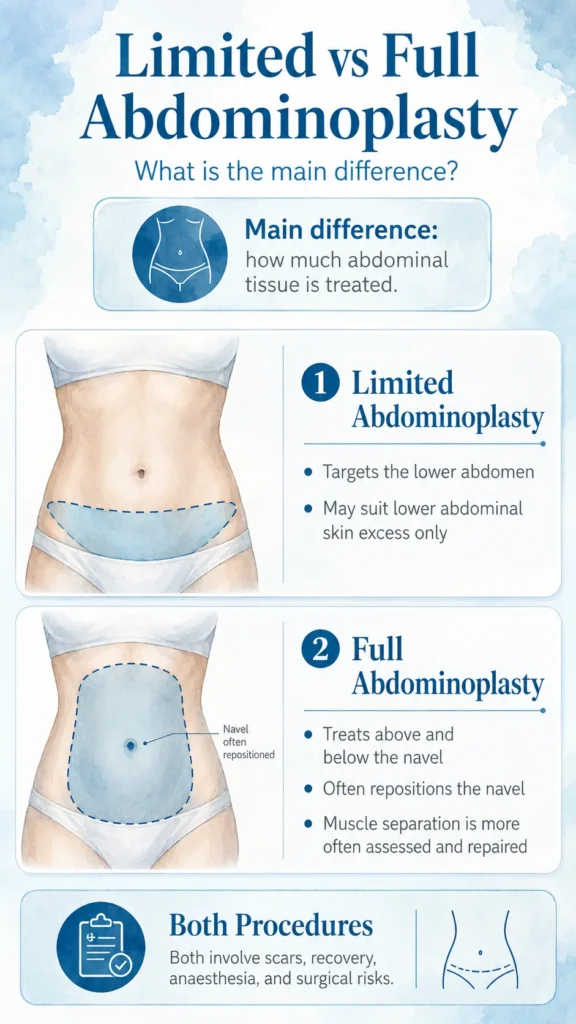
What Is the Main Difference Between Limited Abdominoplasty and Full Abdominoplasty?
The main difference is the amount of abdominal tissue being treated. Limited abdominoplasty generally focuses on the lower abdomen below the navel, while full abdominoplasty addresses a broader area of the abdomen and may involve the navel and abdominal wall.
- Limited abdominoplasty may suit lower abdominal skin excess only.
- Full abdominoplasty may treat skin excess above and below the navel.
- Full abdominoplasty often involves repositioning the navel.
- Muscle separation is more commonly assessed and repaired during full abdominoplasty.
- Both procedures involve scars, recovery time, anaesthesia and surgical risks.
The procedure name should not decide the operation. Dr Michael Kernohan assesses the abdomen, skin quality, abdominal wall, weight history and recovery needs before discussing which option may be suitable.
Who Is Best Suited to Limited Abdominoplasty or Full Abdominoplasty?
Limited abdominoplasty may suit selected patients whose concern is mainly below the navel. Full abdominoplasty may be more appropriate when excess skin, tissue laxity or muscle separation involves the upper and lower abdomen.
- Limited abdominoplasty may suit patients with mild lower abdominal skin excess.
- It may suit patients whose navel position does not need to change.
- It may suit patients without significant upper abdominal laxity.
- Full abdominoplasty may suit patients with broader skin excess.
- Full abdominoplasty may suit patients with abdominal muscle separation that needs repair.
Suitability is not based only on the size of the skin fold. Dr Michael Kernohan considers anatomy, weight stability, previous surgery, scars, medical history, smoking status and ability to manage recovery.
What Are the Potential Advantages of Limited Abdominoplasty?
Limited abdominoplasty may offer a smaller surgical approach for selected patients. It may be considered when the concern is localised to the lower abdomen and broader abdominal surgery is not required.
- Shorter incision pattern in selected patients.
- More limited tissue dissection.
- Navel repositioning is usually not required.
- May involve a different recovery profile from full abdominoplasty.
- May avoid doing more surgery than the anatomy requires.
The main advantage is selectivity. When the concern is truly limited to the lower abdomen, a limited approach may be considered as part of a tailored surgical plan.
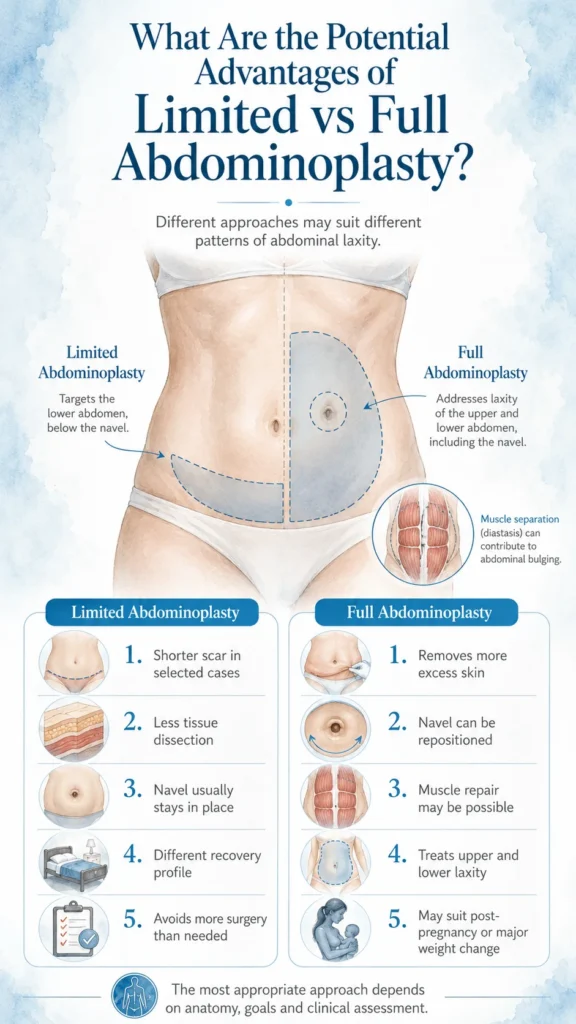
What Are the Potential Advantages of Full Abdominoplasty?
Full abdominoplasty may allow broader treatment of abdominal skin excess and tissue laxity. It may be more appropriate when changes involve both the upper and lower abdomen.
- Broader removal of excess abdominal skin.
- Ability to reposition the navel when required.
- Ability to repair muscle separation when clinically appropriate.
- More suitable for abdominal laxity above and below the navel.
- May be more appropriate after pregnancy or significant weight change in selected patients.
The main advantage is scope. Full abdominoplasty may be more suitable when several abdominal concerns are connected and cannot be addressed through a limited approach.
What Are the Possible Disadvantages of Limited Abdominoplasty?
Limited abdominoplasty may not address upper abdominal laxity, significant muscle separation or widespread skin excess. If the operation is too limited for the patient’s anatomy, the main concern may remain partly untreated.
- It may not treat loose skin above the navel.
- It may not address significant abdominal muscle separation.
- It may not reposition the navel.
- It may be less suitable after major weight loss or multiple pregnancies.
- It still involves scars, swelling, bruising and surgical risks.
A smaller operation is not always the more appropriate operation. Dr Michael Kernohan discusses these limits before recommending a limited approach.
Tummy Tuck- Abdominoplasty Before and After Photos

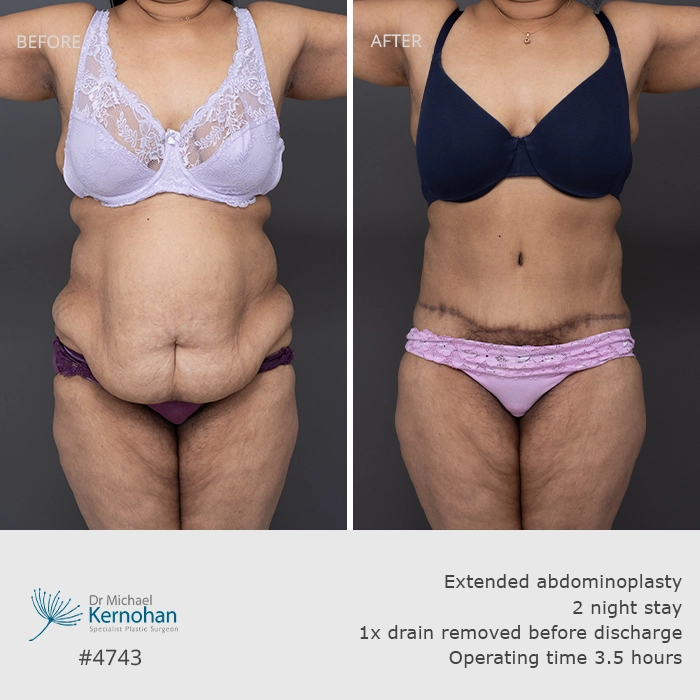
Disclaimer: All surgical or invasive procedures come with inherent risks, and results can vary widely between individuals due to factors like lifestyle, anatomy, overall health, weight, and nutrition. We encourage you to conduct thorough research and consider seeking a second opinion from a qualified healthcare provider.
What Are the Possible Disadvantages of Full Abdominoplasty?
Full abdominoplasty is a more involved operation than limited abdominoplasty. It may require a longer incision, broader tissue dissection, navel repositioning and a more detailed recovery plan.
- Longer scar pattern in many patients.
- Broader abdominal tissue dissection.
- Navel repositioning may be required.
- Recovery may be more involved, especially if muscle repair is performed.
- Risks include bleeding, infection, seroma, wound-healing problems, scarring and blood clots.
Full abdominoplasty is not needed for every patient. Dr Michael Kernohan recommends broader surgery only when the clinical assessment supports that approach.


How Does Recovery Compare Between Limited Abdominoplasty and Full Abdominoplasty?
Recovery depends on the extent of surgery, whether muscle repair is performed, the patient’s health and how the tissues heal. Limited abdominoplasty may involve a smaller recovery area, while full abdominoplasty often requires more planning because a broader area is treated.
- Both procedures can involve swelling, bruising, tightness and altered sensation.
- Limited abdominoplasty may allow a less involved recovery in selected patients.
- Full abdominoplasty may involve more tightness if muscle repair is performed.
- Heavy lifting and strenuous exercise are restricted after both procedures.
- Follow-up appointments are needed to review wounds, swelling and scar healing.
Recovery should not be judged only by the procedure name. Dr Michael Kernohan provides recovery advice based on the actual surgical plan and the patient’s progress.
How Long Do Limited Abdominoplasty and Full Abdominoplasty Results Last?
Both procedures can create long-term abdominal contour changes, but neither prevents future weight change, pregnancy-related tissue change or ageing. Longevity depends on skin quality, weight stability, muscle repair, health factors and whether the right procedure was chosen for the anatomy.
- Limited abdominoplasty results may be less durable if upper abdominal laxity was present but untreated.
- Full abdominoplasty may provide broader correction in suitable patients.
- Future weight gain can stretch abdominal tissues again.
- Further weight loss can create new skin laxity.
- Pregnancy after surgery can affect skin and abdominal wall support.
The most suitable operation is the one that matches the patient’s anatomy and long-term plans. Dr Michael Kernohan discusses longevity in realistic terms during consultation.

How Do Costs Compare Between Limited Abdominoplasty and Full Abdominoplasty?
Costs can differ because limited and full abdominoplasty may involve different operating times, anaesthetic requirements, theatre needs, garment use and follow-up planning. Full abdominoplasty may cost more in some cases because it is often a more involved procedure.
- Full abdominoplasty may involve longer operating time.
- Muscle repair may affect surgical complexity.
- Navel repositioning can add to the surgical plan.
- Theatre and anaesthetic requirements may vary.
- Post-operative garments, dressings and follow-up needs may differ.
Cost should not be the main reason to choose a procedure. The more important question is whether the operation is suitable for the patient’s anatomy, health, expectations and recovery capacity.
Take the Quiz
What Does Dr Michael Kernohan Recommend When Comparing Limited and Full Abdominoplasty?
Dr Michael Kernohan’s recommendation depends on clinical assessment rather than a fixed preference for one procedure name. The aim is to match the extent of surgery to the extent of the abdominal concern.
During consultation, Dr Michael Kernohan may assess:
- Amount and location of excess abdominal skin.
- Skin quality and elasticity.
- Navel position.
- Abdominal muscle separation.
- Previous pregnancy, weight change or bariatric surgery history.
- Previous abdominal scars or hernias.
- Medical history, medications and smoking status.
- Recovery needs, work demands and support at home.
A limited abdominoplasty may be discussed when the concern is mild and limited to the lower abdomen. A full abdominoplasty may be discussed when the upper and lower abdomen, navel position or abdominal wall need broader planning.

FAQs About Mini Tummy Tuck Vs Full Tummy Tuck
Download Dr Michael Kernohan’s Abdominoplasty Surgery Guide

Book a Consultation With Dr Kernohan to Discuss Your abdominoplasty Options
Choosing between a mini tummy tuck and a full tummy tuck requires careful assessment and honest discussion. Dr Michael Kernohan offers personalised consultations in Sydney, focusing on anatomical suitability, safety, and realistic outcomes.
Gathering medically reliable information is an important step in making an informed decision about whether surgery and a particular surgical approach may be appropriate. To arrange a consultation or submit photographs for a preliminary assessment, contact the clinic team. Understanding your options is an important step toward informed surgical planning.
Further Reading
- Read Dr Michael Kernohan’s Procedure Page on Extended Abdominoplasty
- Read Dr Michael Kernohan’s Procedure Page on Fleur De Lis Abdominoplasty
- Read Dr Michael Kernohan’s Procedure Page on Corset Abdominoplasty
- Read Dr Michael Kernohan’s Procedure Page on Liposuction Sydney NSW
- Read Dr Michael Kernohan’s Procedure Page on Belt Lipectomy Sydney
- Read: Tummy Tuck Scarring – What Patients Should Understand
- Read: How to Prepare for Your Tummy Tuck Surgery
- Read: Tummy Tuck Recovery Timeline