
- Take the Quiz
- How Scars Form After Surgery
- Where Tummy Tuck Scars Are Typically Located
- Common Scar Characteristics After Tummy Tuck
- Download Dr Kernohan’s Abdominoplasty Surgery Guide
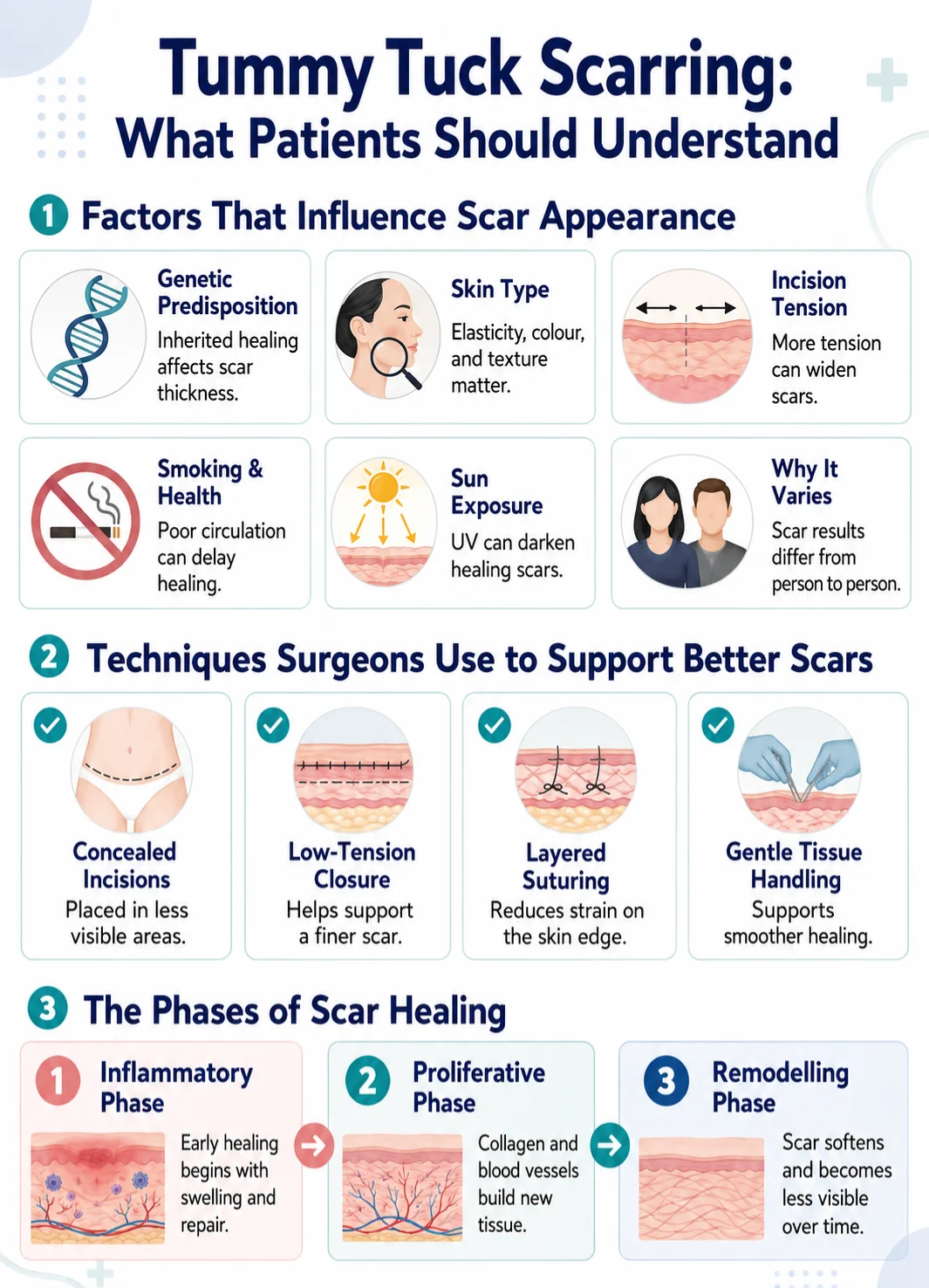
- Factors That Influence Scar Appearance
- Techniques Surgeons Use to Support Better Scars
- The Phases of Scar Healing
- What Scars Look Like During Early Healing
- Scar Maturation Over Months and Years
- Tummy Tuck- Abdominoplasty Before and After Photos
- How To Support Scar Healing After Tummy Tuck Surgery
- Scar Care Products and Therapies
- When Scar Revision Might Be Considered
- Managing Patient Expectations About Scars
- Common Questions About Tummy Tuck Scars
- FAQs About Tummy Tuck Scarring
- Looking Ahead: Scar Awareness and Surgical Planning
- Next Steps for Healing – Get Tailored Advice From a Specialist
- Further Reading
A tummy tuck (abdominoplasty) reshapes the abdomen by removing excess skin and, in many cases, tightening underlying muscle. Because it involves incisions, scarring is an unavoidable part of the surgical process. Understanding how scars form, where they are placed, and what influences their appearance is essential for setting realistic expectations.
Dr Michael Kernohan, Specialist Plastic & Reconstructive Surgeon in Sydney, explains that while some scarring is inevitable, careful planning, surgical technique, and post-operative care can support improved healing and reduced visibility over time. This article outlines the nature of scarring after abdominoplasty, factors that influence scar quality, and strategies to support optimal outcomes.
Take the Quiz
How Scars Form After Surgery
Scars are a natural result of wound healing. Whenever the skin is cut, the body repairs the injury by forming new connective tissue. This process involves several phases, starting with inflammation and collagen deposition, and progressing to remodelling and maturation over many months or even years.
Initially, scars may appear pink, firm or raised. Over time, they usually soften and fade in colour as collagen fibres reorganise and blood supply changes. The final appearance of a scar is influenced by genetics, skin type, location on the body, tension across the incision and post-operative care. Scars following a tummy tuck reflect this same biological healing process.
Where Tummy Tuck Scars Are Typically Located
Tummy tuck incisions are planned with both functional access and scar concealment in mind. In most procedures, the incision runs low on the abdomen – typically from hip bone to hip bone – so that the resulting scar can be concealed within underwear or swimwear. A second incision around the umbilicus (belly button) is often necessary to reposition it following skin removal.
These locations are chosen to balance effective access to underlying tissues with placement that considers daily life and clothing choices. While the scars are permanent, their low position allows them to be covered by most garments, and with time and care, they tend to become less conspicuous.
Common Scar Characteristics After Tummy Tuck
In the months following a tummy tuck, many scars display similar characteristics:
- Pink or reddish tone in the early weeks
- Firmness that gradually softens
- Slight elevation that flattens over time
Scars usually mature over a period of six to twelve months, although minor changes can continue beyond this timeframe. Individual healing differences mean that some people’s scars lighten evenly, while others may initially appear more noticeable before gradually improving.
Download Dr Kernohan’s Abdominoplasty Surgery Guide
Factors That Influence Scar Appearance
Several factors affect how scars develop and appear after surgery. These include:
- Genetic Predisposition: Some people form thicker or more noticeable scars due to inherited healing responses.
- Skin Type: Skin elasticity, colour and texture influence how scars look over time.
- Tension Across the Incision: High tension in healing wounds can lead to wider or firmer scars.
- Smoking and Health Status: Smoking impairs circulation and can delay healing, increasing scar visibility.
- Sun Exposure: UV exposure during healing can cause pigment changes in scars.
Recognising these influencing factors helps patients understand why scar appearance varies widely between individuals and reinforces the importance of personalised planning and aftercare.
Techniques Surgeons Use to Support Better Scars
Experienced surgeons adopt several practices to help support scar quality, including:
- Planning incisions in naturally concealed areas
- Minimising tension on wound closures
- Layered suturing techniques that reduce strain on the skin edge
- Gentle tissue handling during surgery
Dr Kernohan emphasises that meticulous surgical technique forms the foundation for optimal scar outcomes, but it must be accompanied by effective aftercare and patient participation in scar support strategies.
The Phases of Scar Healing
Scar healing progresses through three main phases:
- Inflammatory Phase: The body responds to the incision with inflammation and formation of new tissue.
- Proliferative Phase: Collagen is deposited, and new blood vessels form to support healing.
- Remodelling Phase: Collagen is reorganise,d and scar tissue softens and becomes less visible.
These phases overlap and proceed at different rates for each person. Patience and consistent care help scars mature with minimal complications.
What Scars Look Like During Early Healing
In the first few weeks after surgery, scars are often pink and slightly raised. This is a typical response as new tissue forms and blood flow to the area remains high. Bruising and swelling around the incision can also influence visual appearance temporarily.
While early scars may draw attention, it is important to understand that initial appearance is not indicative of the final result. Early care – including keeping incisions clean and following wound care instructions – supports steady progression.
Scar Maturation Over Months and Years
As healing continues, scars gradually become flatter and lighter in colour. By around six months, most scars show significant changes from their early appearance. Beyond this point, further softening and blending with the surrounding skin often occur over the next six months to a year.
Some patients find that scars continue to improve subtly even beyond the first year, particularly with consistent care and protection from factors like sun exposure.
Tummy Tuck- Abdominoplasty Before and After Photos


Disclaimer: All surgical or invasive procedures come with inherent risks, and results can vary widely between individuals due to factors like lifestyle, anatomy, overall health, weight, and nutrition. We encourage you to conduct thorough research and consider seeking a second opinion from a qualified healthcare provider.
How To Support Scar Healing After Tummy Tuck Surgery
Effective scar support involves both protection and active care at the right stages:
- Keep incisions clean and dry as advised by your surgical team.
- Avoid sun exposure to healing scars, as UV radiation can cause darkening.
- Follow wound care instructions closely, including any guidance on dressings or topical therapies.
- Adopt gentle scar massage when your surgeon confirms it is appropriate, usually after full epithelialisation.
Maintain stable hydration and nutrition to support overall tissue health.
These measures help create an environment favourable to optimal scar maturation and reduce the risk of unnecessary irritation.
Scar Care Products and Therapies
Some patients may use supportive products once incisions are fully healed and cleared by their surgeon. These may include:
- Medical‑grade silicone sheets or gels
- Scar creams with approved formulations
- Pressure therapy, when indicated by clinical guidance
It is essential that scar products are recommended or approved by your surgeon, as inappropriate use of unregulated substances can irritate healing tissue or interfere with progress.
When Scar Revision Might Be Considered
In rare cases where scars heal in an unfavourable way – such as prominent hypertrophic scars – your surgeon may discuss scar revision once healing is complete, often after approximately twelve months. Revision approaches vary and might include:
- Targeted surgical scar revision
- Refined closure techniques
- Medical scar treatments
Scar revision is considered only when healing has fully matured and when the potential for outcome improvement outweighs additional intervention.
Managing Patient Expectations About Scars
One of the most important aspects of discussing scarring is aligning expectations with anatomical reality. While scars tend to fade and soften over time, they do not disappear entirely. Acceptance of this fact – paired with knowledge of how scars evolve – supports a balanced understanding of surgical trade-offs.
During consultation, Dr Kernohan reviews incision plans with patients, including positioning and likely patterns of healing. This transparency is a key component of informed decision-making.
Common Questions About Tummy Tuck Scars
Patients often ask whether scars are visible in everyday life, how long they take to fade, or whether they can be minimised further. It’s important to note that while scars can become discreet with time, genetics and individual healing patterns play major roles in their final appearance. Scar care and protection from sun exposure are practical ways to help support favourable outcomes.

FAQs About Tummy Tuck Scarring
Looking Ahead: Scar Awareness and Surgical Planning
Scarring is an expected and natural result of a tummy tuck. Its final appearance depends on a combination of surgical technique, anatomical factors and post-operative care. With thoughtful planning and informed aftercare, abdominoplasty scars usually fade and become less noticeable over time, and they can be positioned to be concealed under most clothing.
Dr Michael Kernohan focuses on transparent discussion of scarring during consultation in Sydney, helping patients understand how scars form and how to support their healing journey. Informed knowledge about scarring forms part of a comprehensive approach to surgical planning and recovery.
Next Steps for Healing – Get Tailored Advice From a Specialist
Understanding how your body may scar is an important part of planning for abdominoplasty. With clear surgical guidance, realistic expectations, and appropriate aftercare, most scars improve significantly over time.
Dr Michael Kernohan, Specialist Plastic & Reconstructive Surgeon in Sydney, offers thoughtful pre-operative discussions and personalised surgical planning focused on both outcome and recovery. His website’s contact page and complimentary photo assessment page are convenient to access for you to get started with a consultation. Whether you’re researching for the first time or ready to explore surgery, his team can help guide your next steps.
Further Reading
- Read Dr Kernohan’s Blog on How to Manage and Treat Fleur De Lis Scars
- Read Dr Kernohan’s Blog on How to Manage and Treat Bodylift Scars After Surgery to Remove Excess Skin
- Read Dr Kernohan’s Blog on How To Manage And Treat Scars After Corset Abdominoplasty
- Read Dr Kernohan’s Blog on Recovery after Tummy Tuck or Abdominoplasty

Facelift Vs Non‑Surgical Tightening: What’s Right For Your Facial Goals
Introduction Dr Michael Kernohan is a Specialist Plastic & Reconstructive Surgeon in Sydney. Facelift surgery…
How to Choose a Facelift Surgeon in Sydney
Dr Michael Kernohan, Specialist Plastic & Reconstructive Surgeon in Sydney, understands that choosing a facelift…
When To Combine Tummy Tuck + Liposuction
Dr Michael Kernohan is a Specialist Plastic & Reconstructive Surgeon in Sydney. Abdominoplasty and liposuction…