
- Take The Quiz
- Is Split Muscle Surgery Considered Cosmetic Or Medical?
- Medicare And Split Muscle Surgery: What You Need To Know
- Eligibility Criteria For Medicare Coverage
- Download Dr Michael Kernohan’s Abdominoplasty Surgery Guide
- What Happens In A Specialist Consultation?
- Surgical Approach To Split Muscle Repair
- Abdominoplasty Before and After Photos
- Recovery Expectations
- Melbourne Patients Considering Split Muscle Surgery
- The Role Of Imaging And Documentation
- Points To Consider Before Proceeding
- Next Steps: Booking A Consultation
- FAQs About Medicare And Split Muscle Surgery
- Take The First Step
- Further Reading
Pregnancy places significant strain on the abdominal muscles. In many cases, this leads to a condition known as rectus diastasis or abdominal separation – commonly referred to as “split muscles.” This occurs when the left and right abdominal muscles stretch apart along the midline, creating a gap that may persist long after childbirth.
While this is a common condition, it can cause ongoing symptoms such as core instability, back discomfort, pelvic floor weakness, abdominal bulging, and changes in posture. Some patients also report difficulty with daily activities such as lifting children, exercising, or standing for long periods. These functional issues often lead patients to consider whether muscle repair surgery is an option.
Rectus diastasis can also contribute to a lack of core support that affects spinal alignment and balance. Over time, this can place additional strain on the lower back and pelvic region. The visual appearance of a persistent bulge in the abdomen, although not the primary concern for Medicare, may further compound the feeling of physical limitation and discomfort.
Take The Quiz
Is Split Muscle Surgery Considered Cosmetic Or Medical?
Not all muscle repair surgery is considered cosmetic. When split abdominal muscles cause functional symptoms such as pain, reduced core strength, bladder control issues, or difficulty with movement, surgery may be medically indicated. This distinction is essential because Medicare in Australia only covers procedures deemed medically necessary.
The Australian Society of Plastic Surgeons advocates for access to medically indicated surgery, and item 30175 under the Medicare Benefits Schedule reflects this position.
As a Specialist Plastic & Reconstructive Surgeon based in South West Sydney, Dr Michael Kernohan regularly assesses patients for split muscle repair to determine if they meet Medicare’s strict clinical criteria. His approach focuses on restoring function and addressing ongoing physical symptoms through individualised care and surgical planning.
In assessing whether the procedure qualifies as medically necessary, the focus is placed on a patient’s ability to perform everyday activities without discomfort or risk. If conservative treatments such as physiotherapy and core strengthening have failed to improve symptoms, surgical repair may be the most clinically appropriate option. While appearance may improve as a secondary effect, the main goal remains restoring physical function and relieving persistent pain or discomfort.
Medicare And Split Muscle Surgery: What You Need To Know

In 2016, Medicare removed item numbers for abdominoplasty in most cases, due to concerns about cosmetic misuse. However, after sustained advocacy and clinical evidence highlighting the functional impact of rectus diastasis, the Medicare Benefits Schedule (MBS) reinstated item 30175 on 1 July 2022.
This item number provides access to a partial Medicare rebate for eligible patients who meet specific criteria related to muscle separation and physical symptoms. It’s important to understand that not every case qualifies for coverage. Medicare support is only offered where surgery addresses significant health concerns, not appearance.
Dr Michael Kernohan supports this functional, patient-centred approach through comprehensive surgical assessments in South West Sydney, ensuring that all Medicare eligibility criteria are carefully reviewed.
Eligibility does not mean full cost coverage. Patients must still anticipate out-of-pocket expenses, including any hospital fees and surgical gaps not covered by Medicare or private health insurance. This is why it’s essential to have a full financial and clinical consultation with your surgeon to understand the scope of support and your responsibilities before making a decision.
Eligibility Criteria For Medicare Coverage
Medicare will only offer a rebate under item 30175 if the following conditions are met:
You must have rectus diastasis of at least 3 cm, confirmed by diagnostic imaging such as an ultrasound. This measurement provides clinical proof that muscle separation has exceeded the threshold considered manageable through physiotherapy alone. A standard physical examination may not be enough; imaging is considered an objective and necessary tool for verification.
You must be at least 12 months post-partum and not currently pregnant. This ensures that natural healing has occurred and there is no ongoing physiological stress that could interfere with surgical results or recovery. Hormonal and tissue changes during pregnancy make it difficult to assess long-term repair outcomes, so this waiting period is both clinically and practically essential.
You must experience functional symptoms such as pain, discomfort, reduced mobility, back weakness, posture issues, or urinary symptoms directly linked to muscle separation. These symptoms should interfere with daily functioning. It is not enough to feel discomfort during exercise alone; the criteria are based on how rectus diastasis disrupts everyday tasks like lifting, walking, bending, or performing essential physical movements.
You must have previously tried non-surgical management such as physiotherapy, core strengthening programs, or bracing, without significant improvement. Documentation of these efforts is essential. This shows that surgery is not the first option but a step taken after exhausting less invasive interventions. Patients are encouraged to maintain records or seek reports from allied health providers.
The surgery must be deemed medically necessary by a Specialist Plastic & Reconstructive Surgeon, such as Dr Michael Kernohan, based on clinical findings and patient history. This includes a detailed physical examination, imaging review, and discussion of symptoms. Only when these elements support the need for surgical intervention will the procedure be considered for Medicare funding.
Download Dr Michael Kernohan’s Abdominoplasty Surgery Guide

What Happens In A Specialist Consultation?
At his South West Sydney practice, Dr Michael Kernohan provides a thorough evaluation that includes a detailed history and clinical assessment. He will ask about when your symptoms began, how they have progressed, and what steps you’ve taken to manage them. This helps determine the timeline and severity of your condition.

The physical examination focuses on identifying muscle weakness, separation, bulging, and the presence of any hernias or tissue strain. If diagnostic imaging has not yet been performed, Dr Kernohan will organise an ultrasound or similar scan to accurately measure the extent of the rectus diastasis.
He will also assess your ability to complete functional movements such as sitting up, lifting, or bracing the core under load. The consultation includes a full discussion about your expectations, what results are achievable, and whether your circumstances align with Medicare criteria. For Melbourne or interstate patients, initial discussions may take place via telehealth, with in-person assessments arranged as needed.
Surgical Approach To Split Muscle Repair
Split muscle repair surgery typically involves bringing the separated abdominal muscles back together through a technique called plication. This involves suturing the rectus muscles to restore the integrity and function of the abdominal wall.
This procedure is often performed in conjunction with removal of excess skin or tissue when required, but the focus is on restoring muscle support. In some cases, the surgery may be performed endoscopically or as part of a full abdominoplasty, depending on patient anatomy and symptom severity.
During the procedure, careful attention is paid to tissue layers, vascular supply, and any signs of weakness along the abdominal wall. If hernias are identified, they may be repaired concurrently. Dr Michael Kernohan uses layered suturing techniques to ensure strength and reduce the risk of recurrence. Surgical drains may be used temporarily to reduce fluid build-up and support healing.
The procedure typically takes several hours and is performed under general anaesthesia in a licensed hospital. Post-operative care and monitoring are essential during the initial recovery phase to ensure there are no complications. Patients are provided with detailed care instructions and a timeline for safe activity resumption.
Abdominoplasty Before and After Photos

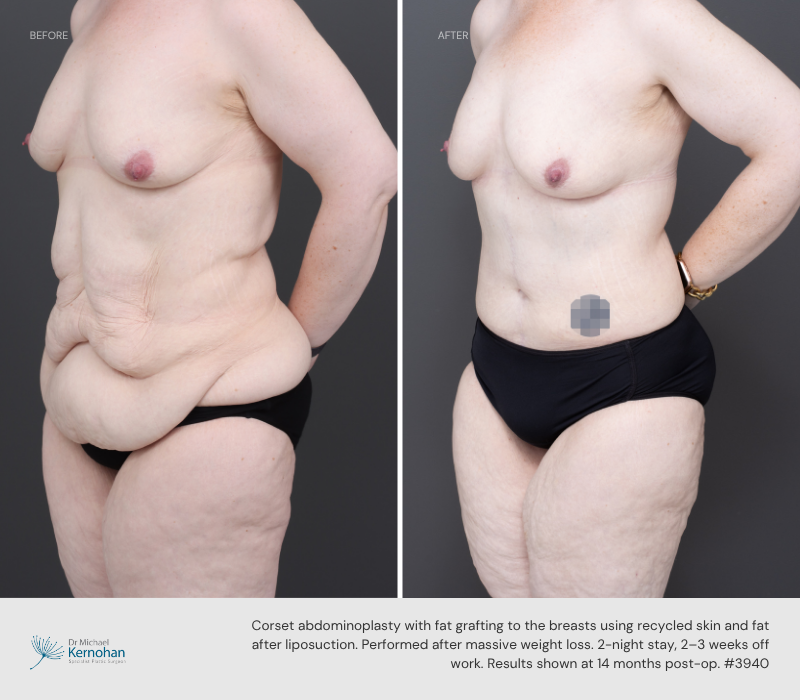
Visit Abdominoplasty Before and After Photos Page
Disclaimer: All surgical or invasive procedures come with inherent risks, and results can vary widely between individuals due to factors like lifestyle, anatomy, overall health, weight, and nutrition. We encourage you to conduct thorough research and consider seeking a second opinion from a qualified healthcare provider.
Recovery Expectations
Every patient’s recovery journey is different and depends on several factors, including general health, the complexity of the surgery, and adherence to post-operative care.
Typically, recovery involves several distinct phases. The first two weeks focus on rest and wound care. Most patients experience moderate discomfort, managed through prescribed medications and supportive garments. It is important to avoid any strain to the abdominal area during this time.
From the third week, gentle mobility is encouraged. Patients may begin to walk more regularly and increase their level of independence at home. Follow-up appointments with Dr Michael Kernohan help track healing and address any concerns.
By weeks four to six, many individuals resume light duties at work if their job does not involve physical exertion. The use of abdominal binders may continue, and patients are reminded to avoid lifting, twisting, or stretching beyond comfortable limits.
After the six-week mark, depending on healing, patients may begin to slowly reintegrate core exercises under guidance. Dr Kernohan advises that complete recovery may take several months, and the return to higher-impact activities should be gradual and supervised if possible.
Melbourne Patients Considering Split Muscle Surgery

With the reinstatement of MBS item 30175, more patients across Australia – including those in Melbourne – are exploring whether they qualify for Medicare-covered surgery.
While many Victorian surgeons offer abdominoplasty, not all have experience in functional muscle repair under Medicare eligibility. This is why some Melbourne patients choose to travel to South West Sydney for a detailed assessment and surgery with Dr Michael Kernohan.
Patients travelling from Melbourne are often looking for a surgeon with a clear understanding of MBS compliance, clinical justification, and a strong track record in reconstructive surgery. Dr Kernohan’s clinic accommodates these patients by offering flexible consultation times, telehealth support, and coordinated surgical planning to minimise the need for multiple interstate visits.
Melbourne patients are also often curious about how Medicare applies when undergoing surgery in another state. It is important to know that Medicare eligibility is national and can be accessed regardless of your home location, as long as the procedure and surgeon meet the listed criteria. Dr Kernohan’s team helps guide patients through this process to ensure continuity of care.
The Role Of Imaging And Documentation
Clear medical documentation is essential for Medicare eligibility.
Dr Michael Kernohan works closely with patients to ensure that all necessary paperwork is in place, including detailed clinical notes, diagnostic ultrasound results, and reports from allied health providers. He may also request letters from physiotherapists who have worked with the patient to confirm that conservative management has been trialled and was insufficient to resolve symptoms.
Proper documentation serves two purposes: it supports the claim for Medicare funding, and it ensures that the surgical decision is based on a complete understanding of the patient’s physical challenges. If imaging was performed more than a year ago or under different circumstances, updated scans may be required to meet the criteria.
Points To Consider Before Proceeding
Surgery for split muscles is a major decision and should be carefully considered. Factors to weigh include the severity and persistence of symptoms, the potential risks of surgery, and your long-term health goals.
For many patients, the decision to proceed comes after years of struggling with discomfort and reduced function. Others may have tried multiple non-surgical options and found little improvement. Understanding your own journey, and being clear on what you hope to achieve from surgery, will help you have a more productive conversation with your surgeon.
Recovery also involves planning for time away from physical tasks. For parents, this might include arranging childcare or modifying work duties. Dr Kernohan advises patients to think carefully about their home support network and readiness to commit to the recovery period.
Future pregnancies can impact the surgical outcome. While surgery does not prevent future childbearing, the repaired muscles may again be stretched, which could compromise results. This is why it is usually recommended to defer surgery until family plans are complete.
Next Steps: Booking A Consultation
If you’re experiencing functional concerns from split muscles after pregnancy, the first step is to speak with your GP. A referral allows you to access a Medicare-rebatable consultation with a Specialist Plastic & Reconstructive Surgeon.
Dr Michael Kernohan welcomes patients from across NSW and Victoria to his South West Sydney clinic. His practice team will guide you through every aspect of the process, from initial paperwork to post-operative care.
Booking a consultation also gives you the opportunity to ask questions, review your imaging results, and clarify whether you meet the eligibility criteria. Whether you choose to travel for surgery or are exploring your options locally, an informed conversation is the best starting point.
FAQs About Medicare And Split Muscle Surgery

Take The First Step
To find out if you meet the Medicare criteria for split muscle surgery, contact our clinic to arrange a personalised consultation with Dr Michael Kernohan. Our experienced team will help you understand your options and support you every step of the way – from referral to recovery. Whether you live in South West Sydney or Melbourne, we are here to help you navigate your surgical journey with clarity and clinical confidence.
Further Reading
- Read Dr Micheal Kernohan Post Pregnancy Surgery Procedure
- Read more about What is Diastasis recti? -Split Tummy Muscles Blog
- Read more about Will Medicare Cover my Abdominoplasty / Tummy Tuck? Blog
- Read more about Medicare for Body Lift Surgery to Remove Excess Skin Blog

Tummy Tuck Scarring: What Patients Should Understand
A tummy tuck (abdominoplasty) reshapes the abdomen by removing excess skin and, in many cases, tightening underlying muscle. Because…

Tummy Tuck Recovery Timeline: What To Expect After Surgery
A tummy tuck (abdominoplasty) is a surgical procedure that reshapes the abdomen by removing excess skin and fat and,…

Surgery for Muscle Separation Repair After Pregnancy
Pregnancy causes dramatic changes in the abdominal wall as the uterus expands, stretching the muscles of the abdomen to…