

What is The Golden Ratio?
Facial beauty has been a subject of interest for many people throughout history. Beauty is often defined as a combination of qualities that pleases the senses, especially the sight. While beauty standards vary across cultures, certain features are widely considered aesthetically appealing. The Golden Ratio is a mathematical concept that has been used to define beauty for centuries, and it is believed to be a key factor in determining facial beauty. In this blog post, we will explore the concept of the Golden Ratio and its relevance to facial beauty.
Specialist plastic surgeon Dr Michael Kernohan has decades of experience in providing both surgical and non-surgical procedures that can help patients achieve optimal results.
Take the Quiz
What Is The Golden Ratio?

The Golden Ratio is a mathematical concept that describes the ratio between two proportions. It is often represented by the number 1.618 and is also known as the Divine Proportion or the Golden Mean. This ratio has been used throughout history in art, architecture, and design to create aesthetically pleasing proportions.
The Golden Ratio and Facial Beauty
The Golden Ratio of Facial Aesthetics, also known as the Phi Ratio, is a mathematical proportion that is believed to define beauty in the human face. The Phi Ratio is a proportion of 1.618 to 1, which is also known as the Golden Ratio. It is used to describe the ideal relationship between different parts of the face and has been studied extensively by scientists and artists alike.
When applied to the face, the Phi Ratio can be used to determine aesthetically pleasing proportions of various facial features, such as the width of the eyes, the distance between the eyes, the length of the nose, and the width of the mouth. The right proportion is believed to be when the ratio of the width of a facial feature to the distance between that feature and another part of the face is approximately 1.618 to 1.
For example, the distance between the eyes should be approximately 1.618 times the width of one eye, and the distance between the eyes and the mouth should be approximately 1.618 times the width of the mouth. The length of the nose should be approximately 1.618 times the width of the nose at its base.
While the Phi Ratio has been used to define beauty in the human face for centuries, it is important to remember that beauty is subjective and that there is no one-size-fits-all definition of beauty. The Phi Ratio is just one tool that can be used to determine proportions, and what is considered aesthetically pleasing varies across cultures and individuals.
The Golden Ratio Is a Guideline Rather Than an Absolute Standard
The Golden Ratio is not an absolute standard, but rather a guideline or tool that can be used to determine facial proportions. While the Golden Ratio is a mathematically defined concept, it is important to recognise that beauty is subjective and can vary across cultures and individuals.
For example, some cultures may value larger or smaller eyes, fuller lips, or a more prominent chin, which may not necessarily conform to the proportions suggested by the Golden Ratio. Additionally, individual preferences and personal desires can also play a role in how one perceives facial beauty.
Therefore, while the Golden Ratio can be a useful tool in facial aesthetics, it should not be seen as the only or ultimate standard of beauty. Instead, it should be used in conjunction with other factors, such as individual facial features, age, skin quality, and overall facial balance and harmony, to determine the right approach to facial cosmetic procedures.
Click to Download Dr Michael Kernohan’s Facelift Guide
Features That Contribute to a Aesthetically Pleasing Face
There are many facial features that contribute to an aesthetically pleasing face, and what is considered desirable can vary depending on cultural and personal preferences. However, here are some common facial features that are often associated with beauty:
- Symmetry: Symmetry is often associated with beauty and is believed to indicate good health and genetic fitness. A symmetrical face is generally favoured over an asymmetrical face. For those concerned about facial asymmetry, facial surgery for facial asymmetry can offer solutions to help restore balance and harmony.
- Proportion: Proportion refers to the relationship between facial features, and pleasing facial proportions are often based on the Golden Ratio. However, it’s important to remember that individual facial features should also be taken into account and that beauty is subjective.
- Clear skin: Clear, blemish free skin is often associated with youth and health.
- Bright, expressive eyes: Bright, expressive eyes are often desirable and can convey warmth and openness
- Full lips: Full, shapely lips are often considered aesthetically desirable and can impact the overall appearance of the face.
- Defined jawline: A well-defined jawline can help to create a more contoured and balanced facial appearance.
- Straight, proportional nose: A straight and proportional nose that complements other facial features is often part of what is concidered desireable when it comes to facial aesthetics.
Facelift Before and After Photo

Disclaimer: All surgical or invasive procedures come with inherent risks, and results can vary widely between individuals due to factors like lifestyle, anatomy, overall health, weight, and nutrition. We encourage you to conduct thorough research and consider seeking a second opinion from a qualified healthcare provider.
Is It Possible to Achieve Golden Ratio with Cosmetic Procedures?
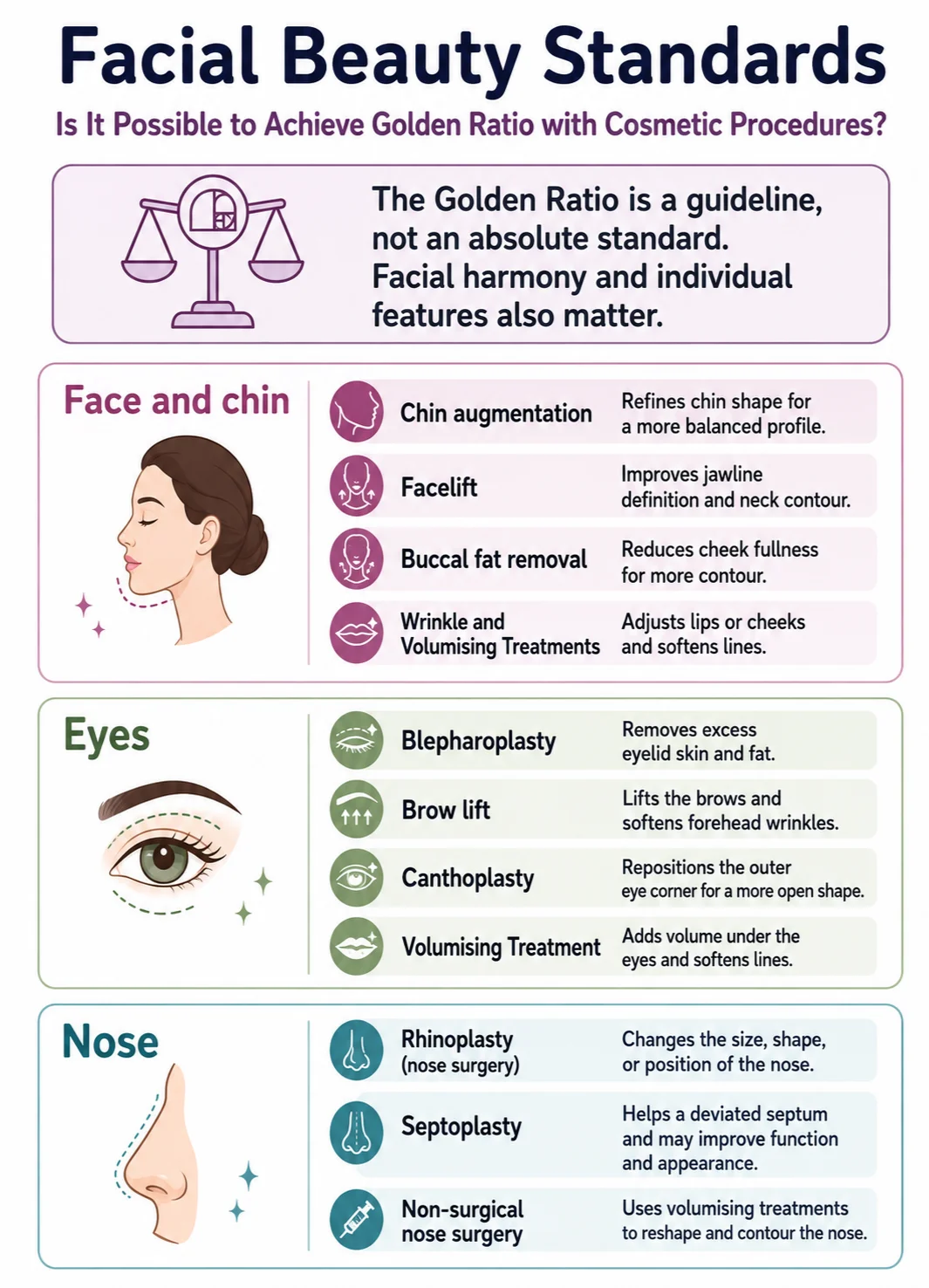
If you are interested in achieving the Golden Ratio in your facial proportions through cosmetic procedures, there are several options to consider. However, it’s important to keep in mind that the Golden Ratio is a guideline and not an absolute standard, and that individual features and facial harmony should also be taken into account.
Some cosmetic procedures that may help achieve facial balance and symmetry according to the Golden Ratio include:
Face and chin
- Chin augmentation: Chin augmentation can alter the shape and size of the chin to create a more defined and balanced facial profile. This can help to achieve a more harmonious relationship between the nose, chin, and other facial features.
- Facelift: A facelift can address excess skin and increase jawline definition and neck contour, altering overall facial proportions.
- Buccal fat removal: Buccal fat removal can help to reduce fullness in the cheeks, creating a more defined facial contour that is often associated with the Golden Ratio.
- Wrinkle and Volumising Treatments: wrinkle or volumising treatments can be used to alter facial features, such as the lips or cheeks, to achieve the desired proportions. They can also help to reduce the appearance of wrinkles and fine lines.
Eyes
- Blepharoplasty (eyelid surgery): Blepharoplasty can be used to remove excess skin and fat from the upper and lower eyelids, which can reduce the appearance of excess skin or puffy eyes
- Brow lift: A brow lift can be used to lift eyebrows and reduce the appearance of forehead wrinkles
- Canthoplasty: Canthoplasty is a surgical procedure that can be used to reposition the outer corner of the eyes. This can help to create a more open and almond-shaped appearance
- Volumising Treatment: Volumising treatments can increase the volume under-eye area or reduce the appearance of wrinkles and fine lines around the eyes
Nose
- Rhinoplasty (nose surgery): Rhinoplasty is a surgical procedure that can be used to alter the size, shape, or position of the nose. By reshaping the nose, your surgeon can help to create a more balanced and harmonious appearance.
- Septoplasty: Septoplasty is a surgical procedure that can be used to alleviate the symptoms of a deviated septum, which can increase both the function and appearance of the nose.
- Non-surgical nose surgery: Non-surgical nose surgery, also known as liquid rhinoplasty, involves the use of volumising treatments to reshape and contour the nose.

FAQs about Facial Beauty and Golden Ratio
Further Reading about Facial Surgery
- Read Dr Kernohan’s Facelift Surgery Page
- Read Dr Kernohan’s Chin Surgery Page
- Read Dr Kernohan’s Blog about How to make your nose Smaller
- Read Dr Kernohan’s Blog about What Makes an Attractive Jaw Profile?
- Read Dr Kernohan’s Blog about Broken Nose Surgery – Break Your Nose?

How Weight Changes Affect Neck Appearance
Many people in their 40s, 50s and 60s notice the same thing in photos: even when they feel quite…

How Long Does a Neck Lift Last?
“How long will it last?” is one of the first questions people ask about neck lift surgery. In Sydney,…

Deep Neck Contouring Surgery for Complex Neck Anatomy in Sydney
Why Deep Neck Contouring Matters Many people seeking neck rejuvenation want more than just superficial tightening of the skin….