
- Take The Quiz
- Understanding The Procedure And Its Impact On Recovery
- Recovery Timeline – What To Expect Week By Week
- Tips To Support Recovery After Brow Lift
- When To Contact Your Surgeon Or Address Recovery Concerns
- Lifestyle Considerations And Long-Term Care
- FAQs About Recovery After Brow Lift
- Final Thoughts
- Ready For A Personalised Look At Your Brow Lift Recovery?
Dr Michael Kernohan is a Specialist Plastic & Reconstructive Surgeon based in South West Sydney, known for his commitment to patient care and surgical precision. This article is for men and women considering a brow lift who want to better understand their recovery. Whether you are just beginning your surgical research or have already booked your procedure, it’s important to know what to expect in the days, weeks, and months following surgery.
The focus here is on recovery after brow lift. We’ll explore how the healing process typically unfolds, what you might experience during each stage, and practical advice to support a smoother recovery. Dr Kernohan tailors every treatment plan to suit the individual patient, taking into account health factors, surgical technique, and lifestyle.
Take The Quiz
Understanding The Procedure And Its Impact On Recovery
A brow lift is a surgical procedure that adjusts the soft tissue and skin of the forehead to reposition the brow and address concerns such as deep lines or a heavy brow appearance. There are several techniques, including endoscopic, open, and temporal lifts. Each approach has a slightly different recovery experience based on the extent of tissue adjustment and incision location.
The type of brow lift performed will influence the healing process. For example, endoscopic methods may involve smaller incisions and typically less swelling, while open techniques can take longer for swelling to subside. Regardless of the method, recovery after brow lift requires attention, patience, and proper care.
Healing is not just about the outward result but also about allowing the internal tissues to settle. Swelling, bruising, and temporary numbness are all part of the body’s natural response to surgery. Taking the recovery period seriously can reduce the chance of complications and help you achieve the most consistent outcome.
Recovery Timeline – What To Expect Week By Week
✓ Days 1 to 3
The first few days after your brow lift are often the most challenging. You may experience moderate swelling and bruising around the forehead, eyelids, and sometimes down into the cheeks. Some tightness across the forehead is common, along with a sense of fullness. During this phase, you will have dressings in place and possibly small drains, depending on the technique used.
Keeping your head elevated is one of the most helpful actions you can take. This positioning helps reduce swelling and encourages proper drainage. It’s best to sleep on your back with your head supported. Discomfort is usually manageable with prescribed medication, and Dr Kernohan will provide clear instructions on when to take it and what to avoid.
✓ Week 1 (Days 4 to 7)
By the end of the first week, the initial swelling often begins to ease. Dressings and any drains are typically removed during your post-operative appointment with Dr Kernohan. You may feel well enough to move around more but should still avoid bending over, lifting heavy items, or any action that increases pressure in the head and neck.
Light activities such as gentle walks are usually permitted, but anything beyond that should be discussed directly with Dr Kernohan during your review. It’s common to still see some bruising and feel tightness or mild numbness across the scalp and forehead.

✓ Weeks 2 to 3
Most patients begin to feel more like themselves by the second and third weeks. Swelling continues to reduce, and bruises fade. For many people, this is the point where they can return to office-based work or resume non-physical tasks. Makeup can usually be applied to conceal any residual discoloration if the skin has healed appropriately.
Even if you feel ready to resume normal routines, it’s vital to listen to your body. Continue to avoid high-impact exercise, bending, or lifting. The brow position will still be settling, and overexertion may interfere with tissue healing.
✓ Weeks 4 to 6
Around one month after surgery, most swelling will have resolved, and incision lines begin to blend more naturally with the surrounding skin. Numbness or tingling may persist but often starts to subside gradually. This is often the point at which you can resume more vigorous activity, under Dr Kernohan’s guidance.
If you have not yet resumed work or social events, you’ll likely feel more comfortable doing so now. Any remaining visible signs of surgery are usually minimal. That said, every patient’s pace is unique, so your experience may vary slightly from this timeline.
✓ Months 3 to 6 And Beyond
The final results of a brow lift take time to fully settle. During this later stage, sensation in the forehead typically returns to normal or near-normal. Scar lines soften and fade gradually. Dr Kernohan may suggest medical-grade skincare or gentle therapies to support long-term healing.
Most patients feel entirely back to normal by the three-month mark, but internal healing continues even after that. By six months, your brow position should be well-established, and your overall appearance more stable. Regular follow-up appointments are important to monitor your progress and address any concerns.
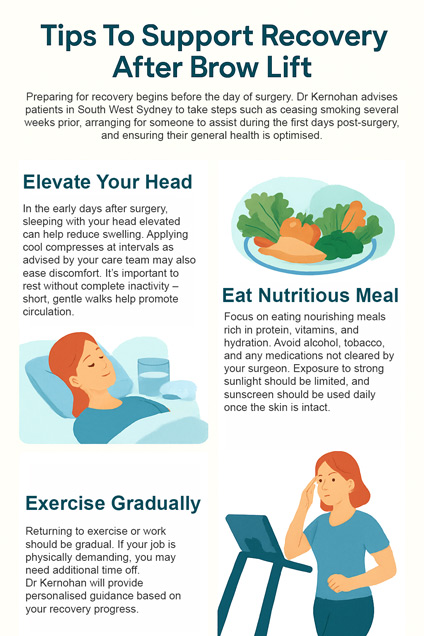
Tips To Support Recovery After Brow Lift
Preparing for recovery begins before the day of surgery. Dr Kernohan advises patients in South West Sydney to take steps such as ceasing smoking several weeks prior, arranging for someone to assist during the first days post-surgery, and ensuring their general health is optimised.
In the early days after surgery, sleeping with your head elevated can help reduce swelling. Applying cool compresses at intervals as advised by your care team may also ease discomfort. It’s important to rest without complete inactivity – short, gentle walks help promote circulation.
Focus on eating nourishing meals rich in protein, vitamins, and hydration. Avoid alcohol, tobacco, and any medications not cleared by your surgeon. Exposure to strong sunlight should be limited, and sunscreen should be used daily once the skin is intact.
Care for your incision sites using only the products and methods recommended by Dr Kernohan. Avoid picking at crusts or scabs, and do not apply makeup directly over healing incisions until cleared. If swelling increases or you notice any change in the appearance of the incision, report it during your check-up.
Returning to exercise or work should be gradual. If your job is physically demanding, you may need additional time off. Dr Kernohan will provide personalised guidance based on your recovery progress.
When To Contact Your Surgeon Or Address Recovery Concerns
While most healing progresses smoothly, it’s important to know what signs indicate a need for review. If you experience increasing redness, pain that does not respond to medication, a sensation of heat around the incision, fluid leakage, or fever, you should contact Dr Kernohan promptly.
Some numbness, tingling, or uneven sensation is common in the early months. Temporary asymmetry or minor differences in brow position can also occur as tissues settle. However, if something feels significantly different or worsens over time, it’s worth raising at your next visit.
Dr Kernohan schedules follow-up appointments at his South West Sydney clinic to monitor healing and answer any patient questions. Staying connected throughout the recovery period is key to achieving your intended outcome.
Lifestyle Considerations And Long-Term Care
Once your initial recovery has passed, maintaining your result involves sensible long-term care. This includes protecting your skin from UV exposure, using medical-grade or surgeon-approved skincare, and maintaining a stable body weight.
In Sydney’s climate, strong sun exposure is a daily reality. Wearing a broad-brimmed hat and high-SPF sunscreen is recommended when outdoors. Smoking cessation is critical not only before surgery but as a permanent change to support skin integrity.
It is important to be patient with your body. A brow lift provides long-term repositioning, but the final appearance continues to evolve over months. Managing expectations and understanding that healing is a journey can help reduce stress and elevate satisfaction.
Many patients choose to integrate their surgery with other treatments at later stages, such as eyelid surgery or non-surgical therapies. Dr Kernohan will always discuss options that align with your goals and clinical needs.
For patients in South West Sydney, privacy, convenience, and continuity of care are added advantages. Whether you are returning to work in the city or enjoying time away from the public eye, planning your recovery thoughtfully makes all the difference.
FAQs About Recovery After Brow Lift
Final Thoughts
Recovery after brow lift surgery is a process that unfolds over several stages. Each phase has its role in achieving a consistent outcome, from managing swelling in the first few days to ensuring long-term maintenance of the brow’s position. Dr Michael Kernohan, Specialist Plastic & Reconstructive Surgeon in South West Sydney, offers personalised care and detailed guidance to support each step of your journey.
Patients who follow recovery instructions carefully, attend scheduled reviews, and remain patient during healing are more likely to experience a smoother recovery and satisfactory outcome. If you’re considering a brow lift, make time to understand the recovery process and speak directly with Dr Kernohan for tailored advice.
Ready For A Personalised Look At Your Brow Lift Recovery?
Every recovery journey is unique – and yours should be supported with care that reflects your needs. Dr Michael Kernohan invites patients in South West Sydney and beyond to explore their options with confidence and clarity.
If you’re considering a brow lift or have questions about your own recovery timeline, contact Dr Kernohan’s clinic at your convenience on 1300 393 899. You can also send through your photos for a complimentary photo assessment to help guide your next step. The sooner you begin the conversation, the better prepared you’ll feel about your surgical journey.