
Neck lift surgery focuses on the skin, fat and muscles of the neck and the area under the chin. Over time, this region can change with ageing, sun exposure, weight shifts and genetics. A neck lift is a hospital based procedure that can remove areas of extra skin, adjust underlying muscles and, when suitable, reduce localised fat under the chin. The aim is to change how the neck area sits in relation to the jawline while maintaining the person’s own facial character.
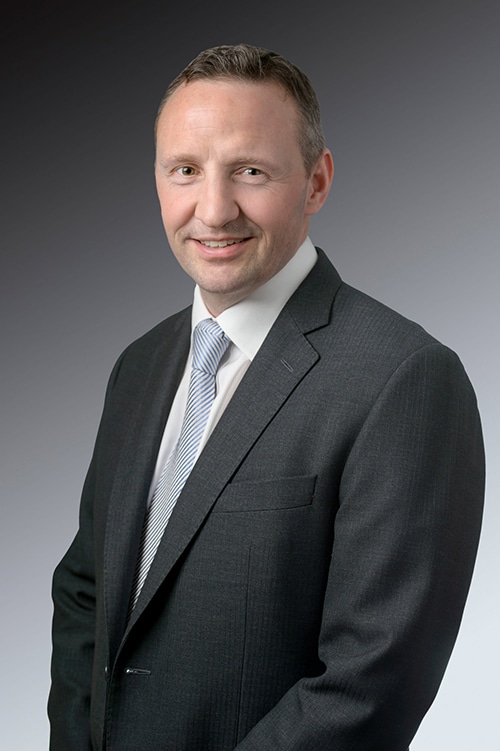
Dr Michael Kernohan is a Specialist Plastic & Reconstructive Surgeon who works in South West Sydney, the Southern Highlands and Sydney City. He holds specialist registration in plastic surgery and qualifications in both medicine and dentistry, with many years of practising in head and neck, reconstructive and facial surgery. This clinical experience is directly relevant to surgery in the neck region.
In South West Sydney, outdoor work, active lifestyles and long term sun exposure can contribute to visible changes in the neck. When skincare, lifestyle measures and non operative options are no longer providing the level of change a person is hoping for, some people consider neck lift surgery as one possible component of their treatment plan.
Dr Kernohan’s approach for patients from Liverpool, Camden and surrounding areas is based on careful assessment, realistic discussion and structured follow up. Planning, understanding risks and focusing on recovery are treated as central parts of care.

What A Neck Lift May Help With
A neck lift cannot guarantee a particular appearance, but it may help address some of the changes that develop in the lower face and neck over time. The procedure can tighten or remove areas of extra neck skin. In suitable patients, this may reduce folds or creases under the chin or along the front of the neck.
The deeper muscles of the neck, particularly the platysma, can also be tightened. This may help soften visible vertical bands at the front of the neck and support a more even appearance when the neck is seen from the front or side. If there is a distinct pocket of fat beneath the chin, liposuction can sometimes be included as part of the procedure to help reduce this in carefully selected patients. The aim is to adjust the soft tissues rather than change the underlying facial identity.
Some people notice day to day changes, such as collars sitting differently around the neck or less bunching of skin when looking down. In some cases, individuals have noted a shift in how they view the neck area in relation to the rest of the face after surgery. These responses differ between individuals and cannot be predicted or promised. Possible benefits are always discussed together with risks and limitations.
Take the Quiz
Who May Consider Neck Lift Surgery
Suitability for neck lift surgery is assessed individually. In general, people considering this procedure should be in good overall health, have a stable weight and have no uncontrolled medical conditions that significantly increase surgical risk. Conditions such as poorly controlled diabetes or ongoing nicotine use can affect circulation and wound healing. In these situations, surgery may be delayed or not advised until health factors are better managed.
People who explore neck lift surgery often notice one or more of the following features. There may be neck skin that has stretched or gathered and has not changed with skincare or lifestyle measures. Vertical muscle bands may be visible at the front of the neck, especially when speaking or smiling. Some individuals have a build up of fat under the chin that remains despite weight loss, or feel that changes in the neck appear more marked than those in the upper face.
Emotional readiness and expectations are as important as physical factors. Neck lift surgery leaves scars, involves time in hospital and requires a recovery period. It can adjust tissue position, but it does not stop ageing. During consultations, Dr Kernohan explains what the procedure may and may not achieve, where scars are likely to sit and how recovery usually progresses. Patients from Liverpool, Camden and nearby areas are encouraged to review their written information at home, discuss decisions with family or support people and seek a second opinion from another suitably qualified practitioner if they wish.
Download Dr Kernohan’s Face and Neck Lift Surgery Guide
Neck Lift Techniques Used By Dr Kernohan
Neck lift is a broad term for several surgical techniques that can be combined or adjusted. The choice of technique depends on the condition of the skin, the amount and location of fat, the way the neck muscles lie and the relationship between the chin, jawline and neck.
One component is often removal of areas of extra skin in the neck region, sometimes called cervicoplasty. Another is platysmaplasty, where the platysma muscle is tightened and in some cases joined in the midline to help reduce the appearance of vertical bands. Through small incisions, fat under the chin can be reduced using direct removal or liposuction when this suits the individual plan.
In some patients, neck lift techniques are combined with lower face surgery so that changes around the jaw and neck are addressed together. For others, an isolated neck lift is planned. As a Specialist Plastic & Reconstructive Surgeon with focused practice in head and neck and facial surgery, Dr Kernohan plans each operation around the deeper structures of the neck rather than using a single method for everyone.
In more complex situations, for example where the salivary glands under the jaw are prominent or where there has been previous surgery, injury or radiotherapy, additional steps may be considered. These decisions involve balancing potential benefits against added risks, with clear explanation in everyday language.
What To Expect On The Day Of Surgery
Neck lift surgery with Dr Michael Kernohan is carried out in accredited private hospitals, with specialist anaesthetists and experienced nursing staff. Patients from Liverpool may have their procedure at Sydney Southwest Private Hospital. Patients from Camden, Gregory Hills and the Southern Highlands may have surgery in South West Sydney or central Sydney hospitals, depending on the treatment plan and hospital availability.
Most neck lifts are performed under general anaesthesia. On the day of surgery, patients are admitted, observations are taken and the anaesthetic team reviews medical history, medications and fasting times. In the operating theatre, safety checks are completed before anaesthesia is started and surgery begins.
Incisions are usually placed in natural creases around the ear and sometimes under the chin. Through these openings, deeper tissues can be tightened, fat can be reduced where this forms part of the plan and the skin can be repositioned without excessive tension. Extra skin is then removed so that the neck can settle in a supported position.
At the end of the operation, the incisions are closed with sutures. A supportive bandage or garment is placed around the neck and lower face. In some cases, a small drain is used to remove fluid in the early post operative period. After surgery, patients are taken to the recovery area, then to the ward, where staff continue to check their comfort, dressings and general progress. Discharge is considered once pain is controlled with tablets, the person is eating and drinking, and the early wound condition is acceptable.
Before surgery, patients from Liverpool, Camden and surrounding suburbs receive written guidelines about fasting, medications, arrival times and what to bring to hospital. This helps the day feel more organised.
Neck Lift Recovery For Patients From Liverpool
Recovery after neck lift surgery is gradual and differs between individuals. In the first few days, swelling, bruising, a sense of tightness and a heavy feeling in the neck are expected. Prescribed pain relief, short walks around the house and sleeping with the head elevated all help manage this stage. A supportive garment or bandage is usually worn most of the time.
During the first week, many people prefer to stay close to home. Patients from Liverpool may attend early review appointments in South West Sydney, while those from Camden, Gregory Hills and nearby suburbs usually see Dr Kernohan at the Gregory Hills rooms. Light activity is acceptable if it does not cause discomfort, but heavy lifting, bending and sudden neck movements are avoided.
From the second week, bruising often begins to fade, although swelling and altered sensation can continue for several weeks. Many people return to desk based work about ten to fourteen days after surgery if their surgeon confirms this is suitable. Those with physically demanding jobs may need more time away. Strenuous exercise, contact sport and heavy lifting are usually delayed for several weeks to support wound healing and help control bleeding and swelling risk.
Driving is not allowed immediately after a general anaesthetic and should only resume when the person is no longer taking strong pain medication and can turn the head safely. Some people who live further from Sydney choose to stay closer to the hospital or clinic for a night or two after discharge so that review is easier to access if needed.
Follow up appointments are scheduled in advance. Early visits focus on wound checks, dressing care and removal of sutures if necessary. Later visits look at how scars are settling, changes in neck movement and any questions that arise as patients return to usual activities.
Long Term Care After Neck Lift Surgery
Neck lift surgery results in scars that take time to settle. In the first months, scars may be pink or raised and may feel firm, itchy or tight. Over twelve to eighteen months they often become softer and less obvious, although the final appearance varies between people. Sun protection and scar care, including massage when advised, form an important part of long term management.
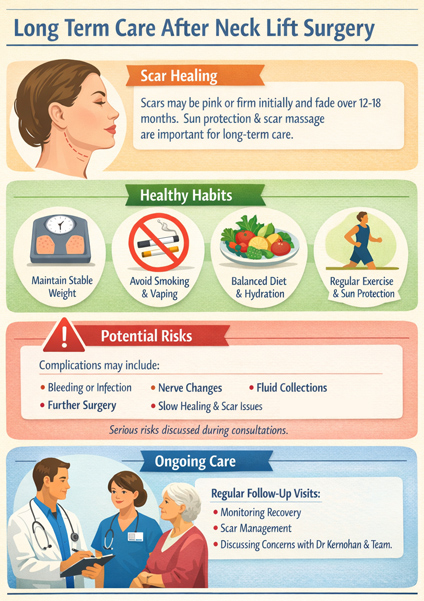
Maintaining a stable weight can help maintain the outcome of a neck lift. Nicotine use can affect blood flow and the condition of the skin, so avoiding smoking and vaping is strongly recommended. A balanced diet, good hydration, regular gentle exercise and protection from ultraviolet exposure support general health and may assist ongoing healing.
All surgery carries risks. For neck lift, possible complications include bleeding, infection, delayed wound healing, fluid collections, changes in skin or nerve sensation, muscle weakness, thick or widened scars and the potential need for further surgery. Less common but more serious risks relate to anaesthesia, deeper structures of the neck and general medical issues. These are discussed in detail during consultations, and written material is provided as part of the consent process. Patients are encouraged to take time to consider this information and to seek a second opinion from another appropriately qualified health practitioner if they wish.
Many people from Liverpool, Camden and surrounding suburbs continue to see Dr Kernohan and his team for several months after surgery. These appointments allow monitoring of healing, adjustment of scar care and discussion of activity levels and any concerns.
Preparing For Surgery And The Early Post Operative Phase
Preparation begins well before the day of surgery. During early appointments, Dr Michael Kernohan takes a detailed medical history, reviews current and past medications, examines the neck and jawline and may arrange blood tests or imaging if needed. Previous operations, allergies and any history of difficulties with anaesthesia or wound healing are discussed.
Patients receive written information about medications that may need to be stopped or adjusted, especially those that affect bleeding. Guidance is provided about avoiding nicotine, planning time away from work and arranging support at home in the early stage after surgery. For patients in Camden and Liverpool with work and family responsibilities, organising meals, household tasks and childcare in advance can make the recovery period easier.
In the days before surgery, the practice team confirms fasting instructions, arrival times and practical details such as clothing and transport. People are usually advised to wear clothes that open at the front and do not need to be pulled over the head. Hair washing and skincare instructions are given according to hospital and clinic protocols.
After the operation, most patients stay in hospital at least one night. Nurses assist with short walks, dressing care and pain medication. Once at home, patients are asked to care for their wounds as instructed, wear any supplied garment, sleep with head support and avoid pressure on the neck region. Any sudden or marked increase in pain, swelling, bleeding, discharge or temperature is a reason to contact the surgical team promptly.
Neck Lift Fees And Practical Arrangements
Fees for neck lift surgery vary between individuals. The overall cost is influenced by the complexity of the neck, whether additional procedures such as lower face surgery or chin liposuction are performed, the length of the operation, the hospital used, the anaesthetist’s fees and the type of post-operative care and garments required.
After a consultation and once a clear surgical plan has been developed, Dr Michael Kernohan provides a personalised fee estimate. Patients from Liverpool, Camden and other areas receive a written outline that separates the surgeon’s fee from hospital and anaesthetic costs, along with information about payment processes and relevant policies.
For current information about pricing and payment, people can go to the cost and pricing page of Dr Kernohan’s website.

Neck Lift Liverpool FAQs
Further Reading
- Read more about Partial Neck Lift Sydney
- Read more about Facial Surgery NSW
- Read more about Facial Nerve Surgery Sydney
- Read more about Chin Surgery Sydney NSW
- Face Lift Liverpool, NSW
- Blepharoplasty Liverpool, NSW
About Specialist Plastic & Reconstructive Surgeon Dr Michael Kernohan
Dr Michael Kernohan is a Specialist Plastic & Reconstructive Surgeon with Fellowship of the Royal Australasian College of Surgeons in plastic surgery. He also holds qualifications in dentistry and has completed extensive specialist training in plastic and reconstructive surgery in Australia and the United Kingdom. His practice includes reconstructive procedures for trauma and cancer, as well as planned facial, breast and body surgery.
For neck lift surgery, this clinical experience in head and neck and facial procedures is particularly relevant. Detailed knowledge of the deeper anatomy of the neck, including nerves, muscles, blood vessels and salivary glands, guides planning and technique. Dr Kernohan aims to match the procedure to the person’s anatomy, health and stated goals rather than seeking major or unrealistic change.
He consults at Gregory Hills Health & Business Centre, Suite 17, Level 2, 13 Digitaria Drive, Gledswood Hills NSW 2557, and at Park Clinic, 423 Bourke Street, Surry Hills NSW 2010. He operates in accredited hospitals including Sydney Southwest Private Hospital in Liverpool and other private hospitals in Sydney. This combination of locations allows people in Liverpool, Camden, Gregory Hills, Narellan, Harrington Park and surrounding areas to access specialist plastic surgery in a way that fits with their local area and travel needs.
Taking The Next Step With Dr Michael Kernohan
For anyone in Liverpool, Camden or nearby suburbs who is considering neck lift surgery with Dr Michael Kernohan, the first step is usually to obtain a referral from a GP or another specialist. This supports coordinated care and accurate sharing of medical information.
Appointments can be arranged by contacting the practice on 1300 393 899 or by sending an enquiry through the contact form on Dr Kernohan’s website. The main rooms are at Gregory Hills Health & Business Centre, with an additional clinic at 423 Bourke Street, Surry Hills.
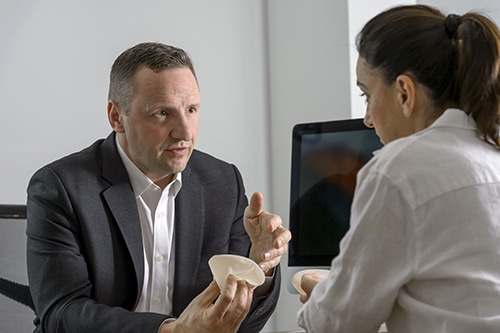
At the initial consultation, Dr Kernohan will ask about your concerns, review your medical history, examine your neck and jawline and discuss possible options. These may include neck lift surgery, neck lift combined with other facial procedures or non operative measures when surgery is not suitable. Risks, recovery, long term considerations and alternative options are discussed in clear terms, and questions are encouraged.
You will receive written information to review at home. A further consultation is often recommended before booking surgery, particularly for more complex cases. This allows you to confirm the plan, revisit any concerns and make sure the timing works for your health, work and family commitments.
Disclaimer: This information is general in nature and does not replace personalised medical advice. It is not intended to encourage or entice patients to have surgery. Surgical suitability, outcomes and risks vary between individuals and will be discussed in detail during your consultation.